
Whac‑A‑Mole at the Capitol: Duplicate Bills & How Citizens Can Fight Back
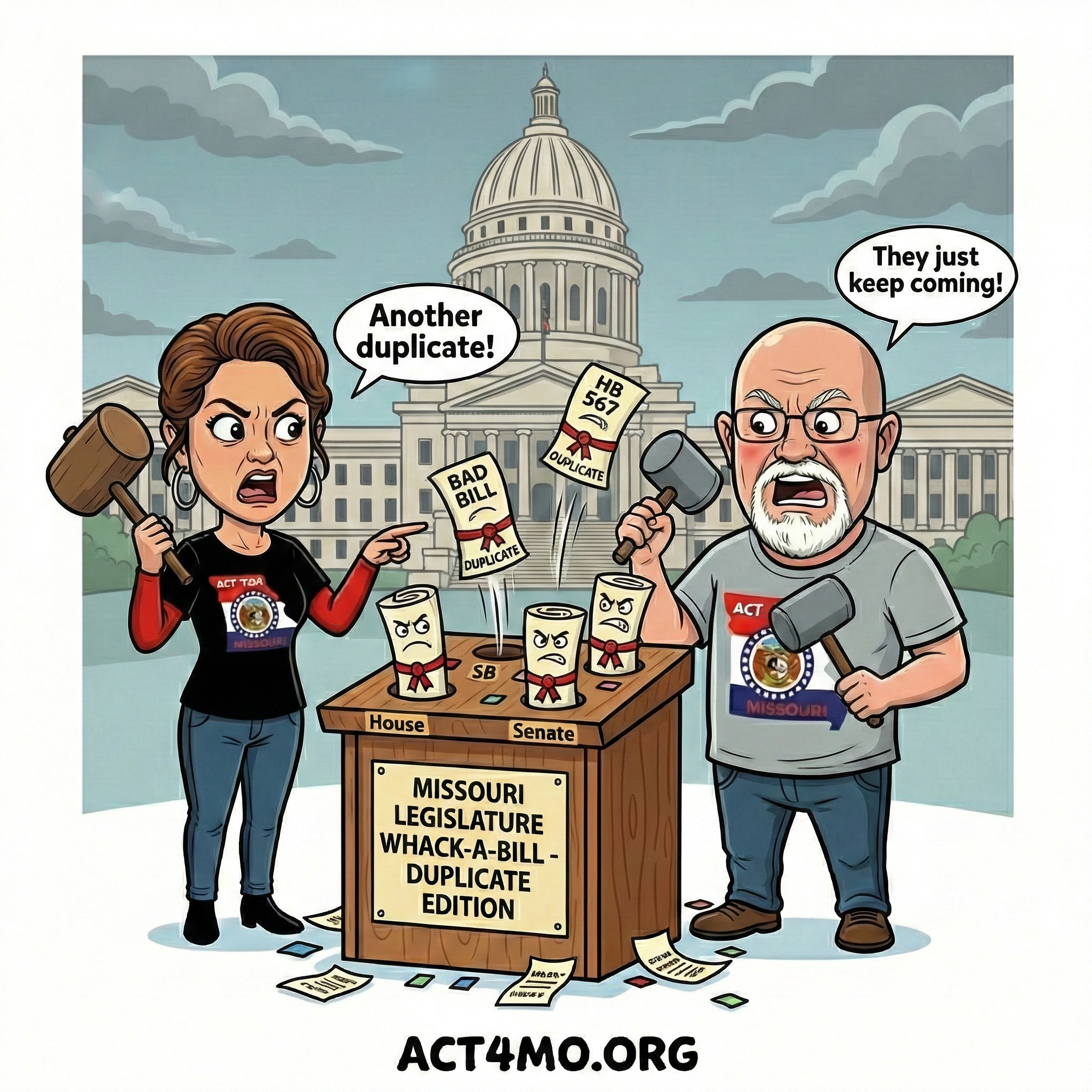
Tomorrow, Thursday, January 29, 2026, we have two different hearings on two different bills. But there’s one common theme: duplicate bills—the same idea filed multiple times, in multiple places, forcing citizens to fight the same battle over and over.
Quick action alerts for Thursday, Jan. 29
SB 836 (Crawford) — Senate Committee Hearing
8:00 AM • Senate Local Government, Elections & Pensions • SCR 1 (1st Floor)
Senate hearings schedule: senate.mo.gov
Our analysis: SB 836 review
HB 1997 — House Committee Hearing
10:30 AM (or upon adjournment) • House Special Committee on Intergovernmental Affairs • House Hearing Room 6
House hearings list: house.mo.gov
Our analysis: HB 1997 review
Why this matters: “duplicate bills” are a citizen‑burnout machine
Filing multiple versions of the same bill is common in Jefferson City. Sometimes it’s done as “backup.” Sometimes it’s done to increase the odds that some version moves. Sometimes it’s a way to shop a proposal to different committees—or to keep the concept alive even after citizens slow it down in one place.
Whatever the motivation, the effect is predictable: citizens get exhausted. We end up chasing bill numbers instead of debating real policy. It becomes legislative whac‑a‑mole.
Exhibit A: HB 1871 vs. SB 836
Yesterday (Wednesday, January 28), HB 1871 moved in a House elections subcommittee. If you missed it, here’s our recap: Facebook post. We’ve been opposing it from the start. Even though HB 1871 is still alive, we at least saw one major provision pulled out: the taxpayer‑funded presidential primary.
The whac‑a‑mole moment
After HB 1871’s presidential‑primary language was removed in the House, SB 836 (a nearly identical Senate bill) popped up for a hearing the very next day—and SB 836 includes the presidential preference primary again.
Primary source links (bill text)
- HB 1871 (Introduced bill PDF): HB1871I.pdf
- HB 1871 (House Committee Substitute PDF): HCSHB1871H.pdf
- SB 836 (Fiscal note PDF—shows PPP cost): SB 836 fiscal note
What’s the presidential preference primary (PPP), and what would it cost?
SB 836 would reinstate a state‑funded presidential preference primary election. The official fiscal note estimates the state cost at about $9 million when the next PPP would occur in March 2028. (See the fiscal note for SB 836 here: senate.mo.gov fiscal note (PDF).)
Is the presidential primary “non‑binding”?
Here’s the important nuance: the government doesn’t “pick delegates”—the party does. Delegates are ultimately selected through party processes (district/state conventions, etc.). But if a statewide presidential preference vote is held, national party rules can require that vote to be used (see the Congressional Research Service overview: CRS R48122) to allocate and bind delegates (at least for an initial ballot). In other words, a “primary” can be both:
- state‑run and taxpayer‑funded (the election administration cost), and
- party‑controlled in outcomes (how delegates are selected/pledged under party rules).
Bottom line for SB 836
Even setting aside the other election‑law changes inside SB 836, bringing back a state‑funded PPP is a big policy decision and a big price tag. It was removed from one vehicle (HB 1871), but it’s still alive in another (SB 836).
Read our full bill reviews: HB 1871 and SB 836.
Exhibit B: HB 2107 vs. HB 1997
The second hearing tomorrow is HB 1997—which is an identical bill to HB 2107 (already voted out of committee on January 20). Same concept, new bill number, new committee stop.
Core concern
These bills allow the General Assembly (House and Senate) to employ “capitol security officers.” That may sound simple, but it raises serious questions: chain of command, accountability, scope of authority, and whether we’re creating a new security force that exists outside the normal checks Missouri citizens expect.
Read our full bill reviews: HB 2107 and HB 1997.
What you can do tomorrow
The system counts on citizens being too tired to show up twice. Don’t give them that win. If you can only do one thing, do this:
- Share this article (and our bill reviews) so people know SB 836 and HB 1997 are duplicate fights.
- Contact the committee members before the hearing and ask them to vote “no.”
- Show up and/or submit testimony if you’re able (even a short, respectful statement matters).
Committee contact lists
Polite, brief calls matter. Ask members to vote NO and to stop the “duplicate bill” games that burn out citizens. (Tip: calling the Chair and Vice-Chair first is usually the most effective.)
Senate
Local Government, Elections & Pensions
| Mike Henderson (Chair) | (573) 751-4008 |
| Jamie Burger (Vice-Chair) | (573) 751-2459 |
| Doug Beck | (573) 751-0220 |
| Rusty Black | (573) 751-1415 |
| Rick Brattin | (573) 751-2108 |
| Sandy Crawford | (573) 751-8793 |
| Joe Nicola | (573) 751-3074 |
| Maggie Nurrenbern | (573) 751-2495 |
House
Special Committee on Intergovernmental Affairs
| Tricia Byrnes (Chair) | 573-751-1460 |
| Philip Oehlerking (Vice-Chair) | 573-751-9765 |
| Bridget Walsh Moore (Ranking Minority Member) | 573-751-0211 |
| Bill Falkner | 573-751-9755 |
| John Black | 573-751-1167 |
| Chris Brown | 573-751-9458 |
| Phil Amato | 573-751-2504 |
| Renee Reuter | 573-751-3607 |
| Sherri Gallick | 573-751-1344 |
| Bryant Wolfin | 573-751-2358 |
| Colin Wellenkamp | 573-751-4207 |
| Mark Meirath | 573-751-1468 |
| Jeff Hales | 573-751-2041 |
| Kem Smith | 573-751-9628 |
| Tonya Rush | 573-751-2135 |
| Ron Fowler | 573-751-8636 |
| Chanel Mosley | 573-751-4468 |
One-minute talking points you can use
On duplicate bills (the big picture)
- Stop playing games with citizens. If a proposal can’t stand on its own, it shouldn’t be refiled and relitigated under new numbers.
- Duplicates waste time and money. The legislature spends more committee time, agencies spend more staff time, and citizens are forced to keep showing up.
- Transparency suffers. When the same idea pops up in multiple places, the public loses track of what’s moving—and what changed.
On SB 836
- Taxpayers shouldn’t bankroll party business. The fiscal note pegs the presidential preference primary at about $9 million in March 2028.
- If it was removed from HB 1871, why is it back in SB 836? That’s exactly why duplicates undermine public trust.
On HB 1997
- Who do these officers answer to? We need clear chain of command and accountability—before creating a new security force.
- Why file duplicates? HB 2107 already moved. HB 1997 is the same idea with a different number.
Help us keep swinging
Act for Missouri is volunteer‑run. We do this research so regular Missourians can understand what’s happening and speak up before it’s too late. If you want to help:
- Join our Watch Team: watch-team.html
- Share this article with two friends who will actually make a quick call.
Help Keep Us Swinging
Throw a buck or two our way!
Act for Missouri is volunteer-run. Your support helps cover things like hosting, printing, and fuel to stay in the fight.
Seriously.
Note: Hearing times and locations can change on short notice. Always verify on the official House/Senate hearing schedules linked above.