
Missouri’s Constitution was written to restrain power, not to make life easier for politicians. When legislators cram unrelated provisions into bloated bills, rewrite titles to fit more cargo, or vote on substitutes they have not seriously reviewed, they are not just being sloppy. They are undermining constitutional safeguards that were put there to protect the people.
Single subject
A bill is supposed to deal with one subject, not become a moving truck for disconnected policy provisions.
Clear title
The title is supposed to tell the truth about what the bill contains so lawmakers and the public are not misled.
Original purpose
A bill cannot be amended during passage so dramatically that it becomes something different from what it started as.
The constitutional baseline
Article III, section 23: “No bill shall contain more than one subject which shall be clearly expressed in its title.”
Article III, section 21 adds another related protection: a bill may not be amended during passage so as to change its original purpose.
Why this matters
These rules are not technicalities. They are anti-deception rules. They exist so controversial provisions cannot be hidden under vague titles, so unrelated policy cannot be fused into one package, and so lawmakers cannot dodge accountability by saying they “had to vote for the bad to get the good.”
Once those guardrails are treated as optional, the whole system becomes easier to manipulate. Bad provisions can hitchhike on popular ones. Stalled bills can be revived as amendments. Final votes can happen on language many members never truly studied. And then, when courts finally enforce the constitutional rules, lawmakers blame the judges instead of the process abuse that got them there.
An 1877 example of what honest titling looks like
Attached below is an 1877 Missouri act that illustrates the point. It is not offered as a romantic museum piece. It is offered as evidence that lawmakers closer to the Constitution’s original framework understood what a real title looked like.
The act’s heading is specific. The title tells the reader what the bill is about. The first page even lays out the section topics. A citizen reading it has a fair chance of understanding the subject matter before ever reaching the body text. That is the opposite of today’s broad “relating to” titles that can become elastic containers for all kinds of legislative cargo.
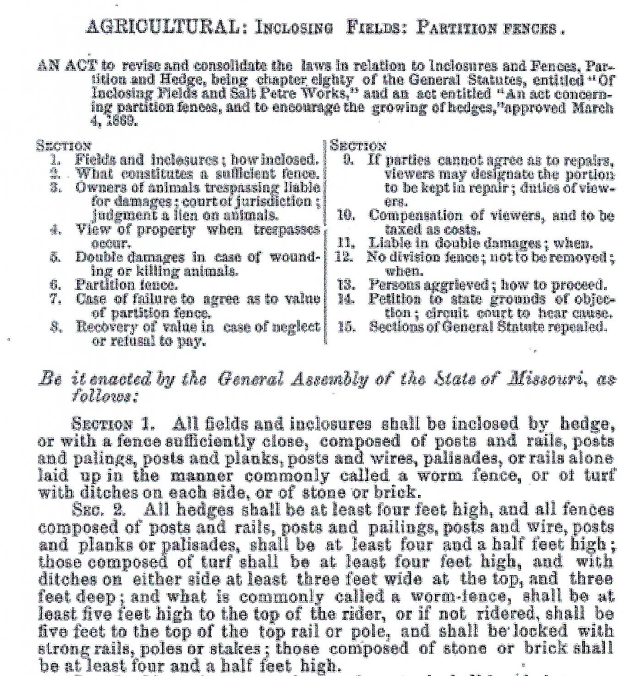
What stands out
- Specific subject matter: fields, inclosures, fences, partition fences, and hedges.
- Specific explanation: the act tells you what it revises and what topics the sections cover.
- Reader-oriented structure: the section list previews the contents instead of hiding them.
Historical note
The current wording of Article III, section 23 traces through the 1875 Constitution, and Missouri courts have recognized that the single-subject requirement itself goes back even earlier. That makes this 1877 act especially useful as a near-era example of how specific titles were still being used in practice.
Read the full 1877 act on the page
If the viewer does not load on your device, use the download or open buttons above.How the process breaks down now
Citizens who closely watch the Missouri legislature see the same pattern again and again. The formal rules still exist, but the process often functions as though those rules are secondary to speed, deal-making, and leadership control.
1. Members vote without hearing or mastering the substance
2. Substitutes appear late and move fast
3. Stalled legislation gets attached to moving vehicles
4. Titles get broadened until they become almost meaningless
5. Constitutional review gets outsourced to the courts
SB 22 shows the danger
A recent and important example is SB 22. The Missouri Supreme Court struck it down because it violated the Constitution’s original-purpose requirement. That matters here because it shows the same mindset at work: constitutional process rules are treated as expendable, and only after the courts intervene does the political class suddenly act scandalized.
That response gets the blame backwards. The problem is not that courts sometimes enforce constitutional guardrails. The problem is that lawmakers keep acting as though those guardrails are optional. If a bill is unconstitutional in the way it was assembled or passed, the fault lies first with the people who built and passed it that way.
Related Act4MO resources
What should change
The solution is not complicated. Missouri does not need some new theory of lawmaking. We need a return to the plain meaning of the constitutional restraints already on the books.
What lawmakers should do
- File honestly: If a provision matters, it should stand on its own whenever possible.
- Title honestly: Stop using broad titles as cargo containers.
- Debate honestly: Give members and citizens time to review substitutes before votes.
- Vote honestly: Stop forcing lawmakers to swallow bad provisions to get one good one.
What citizens should demand
- Transparency: Final language should be visible and understandable before final votes.
- Accountability: Each provision should be traceable to legislators willing to defend it openly.
- Separate votes: Unrelated ideas should not be welded together for political cover.
- Constitutional fidelity: The oath should mean more than “we will wait and see if anyone sues.”
Omnibus bills and title-stretching do more than create legal risk. They give politicians a shield. They let members tell constituents they had no choice. They hide controversial provisions inside packages that were designed to blur accountability. That is why this issue matters so much. It is not just about process. It is about whether the people of Missouri can still tell what their government is actually doing.
The legislature is not broken because the Constitution failed. It is broken because too many lawmakers have stopped honoring it. The answer is not to weaken the guardrails. The answer is to put them back at the center of the legislative process.
Bottom line
Missouri’s Constitution is not a suggestion. It is the rulebook. Until the General Assembly starts acting like that is true, Missourians will keep getting deceptive packaging, blurred accountability, and laws that collapse when finally tested.
Go deeper
Start with the actual constitutional language. Then compare it to the way bills are really being handled in committee and on the floor. Once you do, the gap becomes hard to ignore.