
Vote Deep Dive • Missouri House • HB 1844
The HB 1844 Vote Is a Case Study: Why You Can’t Trust Party Labels Alone
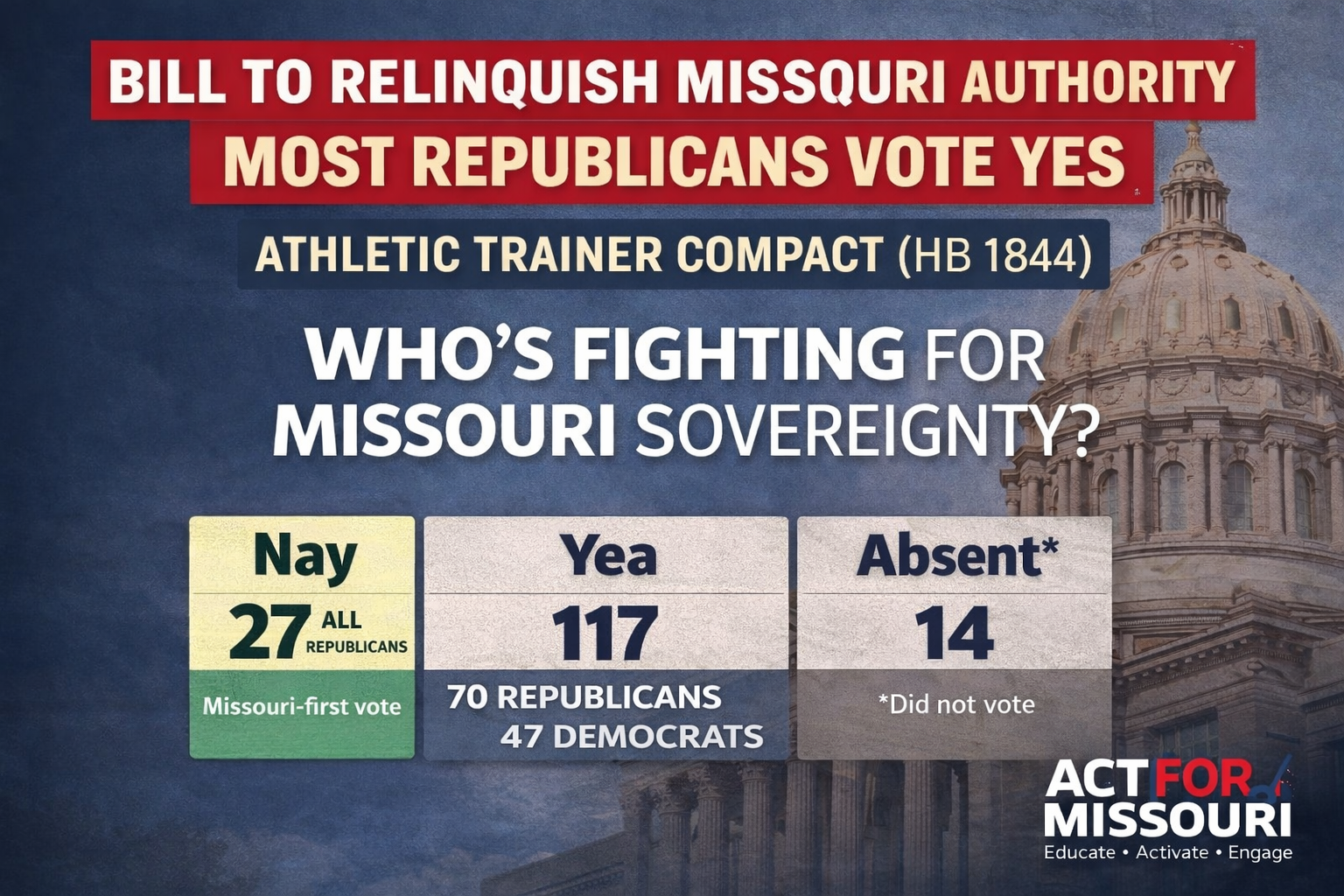
HB 1844 looks “limited scope” on the surface — athletic trainers. But it advances a bigger pattern: shifting Missouri authority to an external multi-state compact structure that Missouri voters do not control. The vote record shows why citizens must analyze the bill and the vote, not just the party letter.
Key point
Compacts can override Missouri control
HB 1844 joins an interstate compact structure that can impose binding rules and ongoing obligations.
Vote reality
Bipartisan “UniParty” coalition
Passed with heavy Republican support plus predictable Democratic support — centralization wins.
What to do
Use votes to identify allies
Track who votes to protect Missouri sovereignty vs. who votes to outsource it.
1) What HB 1844 does (plain English)
HB 1844 is an interstate compact bill. That means Missouri would sign onto a multi-state “commission” structure, allowing compact privileges across member states and creating a rule-system that can operate across state lines. When states join these compacts, they often inherit:
- External rulemaking (rules written by an unelected commission/board)
- Centralized data systems (multi-state information sharing)
- Ongoing assessments/fees (member states can be billed for operations)
- Difficult exit ramps (withdrawal is slow and still leaves “tail” effects)
Our full statutory analysis and citations are here: https://new-site.act4mo.org/bills/2026/HB1844.html
2) Rep. Lisa Durnell warned the House — and nobody answered her
Watch Rep. Lisa Durnell’s floor warning (video)
This clip is from the Missouri House floor debate before the perfection vote on HB 1844. Listen for the “blank contract / blank check” warning — and notice how quickly leadership moves on without addressing the substance.
If the embed doesn’t load on your device, watch on Facebook: Open the clip
During the floor debate before the perfection vote (Feb. 18), Rep. Lisa Durnell laid out the core danger: Missouri is being asked to accept a structure that functions like signing a blank contract — and giving a blank check — to an external compact authority that Missouri voters cannot hold accountable.
Her points weren’t “inside baseball.” They were fundamental: who writes the rules, who controls the data, who pays the bills, and how Missouri gets out later.
Why this matters: even when a bill seems “narrow,” the mechanism can be broad. A compact is a governance structure — and structures tend to expand over time.
3) What happened next: no rebuttal, no fixes, straight to a voice vote
After Durnell’s warning, the House did not meaningfully address the sovereignty concerns. Instead, they moved directly to a voice vote to perfect the bill — pushing it one step closer to final passage. That “jump” is the story: when arguments aren’t answered, it’s often because leadership has already decided the outcome.


4) Why vote analysis matters (and how to do it yourself)
The official House site makes it easy to see how each representative voted — but it typically does not show party. Citizens should add that missing context and ask:
- What does the bill actually do? (not what the title sounds like)
- Who voted Yea/Nay/Absent? (and who avoided the vote?)
- How does it break down by party? (sometimes “bipartisan” means “establishment consensus”)
- Do the same names show up on high-stakes liberty votes? (they often do)
5) HB 1844 vote breakdown
HB 1844 passed with a coalition that illustrates the UniParty problem: strong Republican support plus predictable Democratic support for centralizing mechanisms that diminish Missouri-first control. The sponsor was Sherri Gallick (R).
Correct vote on HB 1844
Nay
27
All Republicans
Voted to advance the compact
Yea
117
70 Republicans • 47 Democrats
Absent or Avoided the vote
Present / Absent
14
10 Republicans • 4 Democrats
Pattern to watch: the “Nay” list on bills like this tends to overlap heavily with the members who most consistently vote to protect Missouri sovereignty, property rights, and liberty. That doesn’t mean they’re perfect — but it does identify a reliable pool on high-stakes structural votes.
Bottom line: On HB 1844, the Missouri-first vote was NAY. Start with the Nay list below — that’s your “who to trust on sovereignty” shortlist.
Nay (27) — Republicans who opposed HB 1844
- Hardy Billington (R)
- Darin Chappell (R)
- Mazzie Christensen (R)
- Jeff Coleman (R)
- Scott Cupps (R)
- Bishop Davidson (R)
- Michael Davis (R)
- Lisa Durnell (R)
- Keith Elliott (R)
- Jamie Gragg (R)
- Bill Hardwick (R)
- Holly Jones (R)
- Steve Jordan (R)
- Ben Keathley (R)
- Ann Kelley (R)
- Don Mayhew (R)
- Mark Meirath (R)
- Jim Murphy (R)
- Matthew Overcast (R)
- Brad Pollitt (R)
- Deanna Self (R)
- John Simmons (R)
- Bob Titus (R)
- Jeff Vernetti (R)
- Richard West (R)
- Burt Whaley (R)
- Bryant Wolfin (R)
Yea (117) — 70 Republicans + 47 Democrats
- Bill Allen (R)
- Phil Amato (R)
- Marlon Anderson (D)
- LaDonna Appelbaum (D)
- Ashley Aune (D)
- Brad Banderman (R)
- Donna Barnes (D)
- John Black (R)
- Stephanie Boykin (D)
- Mark Boyko (D)
- Bob Bromley (R)
- Chris Brown (R)
- Michael Burton (D)
- Gregg Bush (D)
- Steve Butz (D)
- David Casteel (R)
- Carolyn Caton (R)
- Brad Christ (R)
- Doug Clemens (D)
- Kimberly-Ann Collins (D)
- Bennie Cook (R)
- Aaron Crossley (D)
- Jeremy Dean (D)
- Dirk Deaton (R)
- Dane Diehl (R)
- Jo Doll (D)
- Melissa Douglas (D)
- Anthony Ealy (D)
- Bill Falkner (R)
- Jeff Farnan (R)
- Betsy Fogle (D)
- Yolonda Fountain Henderson (D)
- Ron Fowler (R)
- Elizabeth (Lilly) Fuchs (D)
- Sherri Gallick (R)
- Dave Griffith (R)
- Kent Haden (R)
- Jeff Hales (D)
- Willard Haley (R)
- Tony Harbison (R)
- Wendy Hausman (R)
- Stephanie Hein (D)
- John Hewkin (R)
- Dave Hinman (R)
- Barry Hovis (R)
- George Hruza (R)
- Josh Hurlbert (R)
- Keri Ingle (D)
- Bill Irwin (R)
- Martin Jacobs (D)
- Kenneth Jamison (D)
- Will Jobe (D)
- Michael Johnson (D)
- Mike Jones (R)
- Doyle Justus (R)
- Jim Kalberloh (R)
- Nick Kimble (D)
- Jeff Knight (R)
- Becky Laubinger (R)
- Ed Lewis (R)
- Cathy Jo Loy (R)
- Bill Lucas (R)
- Ian Mackey (D)
- Pattie Mansur (D)
- John Martin (R)
- Mark Matthiesen (R)
- Peggy McGaugh (R)
- Mike McGirl (R)
- Scott Miller (R)
- Marty (Joe) Murray (D)
- Jeff Myers (R)
- Mark Nolte (R)
- Philip Oehlerking (R)
- Bill Owen (R)
- Jonathan Patterson (R)
- Chad Perkins (R)
- Brandon Phelps (R)
- Adrian Plank (D)
- Sean Pouche (R)
- Tiffany Price (D)
- Raychel Proudie (D)
- Ray Reed (D)
- Rodger Reedy (R)
- Louis Riggs (R)
- Alex Riley (R)
- Bruce Sassmann (R)
- Melissa Schmidt (R)
- Jim Schulte (R)
- Brian Seitz (R)
- Greg Sharpe (R)
- Brenda Shields (R)
- David Tyson Smith (D)
- Kem Smith (D)
- Marla Smith (D)
- Kathy Steinhoff (D)
- Connie Steinmetz (D)
- Mike Steinmeyer (R)
- Melanie Stinnett (R)
- Kemp Strickler (D)
- Tim Taylor (R)
- Del Taylor (D)
- Marlene Terry (D)
- Wick Thomas (D)
- Terry Thompson (R)
- Dean Van Schoiack (R)
- Rudy Veit (R)
- Terri Violet (R)
- John Voss (R)
- Bridget Walsh Moore (D)
- Christopher Warwick (R)
- Emily Weber (D)
- Colin Wellenkamp (R)
- Cecelie Williams (R)
- Travis Wilson (R)
- Eric Woods (D)
- Dale Wright (R)
- Jaclyn Zimmermann (D)
Present (0) / Absent (14)
- Mitch Boggs (R)
- LaKeySha Bosley (D)
- Danny Busick (R)
- Tricia Byrnes (R)
- Mike Costlow (R)
- David Dolan (R)
- Chanel Mosley (D)
- Cameron Parker (R)
- Tara Peters (R)
- Renee Reuter (R)
- Lane Roberts (R)
- Tonya Rush (D)
- Mark Sharp (R)
- Yolanda Young (D)
This isn’t the first compact push this session
HB 1844 is part of a broader pattern: interstate “compacts” framed as convenience or workforce mobility, but implemented through outside commissions, rulemaking, shared data systems, and ongoing assessments. If you want the bigger context, start here:
6) The bigger warning
One bill here, one compact there — “small,” “limited,” “technical.” That’s how power shifts happen: not always with one massive takeover, but with dozens (or hundreds) of quiet transfers of authority to boards, commissions, and systems voters don’t control. If we want Missouri to remain Missouri, citizens must track votes and hold legislators accountable — especially when leadership tries to rush past unanswered objections.