
Act for Missouri · Legislative Accountability
HB 1847 “Dental Compact”: Unanswered Questions, Sovereignty Risks, and a Rushed Floor Vote
HB 1847 wasn’t just debated and passed — it was rushed through in under ten minutes, including floor inquiry, a motion to cut off debate (PQ), and the final vote. In that short window, the only member pressing the core accountability questions never got answers — and the bill handler admitted he had not read the model compact and did not have the commission rules Missouri would be required to follow.
Less than 10 minutes. Major sovereignty shift.
Missouri was asked to sign onto an interstate compact where an unelected commission’s rules can carry legal force in Missouri (§332.740.2), Missouri’s rulemaking safeguards “shall not apply” (§332.745.14), and conflicts can supersede Missouri requirements (§332.760.2). That should trigger maximum scrutiny — not a rushed floor vote.
Watch the clip: the entire sequence (questions → PQ → vote) is under ten minutes.

Clock, PQ, Vote: Managed From the Top
Speaker Jon Patterson enforced the clock—ending Rep. Durrell’s inquiry on HB 1847—and moments later Rep. Alex Riley moved the Previous Question to shut down debate and force the vote. Riley isn’t just any member: he is widely described as the House GOP’s future Speaker (Speaker-designate), which matters because Missouri House Republicans often select their Speaker well in advance of the term in which he will wield that power. In other words, the same leadership pipeline that pre-selects the next Speaker also controlled the floor clock and the debate-ending motion—helping rush a sovereignty-shifting compact through before Missourians could get straight answers.
Vote record
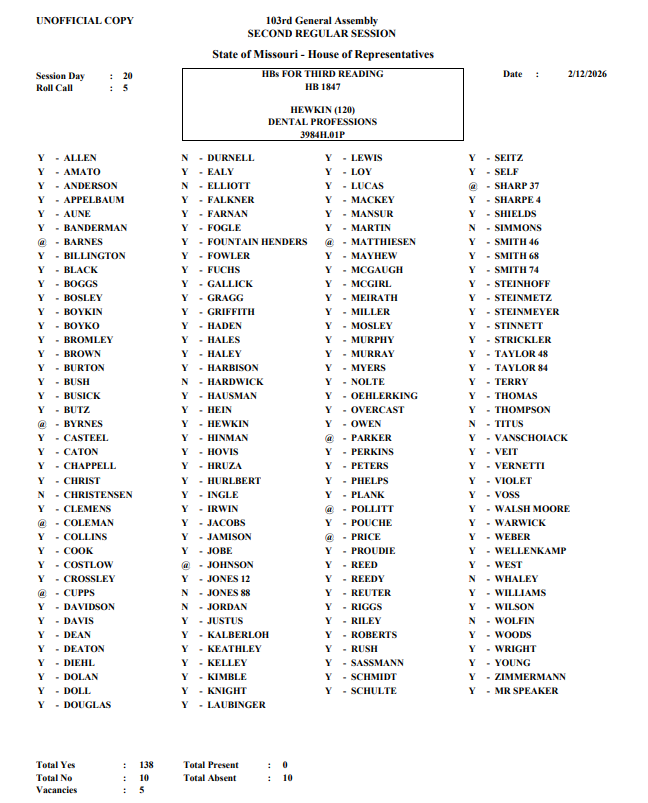
HB 1847 passed on third reading and final passage with 138 Yes, 10 No, 10 Absent.
Missourians deserve to know who stood up for state sovereignty—and who voted to hand a piece of it to an unelected interstate commission without even getting basic questions answered first. On HB 1847, the House rushed a sovereignty-shifting compact through in under ten minutes, while the bill handler admitted he hadn’t read the model compact and couldn’t identify the commission rules Missouri would be bound to follow. The “No” votes are the members who refused to rubber-stamp that kind of blind governance. The “Yes” votes chose speed and convenience over accountability—voting to place Missouri under outside rulemaking power without the due diligence Missourians should expect from their elected representatives.
Watch the floor debate and vote
The unanswered questions (with timestamps)
1) “Have you read the model compact? Where can I find it to read it?”
Timestamp: ~3:33
- The sponsor said he had not read the model compact.
- No location was provided for Missourians (or lawmakers) to read it.
Why this matters: the bill requires participating states to enact a compact “not materially different from the model compact” (§332.710(1)) and defines “model compact” (§332.705(19)).
2) “What are the commission rules we would have to comply with?”
Timestamp: ~6:09
- The sponsor could not identify what those rules are and said he did not have them.
- That’s the governance problem: Missouri votes now; binding rules arrive later.
The bill empowers the commission to promulgate rules (§332.740.1) and says those rules have the “force of law” in participating states (§332.740.2).
What was admitted on the record
The public deserves to understand what was conceded during the floor exchange — because it goes directly to whether Missouri knew what it was voting on.
- The bill handler admitted he had not read the model compact. Yet the bill requires Missouri to enact a compact “not materially different from the model compact” (§332.710(1)) and defines the model compact (§332.705(19)).
- The bill handler could not identify the commission rules Missouri must comply with. But the bill empowers the commission to promulgate rules (§332.740.1), says those rules have the “force of law” (§332.740.2), and says Missouri’s own rulemaking requirements do not apply under the compact (§332.745.14).
- Debate ended immediately after the time expired, and the body moved the “previous question.” Whatever one thinks of compacts in general, this is the wrong process for a bill that transfers ongoing authority away from Missouri voters and legislators.
This is the core scandal:
Missouri voted to bind itself to future commission rules that were not identified on the floor — after the sponsor said he didn’t have them. That is not “getting efficiency.” That is governing blind.
Bottom line
HB 1847 is not just “licensing reform.” It locks Missouri into an interstate governance system where an unelected commission can issue rules with legal force in Missouri (§332.740.2), Missouri’s rulemaking safeguards do not apply (§332.745.14), and conflicts can supersede Missouri requirements (§332.760.2). The House rushed this through in under ten minutes — after the bill handler admitted he had not read the model compact and could not identify the rules Missouri would be bound to follow. That is not responsible government.
Timeline: the whole decision in under 10 minutes
| Segment | Approx. time | What happened |
|---|---|---|
| Floor inquiry | ~1:18–6:39 | Key questions asked; sponsor admits he hasn’t read the model compact and doesn’t have the rules. |
| Time expires | ~6:39 | “The lady’s time has expired.” |
| PQ moved | ~7:50 | Motion to cut off debate and force the vote. |
| Final passage vote | ~8:54–10:19 | HB 1847 passes 138–10. |