
Understanding the "Statutory Contract"
Interstate compacts are often marketed as "cooperation," but they can lock Missouri into rigid agreements that our own legislature cannot easily change.
Watch our brief explainer on how compacts affect your rights.
The "Statutory Contract"
The unique power of an interstate compact lies in its dual nature. It is both a statute (law) and a binding contract between states.
Once Missouri joins a compact, we are "locked in." Because the U.S. Constitution protects contracts, our legislature cannot unilaterally repeal parts of the agreement if they stop working for us.
- Supersedes State Law: Compact rules can override our state constitution.
- Democratic Deficit: Unelected "Interstate Commissions" often make the rules, not your voted representatives.
- Hard to Exit: Leaving a compact often requires years of notice or the permission of other states.
The Paradox
"While these pacts are marketed as preserving state sovereignty... they effectively strip a state legislature of its ability to respond to the unique needs of its own citizens."
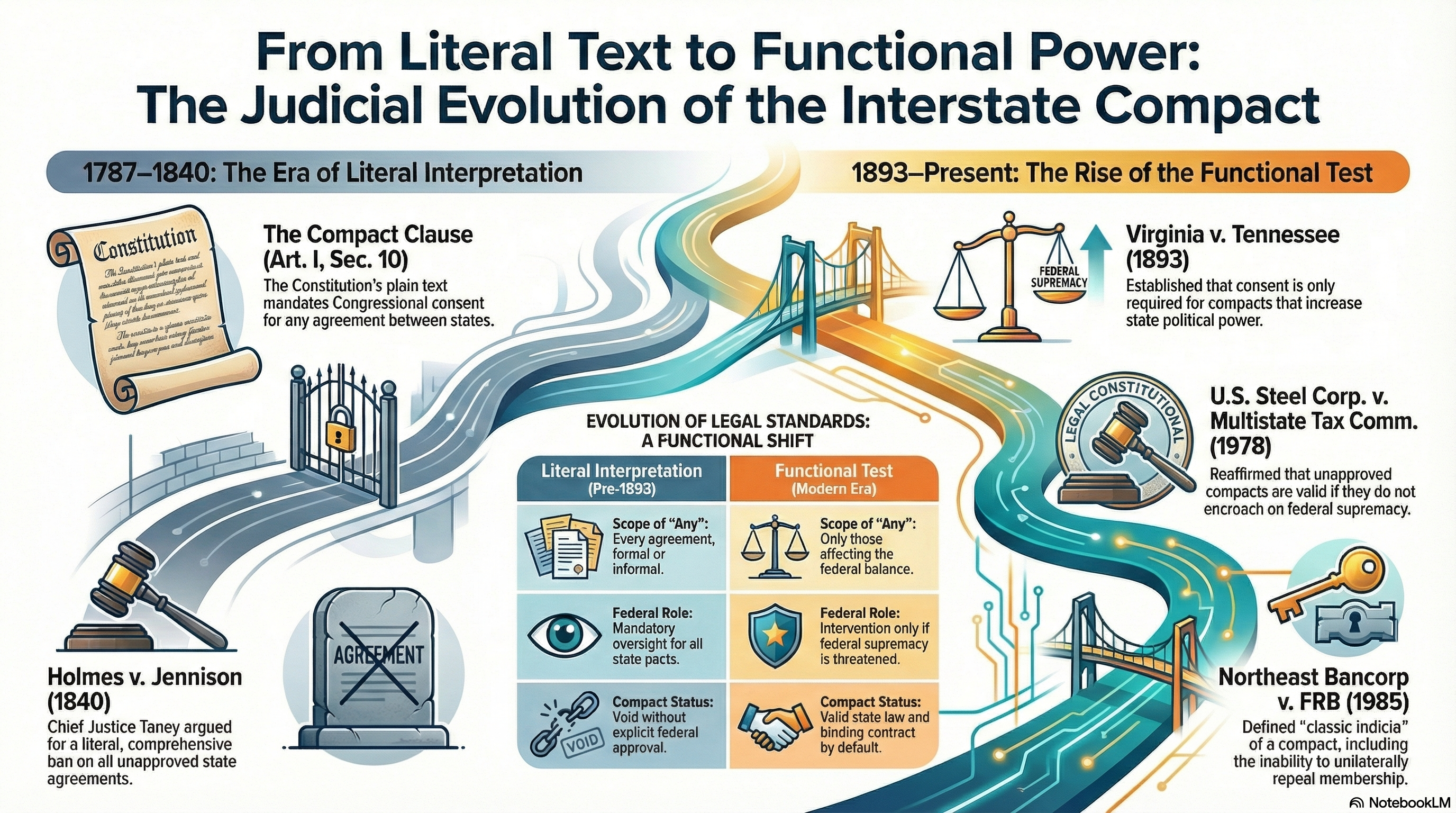
The History of the Trap
See how changes in the legal landscape have made compacts an increasingly common threat to state sovereignty.
Current Sovereign Threats
The most pressing dangers facing Missouri today.
Major Threat
National Popular Vote (NPVIC)
National Popular Vote (NPVIC)
This compact seeks to circumvent the Electoral College. If enacted, Missouri's electoral votes would be awarded to the winner of the national popular vote, regardless of how Missourians voted.
Current Status: As of 2026, it has reached 209 of the 270 electoral votes needed. Missouri must remain steadfast in rejecting this "end run" around the Constitution.
Fiscal Risk
Multistate Tax Commission (MTC)
Multistate Tax Commission (MTC)
While the MTC helps audit large corporations, it pushes for "uniformity" in tax policy. This can hinder Missouri's ability to create a unique, competitive tax environment—such as our recent moves to eliminate capital gains tax.
The Danger: The pressure for multistate uniformity acts as a harness, preventing us from boldly slashing taxes to attract business if other states don't agree.
Mixed Bag
Professional Licensing Compacts
Professional Licensing Compacts
Compacts for nurses, doctors, and psychologists promise "borderless practice." However, they often require Missouri to adopt external regulations, FBI background checks, and fees set by an out-of-state commission.
A Partial Victory (2025)
In 2025, the General Assembly passed SB 150, which updated Missouri’s universal licensure statute (RSMo 324.009) by removing the prior “compact exception” sentence. However, SB 150 also clarifies that this law does not override interstate licensing compacts or existing reciprocity agreements; those compacts remain governed by their own statutes, and a license issued under this provision is Missouri-only and does not confer compact privileges.
Is a Compact Safe? The Diagnostic Test
Not all compacts are necessarily bad. Use this framework to evaluate whether a proposed agreement protects Missouri’s interests or surrenders them.
| Risk Factor | Favorable Indicator | Warning Indicator |
|---|---|---|
| Withdrawal Mechanism | SAFE 180-day notice; simple statutory repeal. | DANGER Requires consent of other states to leave. |
| Rulemaking Authority | SAFE Advisory only; MO legislature must ratify rules. | DANGER Commission rules automatically have force of law. |
| Fiscal Impact | SAFE Voluntary participation; State controls funding. | DANGER Mandatory fees; "Locked-in" funding obligations. |
| Reciprocity | SAFE Mutual recognition; MO laws remain the "floor." | DANGER Uniform standards; MO must adopt external rules. |
Protect Missouri's Sovereignty
The only way to ensure our state remains independent is to hold our representatives accountable. Use the tool below to find your legislators and ask them: "Does this compact pass the Sovereign Risk Test?"