
The Trigger Nobody's Talking About
August 2026 Ballot | Missouri Constitutional Amendment 5
🎧 Listen to this article
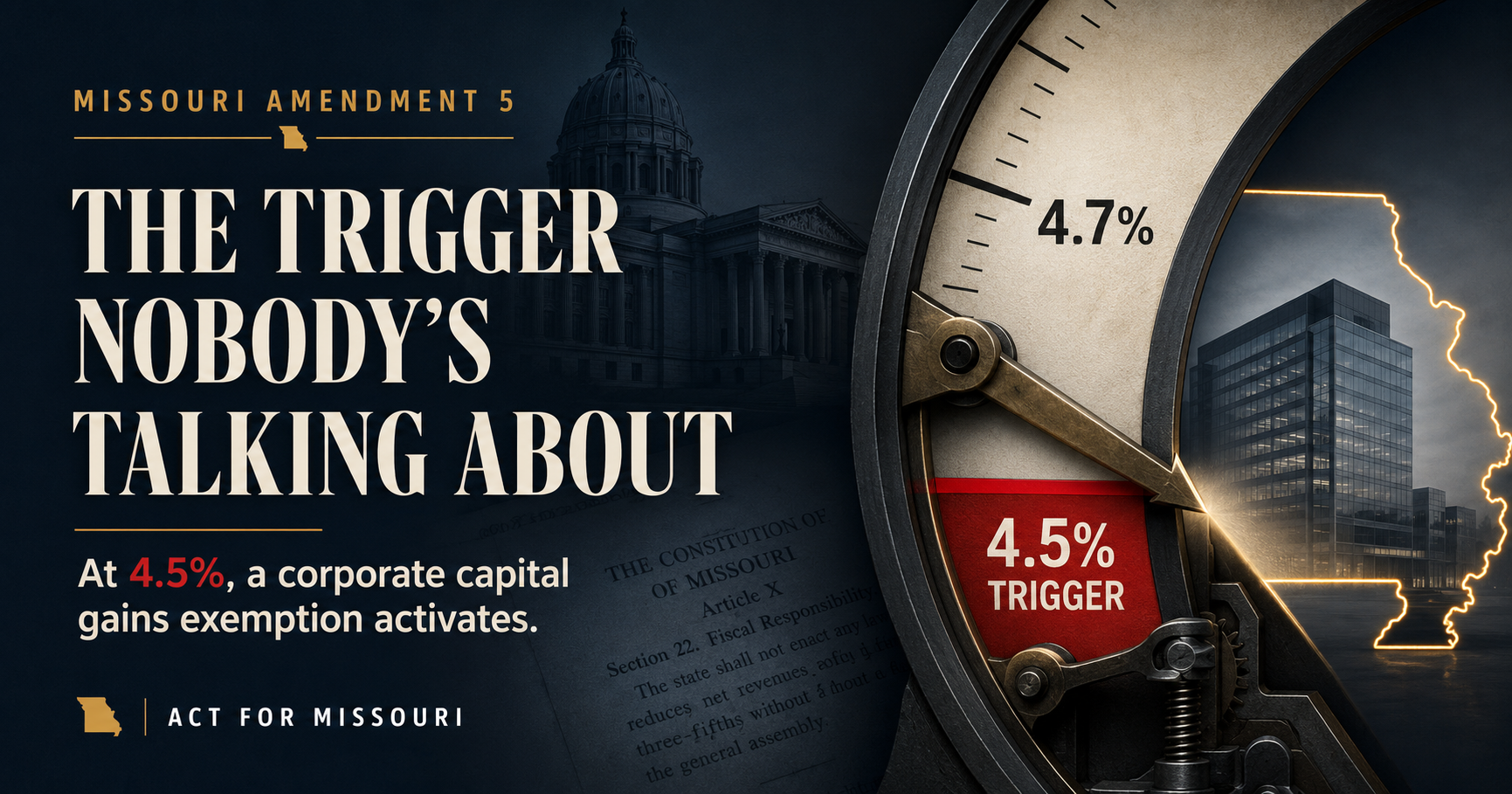
There is a provision in Missouri law right now that gives corporations a 100% exemption from state tax on capital gains. It is already signed. It is already on the books. It is not waiting on a vote, a bill, or a debate.
It is waiting on one number.
When Missouri's top individual income tax rate reaches 4.5% or lower, the corporate capital gains exemption takes effect the following tax year — automatically, with no further action by anyone. The rate today is 4.7%.
Amendment 5 requires the income tax to keep falling until it is gone. To get to zero, it has to pass through 4.5%.
Nobody running ads for Amendment 5 is mentioning this. So let's put the actual law in front of you and let you judge it.
What the Statute Says
The provision is Section 143.121, RSMo, subsection 3(14). Paragraph (a) is the part that made news last year: starting with tax year 2025, individuals subtract 100% of their capital gains from Missouri taxable income. Missouri became the first state with an income tax to fully exempt capital gains for individuals.
Paragraph (b) is the part that did not make news. Here it is, word for word, from the Missouri Revisor of Statutes:
"For all tax years beginning on or after January first of the tax year following the tax year in which the top rate of tax imposed pursuant to section 143.011 is equal to or less than four and one-half percent, one hundred percent of all income reported as a capital gain for federal income tax purposes by an entity subject to tax pursuant to section 143.071..."
— §143.121.3(14)(b), RSMo
Two cross-references decode it. Section 143.011 is the individual income tax rate statute — its top rate is the trigger. Section 143.071 is the corporate income tax statute — corporations are who the exemption fires for.
The Missouri Department of Revenue describes it the same way. Its own guidance states that corporations can deduct 100% of capital gains from federal taxable income when the top individual income tax rate falls to 4.5% or lower, effective the tax year following the reduction. This is not an interpretation. The state's own tax agency reads the statute exactly as it is written.
The language entered Missouri law through House Bills 594 & 508, signed by Governor Mike Kehoe on July 10, 2025.
How Close Is It?
Closer than most Missourians realize. Section 143.011 sets out the rate schedule and the reductions:
- Beginning in 2023, the top rate was set at 4.95% (subsection 2).
- One reduction of fifteen-hundredths of a percent brought it to 4.80% (subsection 3).
- Then up to three further reductions of one-tenth of a percent each — and no more than three (subsection 4).
Do that arithmetic and the current schedule bottoms out at exactly 4.5%. That is not a coincidence. The corporate capital gains trigger was written to fire when Missouri's existing rate-reduction schedule finishes.
One of those three reductions has already happened. The top rate is 4.7% for the 2026 tax year. Two more one-tenth-point reductions remain — 4.7 to 4.6, then 4.6 to 4.5 — and the corporate exemption begins the following year.
Under current law, those last two cuts depend on Missouri's economy. Each requires the state to hit revenue-growth targets written into subsection 4: net general revenue in the prior fiscal year must exceed the highest of the three preceding fiscal years by at least $200 million, adjusted for inflation, and also exceed collections from five years earlier on an inflation-adjusted basis. Tax practitioners writing about HB 594 noted it could be several years before organic growth gets the rate to 4.5%.
Where Amendment 5 Comes In
Amendment 5 does not mention capital gains. It does not have to. It works on the number the trigger is watching.
Section 4(d) of the amendment is a command, not an option. It states that "the general assembly shall enact legislation to reduce and eliminate the state individual income tax by requiring reductions to the top rate of the individual income tax based on revenue growth until such tax is eliminated," and bars the legislature from ever reimposing it.
The trigger in §143.121 watches one number: the top rate of tax imposed pursuant to section 143.011. Amendment 5 puts a constitutional obligation on the legislature to drive that exact number to zero. A rate cannot reach zero without passing through 4.5%. Under current law, reaching 4.5% is a possibility contingent on revenue growth. Under Amendment 5, it becomes a constitutional destination.
It also changes how those reductions get paid for. Amendment 5 lifts the constitutional restriction that currently keeps the legislature from taxing services, and requires any such expansion to be paired in the same bill with a cut to the top individual income tax rate. Under current law, rate cuts wait on organic revenue growth. Under Amendment 5, the legislature gains a second engine: expand the sales tax to services Missourians buy, and convert that revenue into income tax rate reductions.
The pairing is looser than it sounds. The amendment does not require a dollar-for-dollar trade. It requires the income tax reduction to be "at least substantially equal" to the revenue the sales tax expansion generates — an approximation, not an equation, with no figure, percentage, or tolerance defined anywhere in the text. Nor is there any mechanism to correct the trade after the fact if the projections turn out to be wrong.
Two-tenths of a percentage point is not a distant target when the legislature has a new, self-directed revenue stream whose stated statutory purpose is buying rate cuts — and, under the five-year suspension of Section 18(e), no obligation to ask voters first.
What It Costs
The official fiscal note for HB 594 priced the corporate exemption separately. Using tax year 2022 data, the Office of Administration's Division of Budget and Planning estimated the provision could exempt at least $3,165,980,618 in corporate capital gains from Missouri income tax, reducing general revenue by at least $126,639,225 per year. The Department of Revenue ran its own model and reached the same annual figure.
Both agencies flagged it as a floor, not a ceiling. The $3.17 billion covered only electronically filed corporate returns. DOR stated plainly that because paper returns were not captured, the actual impact will be larger than estimated. Every corporate line in the fiscal note reads "could exceed."
There is good reason to take that warning seriously, because Missouri just ran this experiment.
The Last Time They Estimated This
The individual half of the same bill — the capital gains exemption that took effect in 2025 — was officially scored at roughly $111 million in ongoing annual revenue loss.
By December 2025, the state's own consensus revenue estimate had revised that to about $500 million in the first year and $360 million annually going forward. The estimate for the year ending June 30 came in $400 million below what had been projected a year earlier.
The official number missed by roughly a factor of three. And the revision was still optimistic: the state projected fiscal year 2026 would close at $13.15 billion. It closed at $13.05 billion — down 2.8% from the prior year's $13.43 billion, even as sales and use tax collections rose 5.3%.
The corporate estimate of $126.6 million was produced by the same two agencies, using the same internal tax model, drawn from the same electronically-filed-only data, carrying the same "could exceed" caveat. We are not predicting it will miss by the same margin. We are asking a simpler question: why should any Missourian treat $126.6 million as the ceiling when the last number built exactly this way turned out to be a floor?
It is worth noting who checked the math. The legislature's own Oversight Division stated it did not have the resources or access to state tax data to produce an independent estimate, and was unable to verify the figures provided by the Department of Revenue and Budget and Planning. Nobody independently reviewed a $300 million tax change before it passed.
The Problem Is the Spending
Here is where this stops being an accounting exercise.
Missouri's Republican State Auditor, Scott Fitzpatrick, released a report on June 10, 2026 with a blunt assessment: Missouri's budget is broken. His findings are not in dispute and did not come from AFM:
- From fiscal year 2020 to 2025, state revenue grew 45.8%. State expenditures grew roughly 53.4% — more than twice the 24.5% increase in the Consumer Price Index over the same period.
- The fiscal year 2027 budget process produced an authorized increase in general revenue spending, not a reduction, and is projected to result in deficit spending of over $1.7 billion for the year.
- The General Revenue Fund balance, roughly $5.8 billion in fiscal year 2023, is projected to fall to about $600 million by the end of fiscal year 2027 and to be completely exhausted early in fiscal year 2028.
The Auditor's prescription is one sentence long: expenditures must be brought down to the level of ongoing revenue. The legislature's answer, in the budget it passed this spring, was to increase spending instead — to more than $50 billion.
That is the context Amendment 5 belongs in. A government committed to spending above $50 billion, with its surplus gone by 2028 and a $1.7 billion annual deficit already booked, does not have the option of simply collecting less. The money has to come from somewhere.
Amendment 5 is where. It lifts the constitutional protection against taxing services and directs the resulting revenue toward income tax reductions.
And here the amendment's own offset language matters, because it does not cover what the rate reductions set off. Section 26 requires that any sales tax expansion "shall be offset in the same legislation by a reduction in the top rate of individual income tax that reduces such tax revenues, less refunds, by an amount that is at least substantially equal to revenues generated by such expansion."
Read what that accounts for: sales tax revenue in, individual income tax rate reduction out. The corporate capital gains exemption is neither. It is not a rate reduction — it is a subtraction from the tax base under §143.121. And it is not the individual income tax — it is the corporate income tax under §143.071, levied at 4%. When the individual rate touches 4.5% and the corporate exemption activates, at least $126.6 million a year leaves general revenue with nothing in Amendment 5's offset formula to account for it.
So follow the money to its destination. Missourians start paying sales tax on services they do not pay tax on today. That revenue funds income tax rate reductions. Those reductions trigger a corporate capital gains exemption that widens the same shortfall the sales tax was supposed to close. And spending never comes down, because nothing in Amendment 5 requires it to.
This is not a tax cut. It is a refinancing — moving the burden from income to consumption, from people who invest to people who buy groceries and get their car fixed, while the spending that created the shortfall continues untouched.
Act for Missouri wants the income tax eliminated. We have said so from the beginning. But it has to be done the way conservatives have always said it should be done: by cutting what government spends, not by finding new things to tax. Missouri's own Republican auditor has spent seven months telling the legislature exactly that. They passed a bigger budget and put Amendment 5 on the ballot instead.
What This Actually Means
We have asked all summer why $14 million in undisclosed corporate money is funding the campaign for Amendment 5, and why the donors behind seven corporate entities will not put their names on it. We are not going to tell you we know what any particular donor wants. We do not, and we will not pretend otherwise.
But we can tell you what is written in the statute books. There is a corporate tax exemption already enacted in Missouri, waiting on a number, and Amendment 5 is the fastest route to that number. Voters deserve to know that before August 4, not after.
What We Are Not Claiming
We hold ourselves to citing the text and telling you exactly where our argument stops. So, plainly:
- Amendment 5 does not trigger the corporate exemption directly. The amendment does not change any tax rate by itself; the legislature implements the phase-out through follow-up legislation. Amendment 5 accelerates the rate reductions that trigger the exemption.
- Corporations do not have this exemption today. Corporate capital gains remain taxable, and corporations were not eligible in tax years 2025 or 2026.
- The trigger could eventually fire without Amendment 5. If revenue growth meets the statutory targets, the rate reaches 4.5% on its own. The question Amendment 5 answers is when, and who pays to get there.
- This applies to corporations, not pass-through entities. The exemption covers entities taxed under Section 143.071. The Department of Revenue has confirmed that pass-through entities subject to the PTE tax and fiduciaries do not qualify under this provision.
- The drop in corporate collections last year was not this exemption. Corporate income and franchise tax collections fell 23.2% in fiscal year 2026, and pass-through entity tax collections fell 19.1%. Neither decline came from the corporate capital gains exemption, which has not taken effect. We note this because the numbers sit close together and are easy to confuse.
- Not all of last year's revenue decline was capital gains. The state budget director attributed the fiscal year 2026 contraction to the capital gains cut and, to a smaller degree, to state effects of federal tax changes.
Check It Yourself
Every claim above rests on primary sources you can read in about ten minutes:
- RSMo §143.121 — the capital gains subtraction. Scroll to subsection 3, subdivision (14), paragraph (b).
- RSMo §143.011 — the individual rate schedule and reduction triggers. Subsections 2, 3, and 4.
- RSMo §143.071 — the corporate income tax, which defines who the exemption applies to.
- Missouri Department of Revenue — the state's own guidance on the capital gains subtraction.
- HB 594 (2025) — the bill that enacted the trigger, signed July 10, 2025.
- HB 594 fiscal note — the official revenue estimates, including the corporate breakout on pages 4 through 7.
- HJR 173 & 174 (truly agreed and finally passed) — the text that became Amendment 5. The mandatory rate reduction is Section 4(d), subsection 2; the offset requirement is Section 26, subsection 2(2).
- State Auditor Scott Fitzpatrick — the June 2026 General Revenue Fund analysis and the December 2025 spending-trend report.
- Office of Administration — the June 2026 general revenue report with final fiscal year 2026 collections.
Do not take our word for it. Read the statute. It is four lines long, and it says what it says.
Act for Missouri is a volunteer-led, principled conservative civic organization. We believe in principle over party. For our full analysis of Amendment 5, including the five-year suspension of Hancock's Section 18(e) voter-approval requirement and the funding behind the yes campaign, see The Party of Limited Government Wants Fewer Limits — On Itself. To learn more about who we are, visit our About page.