
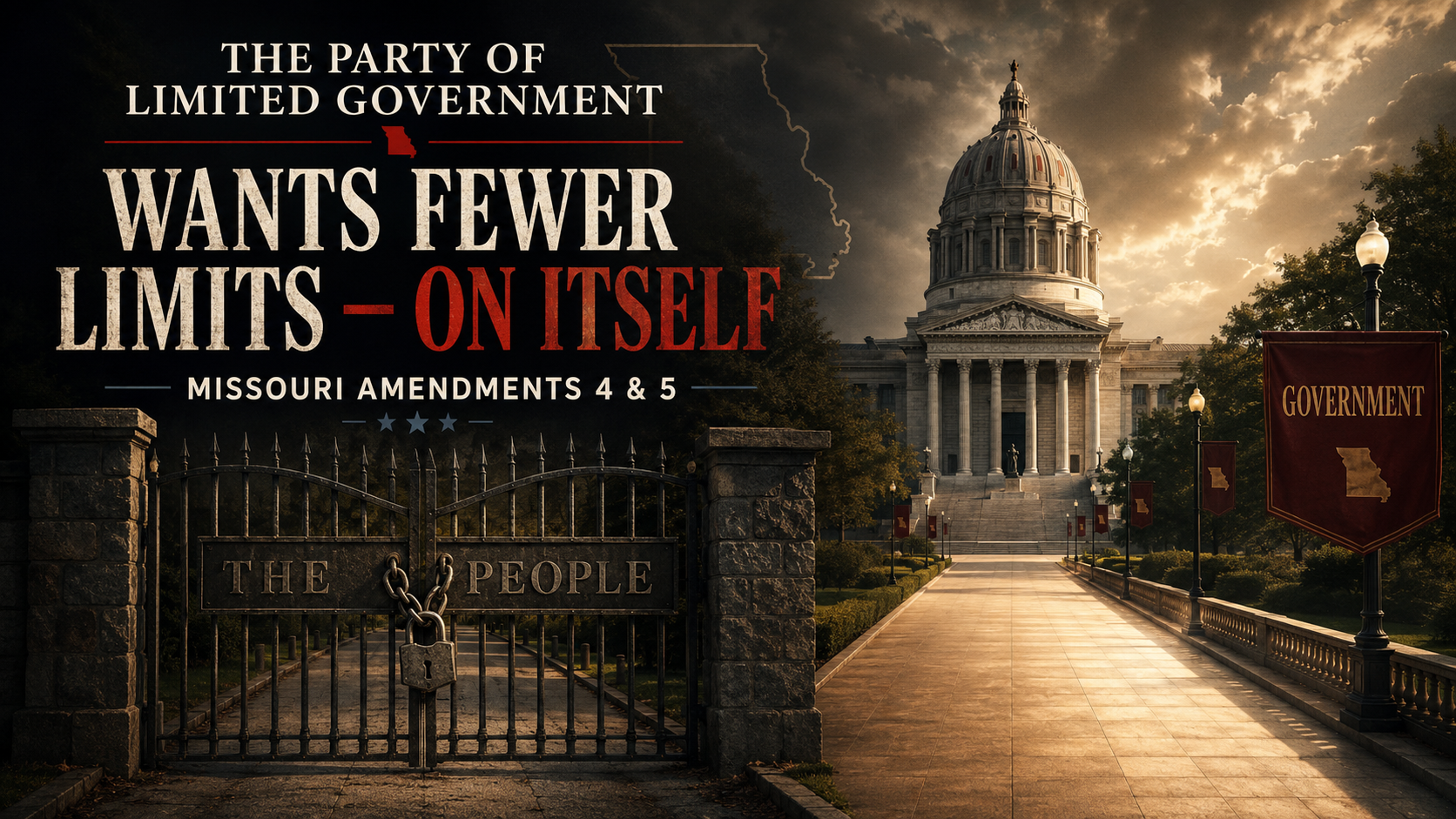
The Party of Limited Government Wants Fewer Limits — On Itself
August 2026 Ballot | Missouri Constitutional Amendments 4 & 5
🎧 Listen to this article
"...keeping and enforcing the Hancock Amendment..."
— Missouri Republican Party Platform, "Freedom" section
That's not us talking. That's the state party's own platform — the document every Republican candidate asks you to trust when they file for office. It doesn't say "consider" the Hancock Amendment. It doesn't say "review" it. It says keep it. Enforce it. The platform goes further still, treating support for what Hancock stands for as a baseline for who deserves your vote in the first place.
This August, the same party is asking you to vote yes on an amendment that suspends Hancock's own enforcement mechanism for five years — and yes on a second amendment that makes it harder for you to ever fix that if it goes wrong. Both came out of the same legislature. Both were placed on your ballot by the same governor, on the same day, by his own choice. And the argument he uses to defend one of them is the argument that convicts the other.
This was never a fight about the size of government, measured in dollars or line items. Nobody serious claims Amendment 5 makes Missouri's government bigger in that sense — its own architects say the opposite. The real conservative question was never "how big." It's "how powerful, and how checked." A government that must answer to voters is limited, even if it spends a great deal. A government excused from answering to voters is unlimited, even if it spends very little. That distinction is the entire premise behind Hancock, behind term limits, behind the initiative petition itself — the premise Missouri conservatives have organized around for fifty years.
By that standard — the actual standard, the one printed in the party's own platform — both amendments on your ballot this August fail. Not as radical departures from conservatism. As quiet ones.
The Man on Both Ballots
In May, Governor Mike Kehoe signed the proclamations placing four constitutional amendments on Missouri's August 4 primary ballot. Two of them are the subject of this piece. Amendment 5, the plan to phase out the state income tax, has been reported as Kehoe's own tax plan and his top legislative priority this session. Amendment 4, the initiative-petition measure, has become just as identified with him personally: for months, Kehoe has argued that out-of-state special interests are using citizen ballot initiatives to bypass the legislature and rewrite Missouri's constitution — the case at the center of his support for Amendment 4.
At the same time, Missouri Promise PAC — the committee bankrolling the campaign for Amendment 5, Kehoe's own agenda — has taken in more than $14 million since May 7, according to large-contribution filings with the Missouri Ethics Commission. Every dollar traces back to a corporate entity, not a named individual. Reporting by ProPublica, corroborated independently by those same MEC filings, found that $1.9 million came from Missouri Promise Inc., a nonprofit incorporated in Delaware months before the donation, and that neither Missouri Promise Inc. nor Secure Missouri — which gave another $1.5 million — discloses who is actually behind it.
🎬 Watch: Where is the Amendment 5 money really coming from? — Shield Maidens of Missouri
A walkthrough of the corporate entities and out-of-state addresses behind Missouri Promise PAC's donor list — cross-check every figure against the Missouri Ethics Commission's own public filings.
Missouri Promise PAC's ads on television and online feature the governor himself. One thirty-second spot follows him through a city block and a factory floor before closing with him on horseback. The narrator promises, "Now he's going to deliver." The governor warning Missourians about hidden money is the same governor whose face sells what hidden money bought.
One more detail, confirmed independently by that same reporting: Marc Ellinger, the lawyer who serves as treasurer of Missouri Promise PAC, has his own law office listed as the address for Secure Missouri — the second-largest, equally undisclosed donor. This isn't a loose coalition of strangers who happen to want the same two things. It's a small, identifiable circle, running one campaign apparatus, for one governor's agenda.
None of this makes the case for eliminating the income tax wrong on its own terms — that case can be made honestly, and AFM has made a version of it ourselves. What it shows is a governor asking Missourians to hand government new, five-year, unsupervised authority over their tax code, financed by people who refuse to be named, defended by an argument about hidden money that he is, in the same breath, benefiting from. Hidden money expanding government's reach into your wallet doesn't stop being a danger because the beneficiary is standing in front of a camera.
Amendment 5: Suspending the Amendment They Swore to Protect
Mel Hancock built the amendment that bears his name through a citizen initiative petition in 1980 — the same process Amendment 4 makes harder. His own words at the time were plain: "I am talking about limiting the size of government," he said, describing an amendment meant to stop politicians from buying votes with tax dollars. For 45 years, Hancock's core promise has been that when the legislature wants a large tax increase, Missouri voters get the final say. That promise lives in Section 18(e) of Hancock's own article — the mechanism, not just the sentiment.
Amendment 5 suspends exactly that mechanism for five years, giving the legislature room to expand the sales tax to services and transactions it doesn't currently reach, adjust rates, and offset the changes against a gradual reduction in the income tax — all without the voter-approval trigger Hancock was built to require.
It doesn't ask permission to do this quietly, either. Amendment 5 contains four separate clauses that begin "notwithstanding any provision of this constitution to the contrary" — language that announces, in the text itself, that the amendment overrides whatever stands in its way. A single override clause could be a narrow fix for one real conflict with existing law. Four means the amendment's drafters ran into the rest of the constitution four separate times while writing it — and each time, instead of rewriting the section in conflict, they wrote in permission to ignore it.
Two more details rarely make it into the ads. Amendment 5 lets the legislature certify its own "purpose" finding for the tax changes it makes — grading its own homework, with no independent check required. And it repeals language Missouri voters themselves added to the constitution in 2016, specifically protecting services from a future sales tax. The 2016 electorate closed that door on purpose. Amendment 5 reopens it.
Supporters call this an income tax elimination. At best, it's a tax shift — trading a tax tied to what you earn for one tied to what you buy, phased in over five years, with the legislature holding new discretion over the pace and scope. Whether that trade is good policy is a fair debate to have. Whether it shrinks government's reach into your finances is not: it moves decision-making authority away from voters, where Hancock put it, and toward the legislature, unsupervised, for half a decade.
And that's before asking who's paying for the campaign to pass it. According to the Missouri Ethics Commission's own large-contribution filings, Missouri Promise PAC has received over $14 million since early May — Missouri Action ($6.5 million-plus, registered to a P.O. box in Jefferson City), American Policy Coalition ($2.05 million, a virtual office in Columbus, Ohio), Missouri Promise Inc. itself ($1.9 million, Delaware), Secure Missouri ($1.5 million), an entity registered in Maryland under two slightly different names ($1.2 million combined), and the Revitalization Project ($900,000, a mailbox address in Springfield, Virginia). Seven names. Seven corporate entities. Not one dollar traceable to a named individual donor.
If Amendment 5 really is the good-faith path to eliminating the income tax its supporters describe, the obvious question is why the money behind it needs this many layers of corporate names and out-of-state mailboxes to stay hidden. A policy that expands what government can tax, defended by donors who won't put their names on it, is not a limit on government. It's an unaccountable expansion of it.
Amendment 4: The Same Instinct, Aimed at You
If Amendment 5 expands what government can do without asking permission, Amendment 4 makes sure government never has to worry about being un-asked. Its mechanism is written into the amendment's own text: Section 54(6) names, specifically, the constitutional provisions it overrides, then requires a majority vote in every one of Missouri's eight congressional districts before a citizen-initiated constitutional amendment can pass.
What that list leaves out matters as much as what it includes. The provision governing how the legislature's own referred amendments pass — Article XII, Section 2(b) — is overridden only for citizen initiatives; for the legislature's own proposals, it's untouched, so lawmakers still need just a simple statewide majority, same as always. And a full constitutional convention, which could rewrite the entire document, isn't touched at all: the section governing what a convention's proposals need to pass isn't even on Amendment 4's own list of what it overrides. A convention could replace Missouri's whole constitution with 50% plus one. A citizen wanting to add a single clause needs all eight districts to agree.
The process matched the substance. HJR 3 went from introduction to the Secretary of State's desk in nine days. It cleared the Senate only after Republican leadership invoked the previous-question motion twice — first to force through the session's own rules, then again to end debate on the bill itself. No floor debate on either survived the maneuver.
This isn't AFM inventing an asymmetry that isn't really there. In 2022, a Republican legislator — Bill Kidd — introduced a version of this same concurrent-majority idea that applied the higher bar equally to the legislature, the initiative process, and a constitutional convention alike. It passed three separate House committee votes and was perfected by the full chamber before dying quietly when the session ran out of time. The fair version existed. It had Republican authorship. It simply wasn't the version that passed in 2025.
We've laid out the full case against Amendment 4 elsewhere — the paths left wide open, the complete comparison to Rep. Kidd's 2022 alternative, and the debate that never happened — see Neither Liberty Nor Safety: The False Bargain of Amendment 4. What matters for this piece is simpler. Amendment 4 does not make Missouri's constitution harder to amend. It makes it harder for you to amend it. Two of the three paths into that document — the legislature's and a convention's — remain exactly as open as they've always been.
Same Architect, Same Calendar
One more fact belongs here, because it isn't really about either amendment individually — it's about the decision to run them together. Kehoe placed Amendment 4 and Amendment 5 on the August primary ballot rather than November, a choice that produces a smaller, more Republican-leaning electorate and keeps both measures separate from the high-turnout fight over abortion rights that will appear on Missouri's November ballot instead.
That is not two unrelated amendments that happened to land on the same ballot by coincidence. It's one governor's calendar, serving one project: less power for the people who vote on citizen initiatives, more room for the government he leads to tax without asking first. The connective tissue between Amendment 4 and Amendment 5 isn't a shared donor list or an ideological accident. It's a signature on a proclamation.
Where We Stand
Apply that standard — power checked, not power's size — to both amendments, and the verdict follows directly.
We oppose Amendment 5 because it swaps one bad tax for another, and because it hands the General Assembly five years of room to keep spending at today's record levels without the voter check Hancock was built to require. Reducing taxes and cutting spending used to be the Missouri Republican position. Today's Missouri GOP spends like it's as addicted to the habit as the party it built its identity opposing.
We oppose Amendment 4 for the same underlying reason, aimed the other direction: we believe in limiting government's power, not the people's. Missouri's initiative process has real problems, and reform is a legitimate conversation to have. But "never let a good crisis go to waste" used to be a line Missouri Republicans mocked Democrats for living by. This year, the legislature took a genuine problem — an initiative process that does need fixing — and used it as cover to grab power for itself instead of fixing it. Amendment 4 doesn't solve the problem of protecting Missouri's constitution. It just decides who gets to abuse it.
Act for Missouri's alternative on both fronts isn't complicated. Eliminate the income tax through spending discipline and growth, not a five-year suspension of Hancock. Make the constitution harder to amend for everyone equally — the model already exists, written by a Republican legislator in 2022, and it never got a final vote. Neither amendment on this ballot limits government. Both expand it, and both ask the people who are supposed to be doing the limiting to hand over the tools they'd use to do it.
Act for Missouri is a volunteer-led, principled conservative civic organization. We believe in principle over party. For the complete case against Amendment 4 — the paths left open, the full comparison to Rep. Bill Kidd's 2022 reform, and the process that produced it — see Neither Liberty Nor Safety: The False Bargain of Amendment 4. Read ProPublica's reporting on Amendment 5's financing, the Missouri Republican Party's platform, the full text of Amendment 4 (HCS HJR 3) and Rep. Kidd's 2022 alternative (HJR 132), and watch Ron Calzone's full interview on the Robb Carter Show. To learn more about who we are, visit our About page.