
Principle Over Party
The Label Won't Save You
Republicans say a GOP vote is the only way to stop socialism. The record shows government's grip on the economy grew faster under their watch than almost anywhere in the world.
Act for Missouri · October 2026
In the final weeks before the November 3 election, the message from the Republican side has been simple: the Democratic Party has been taken over by socialists and communists, so vote Republican. Some of those warnings deserve to be heard. But it is fair to ask a harder question. How long do we keep handing power to a party because it is "better than the alternative," if it keeps moving us in the same direction?
The Pitch
The message has been delivered from the top down. At the Republican midterm convention in Dallas in September, President Trump told the crowd, "It's going to be a communist country if they win." The Associated Press counted at least 60 mentions of communism or communists from convention speakers.
Vice President JD Vance has carried the same message across the country. Asked on Fox News this summer whether democratic socialists would take over the Democratic Party, he answered, "And it is communism, Laura." House Republicans' campaign arm is running ads in battleground districts that end with four words: "Stop socialism. Vote Republican."
We are not here to defend the Democratic Socialists of America. Their agenda would greatly expand government, and Missourians should reject it. Our question is a different one: is the party making this pitch actually stopping the thing it warns about?
What the Numbers Say
The Varieties of Democracy (V-Dem) project ranks 179 countries on how much the state owns or controls their economy. For most of the last two decades, the United States has been near the very top of the list, meaning almost the least government control in the world. Since 2010, it never ranked lower than 4th.
Then came 2025. In a single year, the United States fell from 2nd to 16th.
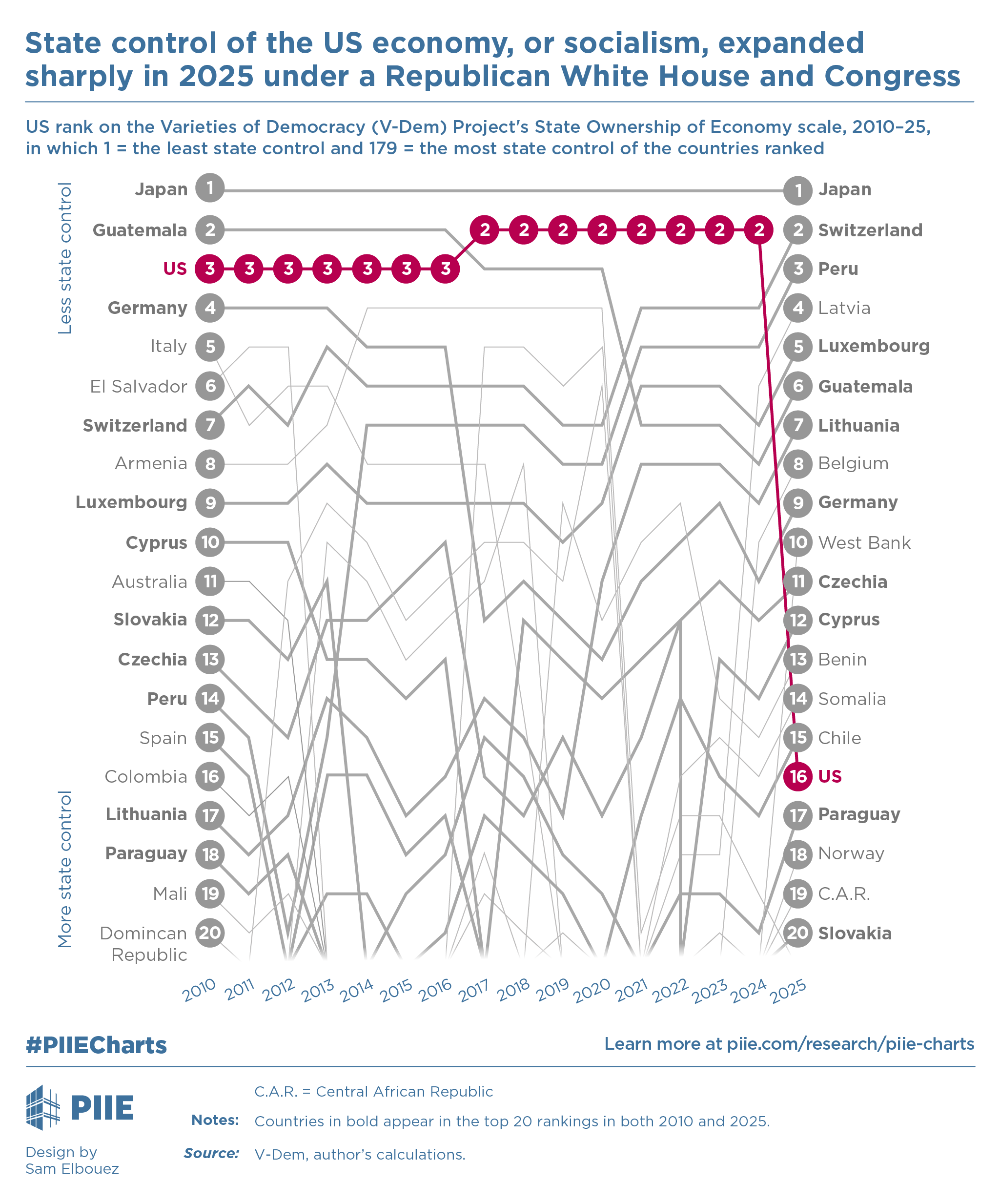
A drop that large is rare. According to PIIE senior fellow Cullen Hendrix, who built the chart, only about 1.2 percent of year-to-year changes since 2005 have been bigger. The countries that usually see swings that size are places like Afghanistan, Burkina Faso, and South Sudan, not large, stable economies.
Hendrix is blunt about who was in charge. He notes the shift happened under unified Republican control of Washington, not because of Democratic Socialists, who hold only a handful of seats in Congress.
To be fair, the United States is still in the top 20, which means it is still one of the most market-driven economies in the world. The concern is not where we are. It's the direction, and how fast we're moving.
How It Happened
Most of this didn't come through headline-grabbing takeovers. It came deal by deal.
Government as shareholder
Since January 2025, the federal government has announced $29.9 billion in investments across 43 deals that give it direct ownership in private companies, according to the Council on Foreign Relations. The biggest is Intel: the government paid $8.9 billion for about 10 percent of the company, converting grants it had already promised into stock. Other stakes include rare-earth miners, a lithium company, chipmakers, and nearly ten quantum computing firms.
Control without ownership
When Japan's Nippon Steel bought U.S. Steel in 2025, the administration required a "golden share" as a condition of approval. It lets the federal government appoint a board member and veto decisions like closing or idling plants, moving jobs, or relocating headquarters. The government owns no stock and earns no dividends, but it gets a say in how the company runs.
A cut of private sales
Chipmakers Nvidia and AMD agreed to pay the federal government 15 percent of revenue from certain chip sales to China, as a condition of getting their export licenses. Bloomberg described the arrangement as legally questionable, and some legal experts have raised concerns about the Constitution's ban on taxing exports.
Tariffs: a tax by another name
The nonpartisan Tax Foundation calls the administration's tariffs the largest U.S. tax increase, as a share of the economy, since 1993. It estimates they cost the average household about $1,000 in 2025. After the U.S. Supreme Court struck down the largest set of tariffs in February 2026, the Tax Foundation still projects about $900 per household this year.
Spending and debt
With Republicans controlling the White House, the House, and the Senate, the Congressional Budget Office projects a deficit of about $2.1 trillion for fiscal year 2026, up $200 billion from the year before. The national debt has passed $40 trillion.
"If the Republicans win, you win with us"
At the Dallas convention, the president promised a $5,000 "Trump dividend" to every adult, but only if Republicans keep control of Congress. Estimates put the cost at more than $1.2 trillion. Sen. Susan Collins (R-Maine) and Florida Gov. Ron DeSantis both raised concerns about the cost and inflation. A government check, conditioned on how you vote, is a strange way to fight socialism.
Republicans Who Noticed
These concerns are not coming only from the left. Some of the sharpest critics are conservatives.
- Sen. Rand Paul (R-Ky.) asked whether the government owning part of Intel would be "a step toward socialism." He later warned on CNBC that the free-market movement within the Republican Party is being diminished.
- Conservative radio host Erick Erickson called the Intel deal "socialism with an R next to its name."
- Vance Gunn, a former White House budget official in Trump's first term, described the approach as "profits privatized, losses socialized."
- The Cato Institute has argued that the administration's deals, made company by company and often under pressure, are slowly wearing away the free-market capitalism that made America prosperous.
Meanwhile, Sen. Bernie Sanders, a self-described democratic socialist, was among the few senators to praise the Intel stake. When the Senate's best-known socialist cheers a Republican economic policy, that should tell us something.
This Isn't New, and It Isn't One Party
It would be easy to make this a story about one president. It isn't.
In 2008 and 2009, during the financial crisis, Washington took ownership stakes in General Motors, Chrysler, and the insurance giant AIG. Those moves started under a Republican president and continued under a Democrat. At the time, Republicans objected loudly, and the stakes were sold off once the crisis passed. The money that became the government's Intel stake also traces back in part to the CHIPS Act, passed under President Biden.
What's different now is the timing. Those earlier interventions happened during emergencies. Today's deals are being made during a period of growth and low unemployment, and the administration has said more are coming.
And here is the pattern that should concern every citizen: when the other party grows government, our side objects. When our side does it, the objections go quiet. PIIE's Gary Hufbauer and Katelyn Hetrick note that the 2008 stakes were especially controversial among Republicans. Today, with a Republican doing the same thing on a larger and more permanent scale, most of that opposition has disappeared. The policy didn't change. Only the team did.
The Same Pattern in Jefferson City
Missouri is not immune. Republicans hold supermajorities in both chambers of our General Assembly, and Act for Missouri has been tracking what actually passes.
In our review of the 2025 session, we found that more than 60 percent of the bills that passed had stronger support from Democrats than from Republicans.
The 2026 session followed the same pattern. Our Chamber Consensus report found 12 bills that passed with Democratic support outpacing Republican support by 20 points or more.
One of those bills is a small, state-level version of the same idea playing out in Washington. SB 1553, the "Missouri Defense and Energy Independence Act," authorizes up to $40 million a year in tax credits, covering 20 to 25 percent of project costs, for companies that build facilities to produce designated critical materials and pharmaceuticals. It also creates a grant fund of at least $10 million. In other words, state government picks which industries get a head start.
There are honest national-security arguments for a bill like this, and people of good faith supported it. But look at how it passed:
Missouri House (final passage)
Democrats: 40 yes, 2 no
Republicans: 65 yes, 27 no
Missouri Senate (third reading)
Democrats: 6 yes, 0 no
Republicans: 13 yes, 9 no
Democrats were nearly unanimous. Republicans split. Twenty-seven House Republicans and nine Senate Republicans voted no, and they deserve credit for it. But that's the point: the "R" next to a legislator's name told you nothing about how he or she voted. Only the record does.
Why Voting by Label Is Failing Us
George Washington warned in his 1796 Farewell Address about "the alternate domination of one faction over another." He saw what party loyalty could do to a republic: it turns citizens into teammates, and teammates make excuses.
That's what "better than the alternative" voting does. It lets politicians skip the hard work of earning your vote on principle. It teaches them that as long as the other side looks worse, they can grow government, spend money they don't have, and pick winners in the economy, and you'll still show up. And it means the people who would normally object, conservatives who believe in limited government, go quiet because the person doing it wears their jersey.
"Lesser of two evils" still chooses an evil. If both parties are moving us toward more government control, just in different flavors, then a vote based only on the label is a vote for the direction we're already headed.
A Principle Test for November 3
The answer isn't to switch teams. It's to stop voting by team. Ask every candidate, whatever letter follows the name:
- Should the government own shares in private companies?
- Should any president be able to demand a cut of a company's sales in exchange for permission to do business?
- Will you vote against deficit spending when your own party proposes it?
- Should government decide which industries and companies get tax credits and grants?
- Can you name a time you voted against your own party because of principle?
Then check the record. For Missouri legislators, our legislation tracker shows how each one actually voted, and how often they broke from their party.
Principle Over Party
Republicans are right that America should not become a socialist country. But a party doesn't stop socialism by saying the word louder. It stops it by refusing to expand government's control of the economy, even when its own leaders want to.
The label won't save the republic. Citizens who know the principles, check the record, and refuse to give anyone a free pass just might.
Sources
- Cullen S. Hendrix, "State control of the US economy, or socialism, expanded sharply in 2025 under a Republican White House and Congress," PIIE Charts, Sept. 21, 2026.
- Cullen S. Hendrix, "You're already getting socialism—and Democratic Socialists have nothing to do with it," PIIE, Sept. 10, 2026 (includes downloadable V-Dem data).
- Gary Clyde Hufbauer and Katelyn Hetrick, "Trump's state capitalism reaches a high-water mark," PIIE, Oct. 6, 2026 (deal table with links to SEC filings).
- Council on Foreign Relations, "Washington's Growing Portfolio: Tracking U.S. Government Investments," updated July 30, 2026.
- Associated Press, "Republicans, facing midterm peril, try to brand Democrats as communists," Sept. 14, 2026.
- The Hill, "Vance says Democrats headed toward communism," July 1, 2026.
- New York Post via AOL, "Zohran Mamdani stars in NRCC ads against House Dems."
- Bloomberg, "Nvidia, AMD Reach Deal to Give US a Cut of China AI Chip Sales," Aug. 10, 2025.
- Reason, "Trump's Tariffs Will Cost Each American Household $900 in 2026," July 31, 2026, citing the Tax Foundation; see also ABC News, "Trump's tariffs cost American households $1,000 last year," Feb. 10, 2026.
- Fox Business, "Federal budget deficit on track to surpass $2T this fiscal year," citing CBO, Aug. 2026.
- The National Desk, "Trump dividend promise gets mixed reviews," Sept. 2026; OPB/NPR, "Republican midterm convention in Dallas," Sept. 10, 2026.
- Boston Globe/AP, "Trump's Intel stake sparks cries of 'socialism' from his party," Aug. 27, 2025.
- Washington Examiner via The Gazette, "Trump administration Intel proposal criticized as 'socialism' by conservatives," Aug. 20, 2025.
- CBC News, "Reaction to the U.S. government's stake in Intel," 2025.
- Ryan Bourne, "Trump's Cronyism Is Quietly Unravelling American Capitalism," Cato Institute, Aug. 27, 2025.
- Act for Missouri, Chamber Consensus report and SB 1553 vote record, 2026 session.
- Act for Missouri, "The Missouri Republican Supermajority Is Failing Us — Here's the Proof," July 8, 2025.
- George Washington, Farewell Address, September 19, 1796.