
Missouri Lawmakers Push New Capitol Security Bills (HB 1997 & HB 2107) With Emergency Clauses and $0 Fiscal Notes
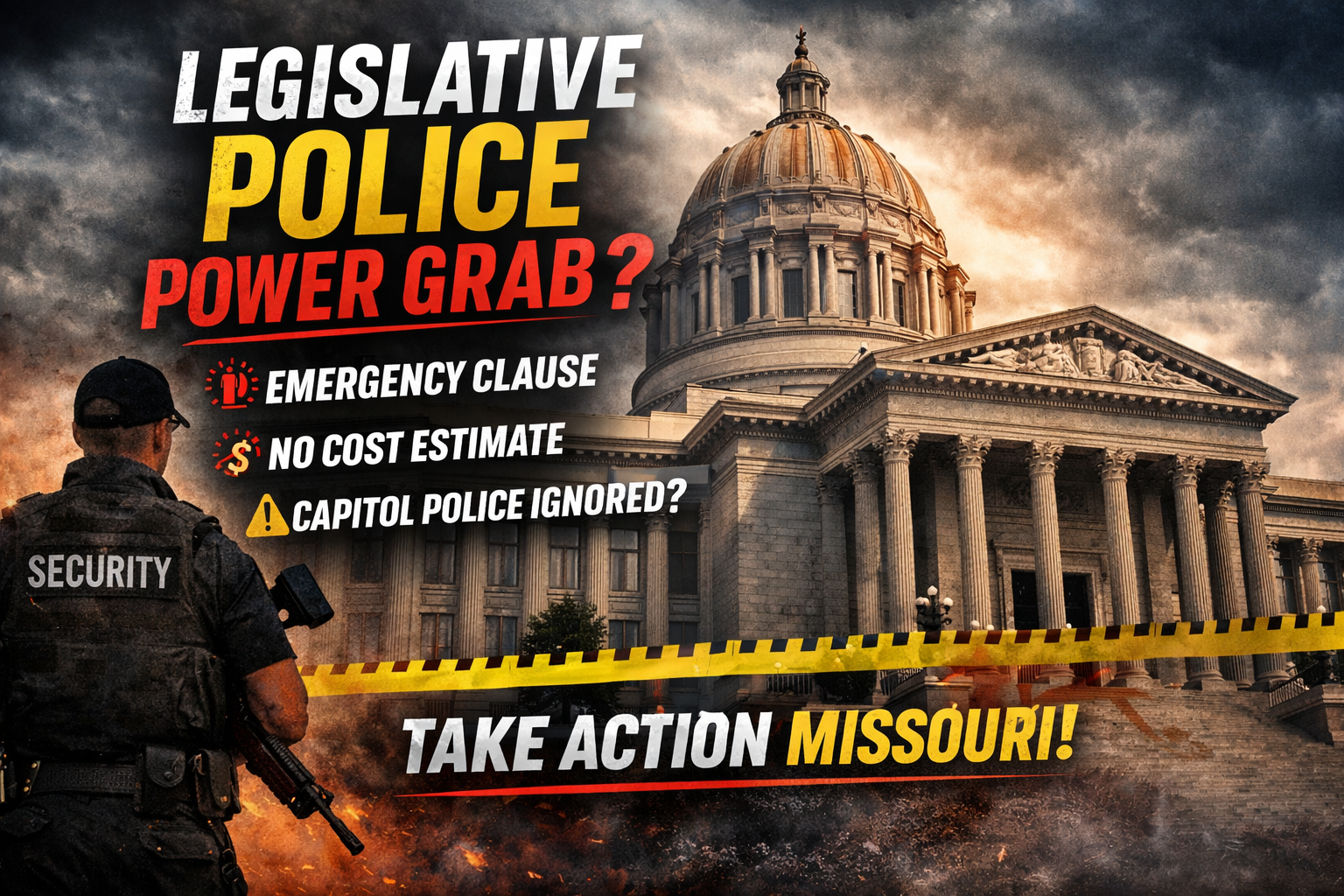
Two nearly identical bills—HB 1997 and HB 2107—would authorize the Missouri General Assembly (or either chamber) to employ its own POST-licensed armed security officers with arrest powers. Both bills also include emergency clauses, even though the official fiscal notes project $0 cost and assume no new hires. That combination raises legitimate questions about necessity, scope, oversight, and transparency.
Use the Missouri House online witness form to register your position and (optionally) add written testimony.
(Public report here: HB2107 Witnesses (1–12))
What HB 1997 and HB 2107 actually do
Both bills add the same new statute section (proposed Section 21.158) authorizing the General Assembly, the House, or the Senate to employ legislative security officers. These officers may carry firearms “when necessary” and must be licensed under Missouri’s Peace Officer Standards and Training (POST) program. The bills also grant these officers “all powers … necessary” to secure and support the functioning of the legislature, including the power to apprehend and arrest.
What is a POST-licensed officer?
POST stands for Peace Officer Standards and Training. Missouri’s POST program licenses peace officers, enforces training and continuing education requirements, and investigates licensing discipline under Chapter 590, RSMo. In short: POST licensing is what separates a security guard from a state-recognized peace officer with law-enforcement authority.
Source: Missouri Department of Public Safety, POST Program: dps.mo.gov/…/post
What is an emergency clause (and why it matters)?
An emergency clause makes a bill effective immediately upon passage and approval, instead of the normal effective date. In Missouri, emergency clauses are supposed to be reserved for laws necessary for the immediate preservation of public peace, health, or safety. They also have the practical effect of accelerating implementation and can limit the public’s time to respond.
Both HB 1997 and HB 2107 use an emergency clause tied to “safety within the capitol building during the current legislative session and thereafter.”
The fiscal note contradiction
Despite authorizing a new class of legislature-employed peace officers, the official fiscal notes for both bills assume no fiscal impact and no additional FTEs (Full time employees) in the out-years. How does that happen?
- “May” vs. “shall”: These bills are permissive. They authorize hiring but do not require it. Agencies can therefore assume “no change” if no hiring occurs.
- Assumptions are not transparency: A fiscal note can be technically correct and still misleading to regular citizens if it does not also disclose plausible costs if the authority is actually used.
- Emergency clause vs. $0 cost: If an emergency truly exists, lawmakers and the public deserve clarity on the operational plan: staffing levels, equipment needs, training, and oversight.
What supporters say (and what still needs answers)
Supporters have described these bills as a way to strengthen legislative security and improve information-sharing—arguing that POST-licensed officers can be brought more fully “into the loop” on law-enforcement communications (such as alerts and database access). They also note that some legislative security personnel may already have training, and that the bills would put key requirements in statute.
Even if you agree with those goals, citizens should still demand clarity on the basics: who supervises these officers, where their authority begins and ends, how they coordinate with Capitol Police, and what the plan and cost range is—especially when an emergency clause is used.
Capitol Police: proven performance under pressure
Missouri already has a dedicated Capitol Police force under the Department of Public Safety. In recent months, Capitol Police have demonstrated that large, emotional crowds can be managed professionally and peacefully—without shutting down citizen access or turning the people’s house into a militarized zone.
- Redistricting protests (September 2025): Large crowds gathered at the Capitol during the 2nd extraordinary session; reports described packed galleries and intense demonstrations managed without major incident. (KCUR coverage)
- HJR 73 rally (May 2025): A large multi-issue rally at the Capitol was handled without reported security breakdown. (Missouri Press Association coverage)
What the bills do not define
Even supporters of better security should want basic guardrails. HB 1997 and HB 2107 do not clearly define:
- Chain of command: The bills say the House, Senate, or General Assembly may “employ” the officers, but do not specify who they report to day-to-day (Speaker? President Pro Tem? Sergeant-at-Arms? an administrative office?).
- Jurisdiction and limits: The text speaks broadly about powers “necessary” for security and functioning, including arrests—without a clear geographic or subject-matter boundary.
- Coordination: There is no statutory framework for coordination with existing Capitol Police (executive branch) or local law enforcement.
- Public accountability: There is no clear complaint process, reporting requirement, or transparency standard beyond whatever POST provides for licensing discipline.
Why two identical bills?
HB 1997 and HB 2107 are substantively identical but are being heard in different committees. There are several common strategic reasons this happens in legislatures:
- Multiple lanes to move a priority: If one committee stalls, the other bill can keep the concept alive.
- Different gatekeepers: A sponsor may believe a different committee chair or membership is more favorable.
- Signaling caucus support: Multiple sponsors filing the same language can signal that leadership views the idea as important.
- Process flexibility: Committees can adopt substitutes or combine bills later; having a “backup vehicle” can make that easier.
Whatever the internal strategy, citizens are right to ask why a major change in Capitol security architecture is being fast-tracked with an emergency clause while the fiscal notes present a “$0 impact” story.
Talking points for witness forms and calls
If you oppose these bills, keep your testimony short, specific, and respectful. Here are ready-to-use talking points (choose 2–4):
- Emergency clause is not justified: “If it’s an emergency, show the plan and costs; if there’s no plan, remove the emergency clause.”
- Undefined chain of command: “Who do these officers report to? What is the complaint process? Where is the accountability?”
- Broad powers without limits: “All powers ‘necessary’ including arrests is too vague for a public civic space.”
- Potential duplication and conflict: “We already have Capitol Police; clarify why this is needed and how forces will coordinate.”
- Transparency on costs: “A $0 fiscal note doesn’t tell the public what it costs if hiring happens. Give ranges.”
- Protect citizen access: “Security should not chill peaceful citizen petitioning in the people’s house.”
Contact the Special Committee on Intergovernmental Affairs
If you can, call committee members and respectfully ask them to vote NO on HB 1997 (and to scrutinize HB 2107 as an identical bill). Here are the phone numbers you provided:
| Member | Phone |
|---|---|
| Rep. Tricia ByrnesChair District 63 • Republican | 573-751-1460 |
| Rep. Philip OehlerkingVice-Chair District 100 • Republican | 573-751-9765 |
| Rep. Bridget Walsh MooreRanking Minority Member District 93 • Democrat | 573-751-0211 |
| Rep. Phil Amato District 113 • Republican | 573-751-2504 |
| Rep. John Black District 129 • Republican | 573-751-1167 |
| Rep. Chris Brown District 16 • Republican | 573-751-9458 |
| Rep. Bill Falkner District 10 • Republican | 573-751-9755 |
| Rep. Ron Fowler District 31 • Republican | 573-751-8636 |
| Rep. Sherri Gallick District 62 • Republican | 573-751-1344 |
| Rep. Jeff Hales District 86 • Democrat | 573-751-4265 |
| Rep. Mark Meirath District 39 • Republican | 573-751-1468 |
| Rep. Chanel Mosley District 75 • Democrat | 573-751-5538 |
| Rep. Renee Reuter District 112 • Republican | 573-751-3607 |
| Rep. Tonya Rush District 67 • Democrat | 573-751-2135 |
| Rep. Kem Smith District 68 • Democrat | 573-751-9628 |
| Rep. Colin Wellenkamp District 105 • Republican | 573-751-2949 |
| Rep. Bryant Wolfin District 145 • Republican | 573-751-5912 |
Bottom line: Missouri citizens do not have to choose between safety and liberty. We can support professional security and demand clear limits, defined oversight, and honest fiscal transparency—especially when emergency clauses are invoked.