
SCOTUS Settles the Missouri Map Fight: The 2022 Map Stands for 2026
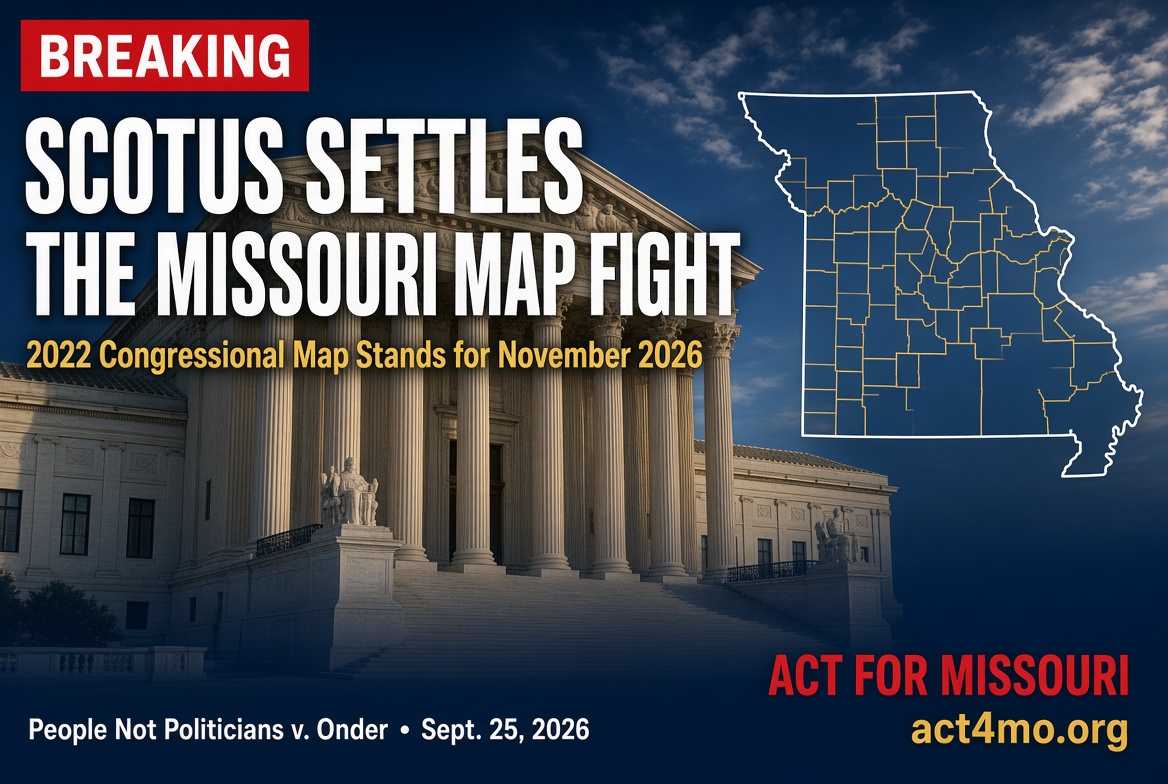
On September 25, 2026, the U.S. Supreme Court granted an emergency stay that keeps Missouri's 2022 congressional map in effect for the November 2026 election — the Court's third intervention in this fight in three weeks, and its most decisive.
The order came in People Not Politicians v. Onder, No. 26A388. It stays a September 21 ruling from the 8th U.S. Circuit Court of Appeals that would have required Missouri to use the 2025 map (HB 1) instead. Barring further action, the 2022 map — the one used in 2022 and 2024 — governs this year's congressional elections.
You can read the Court's opinion in full on the official Supreme Court docket for No. 26A388.
How We Got Here: A Three-Week Timeline
- September 3 — The Missouri Supreme Court rules unanimously that HB 1 (the 2025 map) "is not the law and has never been the law," because a valid referendum petition means it cannot take effect until approved by voters. The court orders use of the 2022 map for November and places HB 1 on the November ballot for a public vote.
- September 4 — U.S. Rep. Bob Onder, state Sen. Rick Brattin, and two voters file a federal lawsuit arguing the U.S. Constitution requires Missouri to use the 2025 map anyway.
- September 8 — Justice Kavanaugh, acting alone as Circuit Justice, denies Missouri's request to stay the state court's ruling. Hours later, a federal district court issues a temporary restraining order requiring the 2025 map instead.
- September 10 — The full Supreme Court stays that district court order, with no dissent. The 2022 map remains in place, and Missouri's election proceeds under it.
- September 21 — The 8th Circuit rules for Onder and Brattin, ordering the district court to permanently require the 2025 map — but stays its own ruling until September 28 to allow Supreme Court review.
- September 22 — People Not Politicians asks the 8th Circuit to reconsider; denied. They immediately file a third emergency application with the Supreme Court.
- September 25 — The Supreme Court grants the stay, again with no dissent, and instructs the lower courts not to require use of the 2025 map for this election.
What the Court Actually Said
The Court's opinion is worth reading carefully, because it does not resolve the underlying constitutional question. On the merits, the Court wrote only that its "precedents have not previously stated that Article I, Section 2 requires a state to use the primary election map in a general election," and that — combined with lopsided practical equities — "it suffices that the merits are not entirely clearcut." That is a stay standard, not a final ruling on the Constitution.
Where the opinion is more pointed is on timing. The Court held that switching maps in the middle of an already-underway election would "usher in electoral chaos," noting that ballots under the 2022 map have already been printed, mailed, and in some cases returned. It directly rejected the 8th Circuit's reasoning that the Missouri Supreme Court's September 3 ruling created the last-minute disruption, pointing to earlier Missouri Supreme Court opinions from as far back as May 2026 warning that HB 1 would not take effect without voter approval. The opinion states plainly that Secretary of State Denny Hoskins "was well aware that conducting the August primary election with the 2025 map carried significant risks" and "nonetheless chose to proceed" with it anyway.
"At this late date, ordering reversion to the 2025 map in the midst of an ongoing election would usher in electoral chaos."
What Happens Next
The 2022 map is locked in for November 2026. The underlying federal lawsuit is not formally dismissed by this order, but there is no realistic path or timeline for a map change before Election Day. Separately, and unaffected by this ruling, Missouri voters will still decide the fate of HB 1 itself in the November referendum — the outcome of that vote will determine whether the 2025 map could ever take effect for a future election.
The Part Where Nobody Fully Wins: Missouri's Voters
Before turning to partisan impact, it's worth sitting with a point the State of Missouri itself made to the Supreme Court: there was no outcome here that would be fair to everyone. In its own brief, the State told the Court that "regardless of what this Court does, Missouri will not be able to run an orderly 2026 General Election."
The State laid out the trade-off plainly. Requiring the 2025 map would have preserved the status quo for the roughly 1.4 million Missourians who voted in the August primary under those district lines — but it would have caused Missouri to miss a federal deadline for mailing ballots to military and overseas voters. Requiring the 2022 map instead — what actually happened — avoids that federal deadline problem, but it means many of those same 1.4 million primary voters may now find themselves voting for a different set of congressional candidates than the ones they helped nominate in August, in some cases candidates who never campaigned in their district at all.
In other words, one group of Missourians followed the constitutional referendum process to its conclusion and got the map that process was designed to produce — while another group of Missourians, who voted in good faith in August under the map that was in effect at the time, now find their primary vote effectively disconnected from their general election ballot. Both are real harms, and neither group did anything wrong. As one Wall Street Journal headline on this saga put it, this fight left "voters on both sides feeling disenfranchised."
What This Means — For Republicans and Democrats Alike
Act for Missouri is "principle over party." This ruling has real, practical consequences for both sides of the aisle, and neither side gets everything it wanted. Here's an even-handed look at both.
For Republicans
- Positive: Republicans now know, with certainty, exactly what the 5th District looks like for November. Rather than campaigning under a map that could still change, GOP candidates and strategists can now build their closing strategy around the actual 2022 lines they'll be running on.
- Negative: This makes flipping Cleaver's Kansas City-based 5th District significantly harder for this cycle — though not impossible, just very unlikely — since the district reverts to boundaries more favorable to Democrats than the 2025 map's version. The Court's opinion also does not vindicate HB 1 on the merits; it explicitly declines to say the 2025 map was constitutionally required. And the opinion singles out a Republican statewide official, Secretary of State Hoskins, by name for proceeding with the 2025 map despite known legal risk.
For Democrats
- Positive: Cleaver's 5th District reverts to its 2022/2024 lines for this election, making it almost certain — though not absolutely guaranteed — that Democrats hold the seat, given how comfortably it has performed for them under those boundaries. The ruling also lets stand the Missouri Supreme Court's interpretation of the state's referendum process, which the map's opponents relied on throughout this litigation.
- Negative: The win is narrow and specific to this election cycle — the Court did not establish a durable constitutional rule against switching maps between a primary and general election, so this result does not necessarily extend to similar disputes in other states or future Missouri election cycles. Nothing in this order prevents a future Missouri General Assembly from passing a new map ahead of a future election, provided it clears the same referendum process in time.
In short: this ruling is best understood as a decision about timing and disruption in an election already underway, not as a constitutional verdict on which map is lawful going forward. Both parties should read it that way.