
Missouri Map Fight Shifts Again: SCOTUS Denies Stay, Federal Judge Temporarily Orders HB 1
By Act for Missouri · Updated September 8, 2026 at 8:28 p.m. CDT · Developing
Missouri’s congressional-map dispute changed repeatedly on September 8. Justice Brett Kavanaugh first denied Secretary of State Denny Hoskins’s request to pause the Missouri Supreme Court judgment, without issuing a written explanation. Minutes later, Chief U.S. District Judge Stephen R. Clark issued a separate 14-day temporary restraining order requiring Hoskins to use the HB 1 districts for the November 3 congressional election. People Not Politicians and Richard von Glahn immediately appealed, asked the federal court to stay its order, and returned to the Missouri Supreme Court seeking to hold Hoskins in contempt. HB 1 is therefore the map Hoskins is federally ordered to use at this moment—but the order is temporary, has already been appealed, and conflicts with an existing state injunction that has not been vacated.
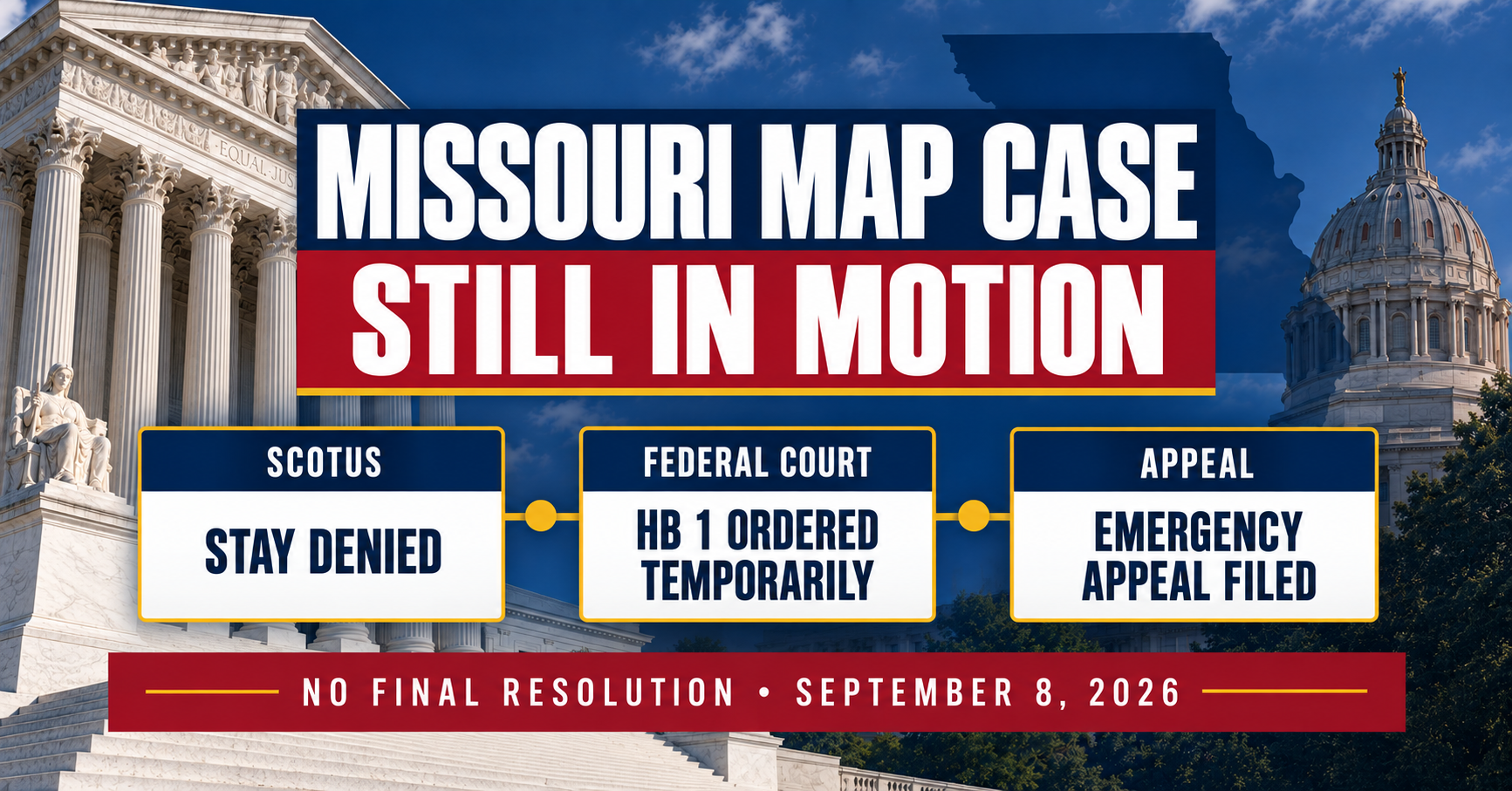
What happened on September 8
- Justice Kavanaugh denied the requested stay. The official Supreme Court docket records:
Application (26A304) denied by Justice Kavanaugh.
It supplies no written explanation and does not resolve the federal arguments on their merits. - Judge Clark then entered a temporary federal order. At 4:58 p.m. CDT, the Eastern District of Missouri granted a 14-day temporary restraining order in Onder v. State of Missouri. It bars Hoskins and covered agents from using any congressional map other than HB 1 for the November 3 election.
- Von Glahn and People Not Politicians appealed. Their filing is titled
Emergency Notice of Appeal
and seeks review in the Eighth Circuit. A notice of appeal does not itself stay the order. - Von Glahn also sought contempt relief in the Missouri Supreme Court. The state Case.net docket confirms a September 8 filing by attorney Charles Hatfield. A circulating first page identifies it as an emergency application asking the court to hold Hoskins in contempt for announcing that he would use HB 1 despite the state injunction.
These are different proceedings brought by different parties. The Supreme Court denial left the state judgment undisturbed at that moment. Judge Clark later granted affirmative relief on separate federal claims. Neither action is a final merits ruling by the U.S. Supreme Court.
Where things stand now
- The Missouri Supreme Court judgment remains on the books. It holds that the referendum petition prevented HB 1 from taking effect under state law, places Proposition A on the ballot, and enjoins use of HB 1 unless voters approve it.
- A separate federal TRO now directs Hoskins to use HB 1. The order remains effective for 14 days unless it is stayed, dissolved, extended, or replaced by another order. Judge Clark said the court would set a preliminary-injunction hearing separately.
- The federal order has been appealed, and the intervenors have asked Judge Clark to stay it. People Not Politicians and von Glahn filed an emergency motion requesting an immediate administrative stay and a full stay pending appeal. As of 8:28 p.m. CDT, the public docket showed no ruling on that motion. The TRO therefore remained operative at that time.
- A contempt application is pending in the state case. The Missouri Supreme Court docket confirms the filing but showed no order on it as of 8:28 p.m. CDT. Filing an application does not itself establish contempt or change either court’s order.
For election administration at this moment, HB 1 is the map Hoskins is federally ordered to use for November 3. The Missouri Supreme Court judgment has not been vacated, but the later federal TRO imposes a separate federal-law command on Hoskins. Judge Clark did not sit as an appellate court reviewing or reversing the Missouri Supreme Court; he granted temporary relief to different plaintiffs asserting federal constitutional injuries.
- Proposition A remains on the November ballot. Judge Clark’s order concerns which districts will be used in the congressional election; it does not remove or decide the referendum on HB 1.
- Amendment 6 remains on the November ballot. Its placement follows the separate state ruling in Harris v. Hoskins, and neither federal action decides the substance of that proposal.
The Secretary’s official ballot-measures page continues to list both Proposition A and Amendment 6. Our first article explains the separate state judgments.
The new state contempt application
The contempt filing puts the conflict between the two commands directly before the Missouri Supreme Court. Its September 3 judgment enjoins Hoskins from using HB 1 unless voters approve it. Judge Clark’s later federal TRO directs Hoskins to use no map other than HB 1 for the November election. Hoskins cannot comply literally with both instructions at the same time.
The publicly visible first page alleges that Hoskins announced an intent to violate the Missouri judgment and cites statements from state officials that HB 1 would be used. The official Case.net entry confirms that Hatfield filed supporting suggestions on September 8, although its description appears to contain a typographical error—Emergency Motion for Content
—and the filing itself was not available through a public document link when we checked. We therefore have not treated the circulating image as the complete application or attributed arguments that are not visible on that page.
The application does not mean Hoskins has been held in contempt. The Missouri Supreme Court could request a response, issue an order to show cause, deny the application, or take another step. Hoskins can point to the federal TRO as a conflicting legal obligation. Von Glahn can answer that the state injunction remains valid and that the federal court’s jurisdiction and authority are being challenged. Which argument controls is now part of the live dispute; neither court had resolved the conflict as of this update.
How Missouri officials and candidates responded
The federal order drew immediate statements from Missouri officials and candidates who support using HB 1. Their comments explain their positions; they do not add to the order’s legal effect.
- Attorney General Catherine Hanaway said Missouri was
prepared to follow and comply
with Judge Clark’s order. She repeated the State’s position that changing congressional districts between the primary and general election would benot feasible and profoundly unjust
to voters. - Governor Mike Kehoe welcomed what he called
much-needed clarity
. Pointing to the ballot-change deadline, he argued that voters and candidates should not face different rules between the primary and general election. - Secretary of State Denny Hoskins called the TRO a victory and said it mandates use of HB 1. The accompanying post described HB 1 as the
Law of the Land
; more precisely, the TRO temporarily directs its use without holding that HB 1 took effect under Missouri law. - State Senator and Republican congressional nominee Rick Brattin expressed disappointment with Kavanaugh’s denial but welcomed the district-court order. He argued that using HB 1 avoids forcing voters to cast November ballots in districts different from those used in the primary.
Two descriptions require care. Brattin said the Supreme Court was not able to grant relief
, but Kavanaugh supplied no reason for the denial, so no inability or rationale can be inferred. His statement also called Judge Clark’s action a stay
; legally, it is a 14-day temporary restraining order in a separate federal case. Kehoe’s statement that HB 1 will be used
states the administration’s expectation while the TRO is operative, but the pending appeal and further district-court proceedings could still change that result.
People Not Politicians responded through both litigation and public comment. The organization and von Glahn immediately appealed. Its attorney, Chuck Hatfield, emphasized that the Missouri Supreme Court judgment remains in effect and said an individual federal judge cannot overrule it. Judge Clark did not purport to act as an appellate court; he issued a separate federal order based on different plaintiffs’ federal claims. (Associated Press; notice of appeal.)
What Judge Clark actually decided
A temporary restraining order requires a preliminary assessment of irreparable harm, the balance of harms, likelihood of success, and the public interest. Judge Clark found the threatened election injuries imminent because Missouri had already conducted its primary under HB 1 and the state ballot-finalization deadline arrived the day he ruled.
- Article I, Section 2: The court found a high probability of success. It reasoned that Missouri makes its primary an integral part of choosing representatives and that changing district boundaries afterward would effectively nullify some voters’ primary participation.
- Equal Protection: The court also found a high probability of success. It reasoned that a map switch would divide voters and candidates into groups depending on whether their districts and electorates remained the same.
- Elections Clause: The court found that the plaintiffs were not likely to succeed. Citing Hildebrant, Arizona State Legislature, and Moore, Judge Clark concluded that Missouri may include the referendum in its lawmaking process for congressional redistricting.
- Purcell: The court called this
Purcell in reverse.
In its view, temporary relief preserves the election rules actually used by candidates, officials, and voters in the primary rather than changing them afterward.
The court required no bond and found a separate hearing unnecessary for the TRO because the parties had fully briefed the request and agreed on the material facts. Those findings support only temporary relief; they are not final holdings after trial or a final judgment.
What the federal order did not decide
Judge Clark’s order notes Justice Kavanaugh’s denial but assigns it no stated reasoning or preclusive effect. It does not hold that HB 1 validly took effect under Missouri law, undo the referendum, remove Proposition A, or decide how voters should vote.
The order also does not expressly resolve several defenses raised by von Glahn and People Not Politicians: standing, alleged collusion between the plaintiffs and aligned state defendants, Rooker–Feldman, abstention, the Anti-Injunction Act, preclusion, and whether a three-judge federal court is required under 28 U.S.C. § 2284. The pending motions to dismiss were not decided in the TRO order.
Why the three-judge-court statute matters
Section 2284 applies when an action challenges the constitutionality of congressional apportionment. If that description fits this case, a three-judge district court must be convened. The statute still allows a single judge to grant a temporary restraining order upon specific findings of irreparable harm, so it does not categorically bar Judge Clark’s 14-day TRO. But a single judge may not hear and decide a preliminary or permanent injunction or enter judgment on the merits in a case governed by the statute. It also says the single-judge TRO remains in force only until the three-judge court hears and decides the preliminary-injunction request.
The key dispute is whether Onder is the kind of action covered by § 2284. The federal plaintiffs argue that it is not: they say they do not challenge the constitutional validity of either district map, but instead challenge the federal consequences of using one set of districts for the August primary and another for the November general election, along with the referendum’s operation under the Elections Clause. People Not Politicians and von Glahn answer that the requested federal ruling necessarily determines which congressional apportionment may be used and therefore falls within the statute. Judge Clark’s TRO did not mention § 2284 or decide that disagreement. (Plaintiffs’ opposition, pp. 25–26; Intervenors’ motion to dismiss, pp. 28–30.)
The Supreme Court’s unanimous decision in Shapiro v. McManus says the three-judge requirement is mandatory when a complaint actually challenges the constitutionality of congressional apportionment, unless the constitutional claim is wholly insubstantial. Shapiro strengthens the argument that a qualifying case cannot simply proceed to the merits before one judge. It does not answer the contested threshold question here—whether the claims in Onder qualify as such a challenge.
Nor does the order separately analyze UOCAVA, the allegation that the emergency was self-created, the Secretary’s timing, or alternative ways to reconcile the primary and general elections. Those issues remain part of the broader dispute.
The central disagreement: which status quo should be preserved?
Hoskins and the Republican National Committee, National Republican Congressional Committee, and Missouri Republican State Committee emphasized the election already conducted under HB 1: voters participated in an August primary, candidates won nominations, and campaigns organized around those districts. They argued that switching districts afterward threatened the integrity of the same election process. (Hoskins reply, pp. 19–29; Republican committees’ reply, pp. 5–11.)
Richard von Glahn emphasized the map’s legal status. The state court held that the timely and sufficient referendum petition prevented HB 1 from taking effect, leaving the 2022 districts in force. In his view, using HB 1 in the primary could not make it law for November. That distinction—administrative practice versus legal authority—runs through nearly every dispute in the briefs. (Opposition, pp. 18–20, 34–40.)
Purcell, election disruption, and military ballots
Purcell refers to the caution against judicial changes to election rules close to voting, when changes can confuse voters and disrupt administration. Hoskins argued that this concern was especially strong after a primary had already occurred. The Republican committees likewise stressed the effects on nominees, voters moved between districts, and approaching ballot deadlines. (Hoskins reply, pp. 23–29; Republican reply, pp. 15–18.)
Von Glahn answered that the principle ordinarily restrains federal interference with state election rules, rather than preventing a state supreme court from enforcing its own constitution. He also argued that compliance was feasible, citing current Jackson County election administrators’ public statements that they could implement the 2022 map. Hoskins countered with the trial court’s findings and declarations describing disruption. The briefs disputed both the governing legal principle and the practical evidence. (Opposition, pp. 35–40; Hoskins reply, pp. 24–27.)
The Uniformed and Overseas Citizens Absentee Voting Act—UOCAVA—added urgency. The filings identify September 19 as the federal deadline for transmitting covered absentee ballots for this election. The Republican committees argued that curing the primary/general mismatch required another primary, making timely compliance impossible. Von Glahn disputed that premise: no court had ordered a new primary, and he maintained that the general election could proceed with the existing nominees under the 2022 map. Neither Kavanaugh’s denial nor Judge Clark’s TRO separately decides the UOCAVA question or supplies a detailed election-administration plan. Judge Clark acknowledged the approaching ballot deadline but based the TRO on the broader federal claims and the election calendar. (Republican reply, p. 11; Opposition, pp. 38–40; Federal TRO, pp. 9–13.)
Article I, Section 2 and Equal Protection
Hoskins and the Republican committees advanced two related constitutional claims. Under Article I, Section 2, they argued that a primary and general election form an integrated process for choosing members of Congress. They read precedents protecting primary voting as requiring the same congressional districting plan throughout that process. (Hoskins reply, pp. 19–23; Republican reply, pp. 6–9.)
Their Equal Protection argument focused on two groups: voters whose November district matched their primary district, and voters transferred into a district whose nominees they had no opportunity to help select. The committees argued that this difference went beyond routine redistricting or replacement of a candidate. (Republican reply, pp. 9–11.)
Von Glahn responded that all qualified voters could participate in the primary and could vote for their representative in November. He argued that the cited precedents protect access to voting and counting ballots, but do not establish an absolute right to identical district boundaries across both stages. He cited decisions allowing certain representational discontinuities; the committees replied that those cases involved materially different circumstances and did not justify unequal participation within a congressional election. (Opposition, pp. 28–34; Republican reply, pp. 7–11.)
Justice Kavanaugh announced no conclusion on either claim. Judge Clark later found a high probability of success on both theories for purposes of the 14-day TRO. That preliminary assessment supports temporary relief in the separate federal case; it does not finally settle the meaning of either constitutional provision.
The Elections Clause and the referendum precedents
The Elections Clause, Article I, Section 4, assigns states an initial role in regulating congressional elections, subject to Congress’s authority. Hoskins argued that allowing a relatively small share of voters to suspend a legislatively enacted congressional map before a statewide referendum improperly displaced that authority. The Republican committees also argued that displacing the General Assembly’s redistricting authority required a clear constitutional statement. (Hoskins reply, pp. 12–19; Republican reply, pp. 12–15.)
Von Glahn relied on three Supreme Court precedents discussed in the filings:
- Ohio ex rel. Davis v. Hildebrant (1916): upheld the use of a state referendum in congressional redistricting.
- Arizona State Legislature v. Arizona Independent Redistricting Commission (2015): recognized the state’s lawmaking process, including an initiative-created redistricting commission.
- Moore v. Harper (2023): recognized state constitutional constraints and judicial review while retaining a federal role when state courts exceed the bounds of ordinary judicial review.
Von Glahn argued that Missouri’s referendum is part of that protected lawmaking process. Hoskins sought to distinguish a completed referendum vote from suspending legislation merely upon a sufficient petition, especially after a primary. Von Glahn answered that the Ohio constitutional process in Hildebrant also withheld effectiveness pending voter approval. The dispute was therefore about the reach of existing precedent, not the absence of referendum precedent. (Opposition, pp. 23–28; Hoskins reply, pp. 15–19.)
Judge Clark did not find the federal plaintiffs likely to succeed on the Elections Clause theory. At the TRO stage, he read Hildebrant, Arizona State Legislature, and Moore as allowing Missouri to include the referendum and state constitutional review in its redistricting process. His temporary order instead rests on Article I, Section 2 and Equal Protection concerns arising from a map change after the primary. (Federal TRO, pp. 8–11.)
Different threshold questions in the two proceedings
The cases reach federal court by different routes. The preservation dispute concerns whether the U.S. Supreme Court may review federal questions in the Missouri judgment. The separate district-court case presents its own defenses, including standing, jurisdiction, preclusion, the Anti-Injunction Act, abstention, and court composition. Judge Clark’s TRO did not expressly decide those pending defenses.
Were the federal claims properly preserved?
Von Glahn argued that an adequate and independent state ground barred federal review: the Missouri Supreme Court expressly treated federal theories not stated in the Secretary’s certificate as waived and abandoned. Ordinarily, a sufficient state-law basis that independently supports a judgment prevents the U.S. Supreme Court from changing that judgment by deciding a federal question. (Opposition, pp. 14–17.)
Hoskins answered that the state court imposed an unforeseeable rule against incorporating the Attorney General’s opinion into the certificate. He said the federal arguments had been raised throughout the litigation and that the court created a contradiction by requiring preservation in a certificate while treating federal questions as outside the Secretary’s review. The Republican committees separately emphasized that their claims attacked the federal legality of the injunction itself. Von Glahn defended the certificate rule as a straightforward application of the statute requiring a stated reason. (Hoskins reply, pp. 6–10; Republican reply, pp. 2–4; Opposition, pp. 14–17.)
Could a stay itself revive HB 1?
Von Glahn said no: suspending an injunction would not transform a bill that never took effect into operative law. He argued that the applicants effectively needed affirmative injunctive relief, with a different and demanding standard. Hoskins answered that his federal challenge targeted the constitutional provision’s application itself; if the injunction were stayed on that basis, he would use HB 1. The committees likewise maintained that a stay would restore the pre-judgment position. Kavanaugh’s denial gives no answer to that contested remedial question. Judge Clark later used a different remedy in a different case: an affirmative federal TRO directing use of HB 1 temporarily, without holding that HB 1 took effect under Missouri law. (Opposition, pp. 18–20; Hoskins reply, pp. 10–11; Republican reply, pp. 4–6; Federal TRO, pp. 12–13.)
What the supporting amici added
Amici are outside participants who submit briefs to assist the Court; they do not decide the case.
- Florida, Texas, and 18 other states supported Hoskins. Their brief emphasized election stability, the completed primary, approaching federal ballot deadlines, and equitable reasons for a stay. It should not be treated as a separate judicial determination of those claims. (States’ brief, pp. 1–6.)
- The American Center for Law and Justice supported Hoskins. It argued that the concern behind Purcell also applies to state-court disruption, and that changing districts after nominations implicated voters’ rights and the Elections Clause. (ACLJ brief, pp. 1–3.)
- Campaign Legal Center and the ACLU organizations opposed a stay. They defended the referendum as part of Missouri’s lawmaking process and invoked the federal requirement in 2 U.S.C. § 2c for districts established by law. They also disputed the asserted emergency and stressed the Secretary’s timing. (CLC/ACLU brief, pp. 3–5.)
- Missouri voters Jake Maggard and Gregg Lombardi opposed a stay. They emphasized meaningful referendum rights and argued that prior litigation had warned officials that HB 1’s legal status depended on the certification process. Their account treated delay as a reason to deny equitable relief, not to preserve HB 1’s use. (Voters’ brief, pp. 1–3.)
Was the emergency self-created?
Von Glahn and opposing amici argued that officials could not wait until primary day to reject the petition and then use the completed primary to defeat its constitutional consequences. They pointed to earlier litigation warning that the map’s status depended on final sufficiency review, and to public statements about delay benefiting HB 1. (Opposition, pp. 35–37.)
Hoskins disputed that characterization. He said signature verification took time and that he acted within the statutory August 4 deadline. He further argued that even accepting criticism of his timing would not justify imposing harm on voters, campaigns, and local administrators. That response matters to a fair account: the dispute concerned both responsibility for the compressed schedule and who would bear the consequences. (Hoskins reply, pp. 28–29.)
The denial does not establish that Justice Kavanaugh accepted the allegation of a manufactured emergency; the docket leaves his reasons unstated. Judge Clark’s TRO also does not separately resolve the self-created-emergency allegation or the dispute over the Secretary’s timing. It focuses on the consequences of changing maps after the primary and the need for immediate interim relief.
What happens next
The most immediate contest has shifted to the federal case. The district court said it would set a preliminary-injunction hearing separately. People Not Politicians and von Glahn have appealed and have asked Judge Clark for an immediate administrative stay followed by a full stay pending appeal. Unless another order intervenes, the TRO remains temporary and is scheduled to last 14 days from its issuance.
Whether the Eighth Circuit may immediately review this particular TRO could itself be contested. Temporary restraining orders ordinarily are not immediately appealable, but the Eighth Circuit looks to an order’s practical effect rather than its label alone. The election deadline, the fully briefed record, and the effect of the order may be part of that analysis; the order’s fixed 14-day duration and planned preliminary-injunction proceeding point the other way. No appellate court had resolved that question as of this update. (La Belle Dairy, pp. 3–5.)
The emergency stay motion makes § 2284 its first argument. It acknowledges that one judge may issue a TRO, but argues that the court should have convened a three-judge panel and that any preliminary-injunction decision belongs to that panel. It also raises Rooker–Feldman, abstention, the Anti-Injunction Act, conflicting state and federal commands, and election-administration harms. These are arguments for a stay; Judge Clark had not ruled on them as of this update. (Emergency motion to stay.)
If § 2284 governs, the preliminary-injunction and merits stages should proceed before three judges rather than Judge Clark alone. A three-judge court could also review the single judge’s action before final judgment. If the court determines that the lawsuit does not challenge the constitutionality of congressional apportionment within the statute’s meaning, the ordinary single-judge process could continue. That threshold issue may therefore affect both who decides the next request and the route of later review.
The state-court track also remains open in a more limited sense. Kavanaugh’s denial does not necessarily prevent a later petition asking the full Supreme Court to review the Missouri judgment. Filing such a petition would not automatically stay either the state judgment or the federal TRO.
The accurate present-tense conclusion is that HB 1 is temporarily required by the federal order while an emergency appellate fight is underway. It is too early to say with confidence which map will ultimately remain in place through Election Day.
Keeping policy positions separate from court rulings
In its first article, Act for Missouri stated that it was not opposed in theory to a 7–1 congressional map, opposed Amendment 6, and supported following constitutional procedures even when the result was politically inconvenient. Those remain the organization’s positions; they are not holdings of any court.
The present dispute exposes two serious process concerns. The Missouri Supreme Court held that the referendum process prevented HB 1 from taking effect under state law. Judge Clark has now found, on a preliminary record, that changing districts after Missouri conducted its primary under HB 1 likely burdens federal voting rights. Readers can recognize both concerns without treating either emergency ruling as the final word or turning the discussion into an attack on the courts.
Sources & Documents
The summaries above distinguish arguments in briefs from court decisions. Page references are to the documents’ printed page numbers.
- Official Supreme Court docket, No. 26A304 — denial and complete filing list.
- Federal docket, Onder v. State of Missouri, No. 4:26-cv-01424-SRC.
- Memorandum and Order granting a 14-day temporary restraining order, Doc. 35, September 8.
- Emergency Notice of Appeal by People Not Politicians and Richard von Glahn, Doc. 36, September 8.
- Emergency motion for an administrative stay and stay pending appeal, Doc. 38, September 8.
- Missouri Case.net docket for von Glahn v. Hoskins, SC101805 — September 8 contempt-related filing; no public PDF link was displayed as of this update.
- Intervenors’ motion to dismiss the federal action, Doc. 33.
- Federal plaintiffs’ corrected opposition to dismissal, Doc. 25.
- Intervenors’ supplemental federal-court brief, Doc. 29.
- Federal plaintiffs’ supplemental brief, Doc. 30.
- La Belle Dairy LLC v. Sharpe Holdings, Inc., No. 25-1803 (8th Cir. July 23, 2026) — appealability of TROs.
- 28 U.S.C. § 2284 — three-judge courts in apportionment cases and the authority of a single judge to issue a TRO.
- Shapiro v. McManus, 577 U.S. 39 (2015) — mandatory use of a three-judge court for a qualifying congressional-apportionment challenge.
- Attorney General Catherine Hanaway’s public statement, September 8.
- Governor Mike Kehoe’s public statement, September 8.
- Secretary of State Denny Hoskins’s public statement, September 8.
- Rick Brattin’s public statement, September 8.
- Associated Press report quoting the parties’ responses, September 8.
- Hoskins emergency application, September 4.
- Republican committees’ supporting brief, September 4.
- Von Glahn opposition, filed September 7.
- Hoskins reply, September 8.
- Republican committees’ reply, September 8.
- Florida, Texas, and 18 other states’ amicus brief.
- American Center for Law and Justice amicus brief.
- Campaign Legal Center and ACLU organizations’ amicus brief.
- Jake Maggard and Gregg Lombardi’s amicus brief.
- Missouri Secretary of State: official 2026 ballot measures.
- Our first article and its links to the September 3 state opinions.