
They Had a One-Sentence Fix. The System Chose Speed Instead.
Listen to this article
Audio Version
Prefer to listen? Use the player below for the narrated version of this article.
Rep. Mike Davis tried to solve the biggest grassroots concern around SB 888 with one clarifying sentence: vaccination status alone should not be enough to prove first-degree child endangerment under §568.045. Rep. Keith Elliott then made sure members had to go on record by demanding a roll call. The amendment failed on an 8-8 tie. Then, on the House floor, supporters repeated the same reassurance that parents have been hearing for days: trust prosecutors, trust the Attorney General, trust that the law will never be used the wrong way. That is not how liberty is supposed to be protected.
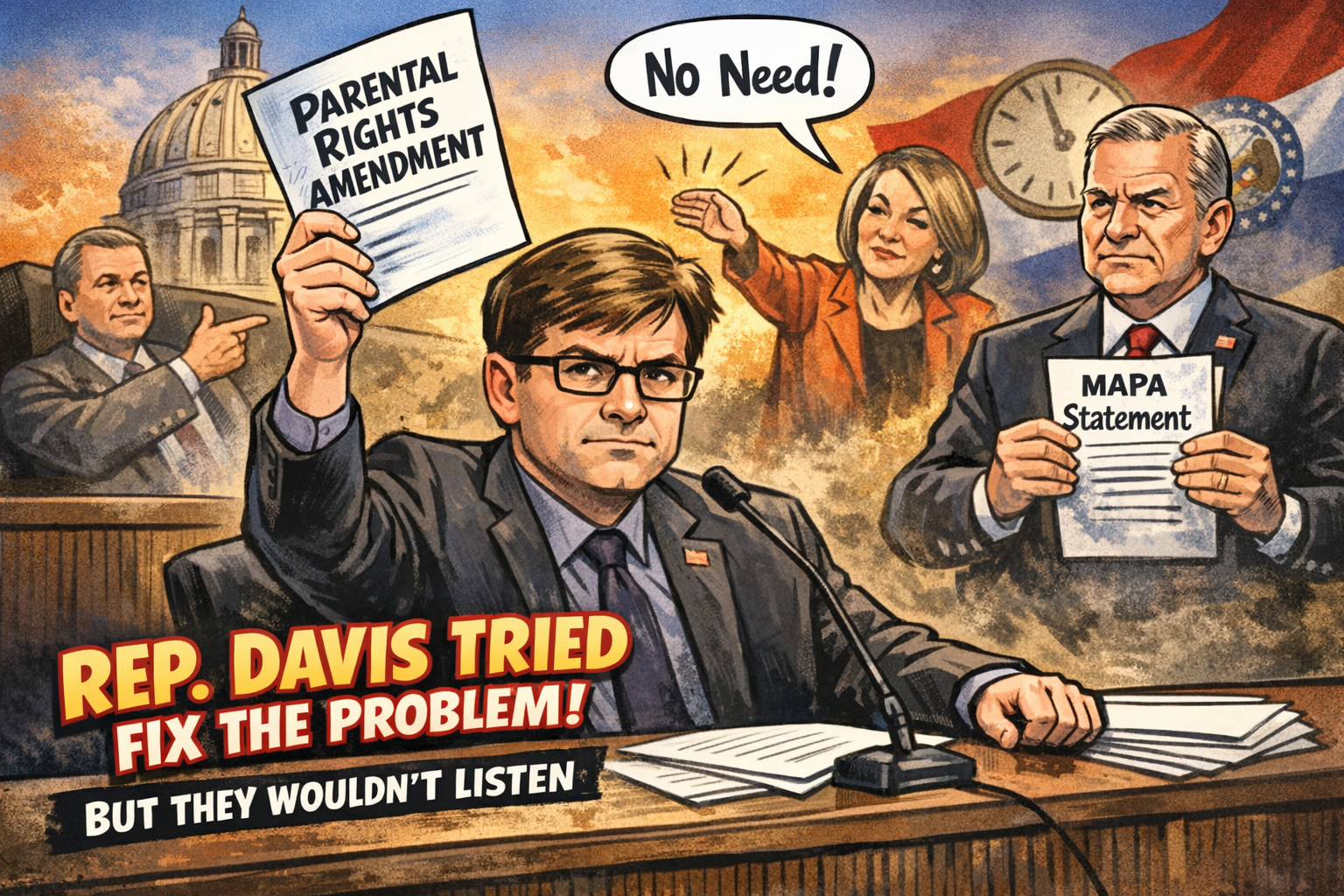
Davis proposed language making clear that vaccination status alone cannot prove first-degree child endangerment.
Elliott requested a recorded roll call. The amendment failed on an 8-8 tie.
Leaders would rather keep the bill moving than accept a simple safeguard that would calm the only serious grassroots objection.
Mike Davis tried to fix the problem instead of explaining it away
Rep. Mike Davis deserves real credit here. He did not mock the concern. He did not pretend it was crazy. He did not hide behind talking points. He offered a direct amendment to address it.
That matters even more because Davis is not speaking as a casual observer. He holds a Juris Doctor from Washburn University School of Law, and in committee he explained the concern plainly: by reclassifying child endangerment in this bill, the change could create a stricter enforcement posture where religious and medical exemption arguments become harder to raise as mitigating circumstances. Whether every attorney agrees with that analysis is not the point. The point is that an attorney in the legislature saw a real enough risk to offer a clarifying amendment — and that should have carried weight.
“This amendment simply clarifies the law stating that vaccination status alone shall not be sufficient to prove a person has committed the offense of endangering the welfare of a child in the first degree.”
Davis also explained why families are uneasy: SB 888 does not just leave §568.045 sitting where it was. It pulls that section into a larger package that changes how serious criminal offenses are treated, and it broadens the child-endangerment section from children under 17 to children under 18. Grassroots groups have been asking a straightforward question: if lawmakers truly believe this language will never be used against parents for medical decisions, why not say so in the statute and end the controversy?
Keith Elliott forced a recorded vote
Rep. Keith Elliott also deserves praise. When the committee started drifting toward “let’s just move on,” Elliott did the right thing and requested a roll call. That forced accountability. Members could no longer hide inside a voice vote or vague committee chatter. They had to choose.
Roll Call on Davis Amendment — 8 Yes, 8 No
Based on the committee roll-call transcript supplied to Act for Missouri.
Voted Yes
- Kimberly-Ann Collins
- Gregg Bush
- Michael Davis
- Melissa Douglas
- Keith Elliott
- Yolonda Fountain Henderson
- Jim Kalberloh
- Marlene Terry
Voted No
- Don Mayhew
- Bennie Cook
- Chris Brown
- David Dolan
- Bill Falkner
- Barry Hovis
- Bill Lucas
- Rudy Veit
That split tells a story. Davis and Elliott were not alone. Several members understood that the grassroots concern was serious enough to deserve a statutory safeguard. But eight members chose not to add even that narrow clarification.
The excuse that gives the game away
The clearest moment in committee came when Rep. Barry Hovis essentially made the process argument out loud. His position was that the amendment was unnecessary because the language is already in statute, there is no history of prosecution for lack of immunization, and adding the amendment would require the bill to go back to the Senate.
That last point is exactly why this episode matters. If a one-sentence amendment really would force the bill back to the Senate, then rejecting it tells us something important: speed and convenience were being treated as more important than precision and protection.
No one has shown that the Davis amendment would have broken the larger purpose of the bill. No one has shown that it would have harmed legitimate prosecutions of abuse, trafficking, or child exploitation. The real objection was procedural. The fix would slow the bill down. And apparently that was enough reason to kill it.
Then the same argument showed up on the House floor
After the amendment failed in committee, the concern did not disappear. On the House floor, Rep. Holly Jones raised the issue again in a public exchange with House bill handler Rep. Brad Christ. That exchange matters because it shows the concern had not been put to rest — and because the response did not actually answer the real question.
Christ said he had worked on vaccination-freedom legislation himself and would never carry a bill that would hold him accountable for not vaccinating his own children. He then relied on the same sources supporters have been citing for days: the MAPA letter and Attorney General research. He argued the bill was merely copying existing statute, that parents have never been prosecuted solely for refusing vaccination, and that the only case involving vaccination records, State v. Ashcroft, did not turn on immunization status as the basis for guilt.
But notice what that argument actually does. It does not say vaccination records could never be used as part of a broader evidentiary picture. It does not say an ambitious future prosecutor could never try to use the statute more aggressively. It does not say the law contains a clear parental safeguard. It simply says that, up to now, the statute has not been used solely for that purpose and that supporters do not expect it to be used that way in the future.
That is not a safeguard. That is a prediction.
And for citizens who worry about government overreach, that prediction is not enough.
Why the word “solely” does not settle the issue
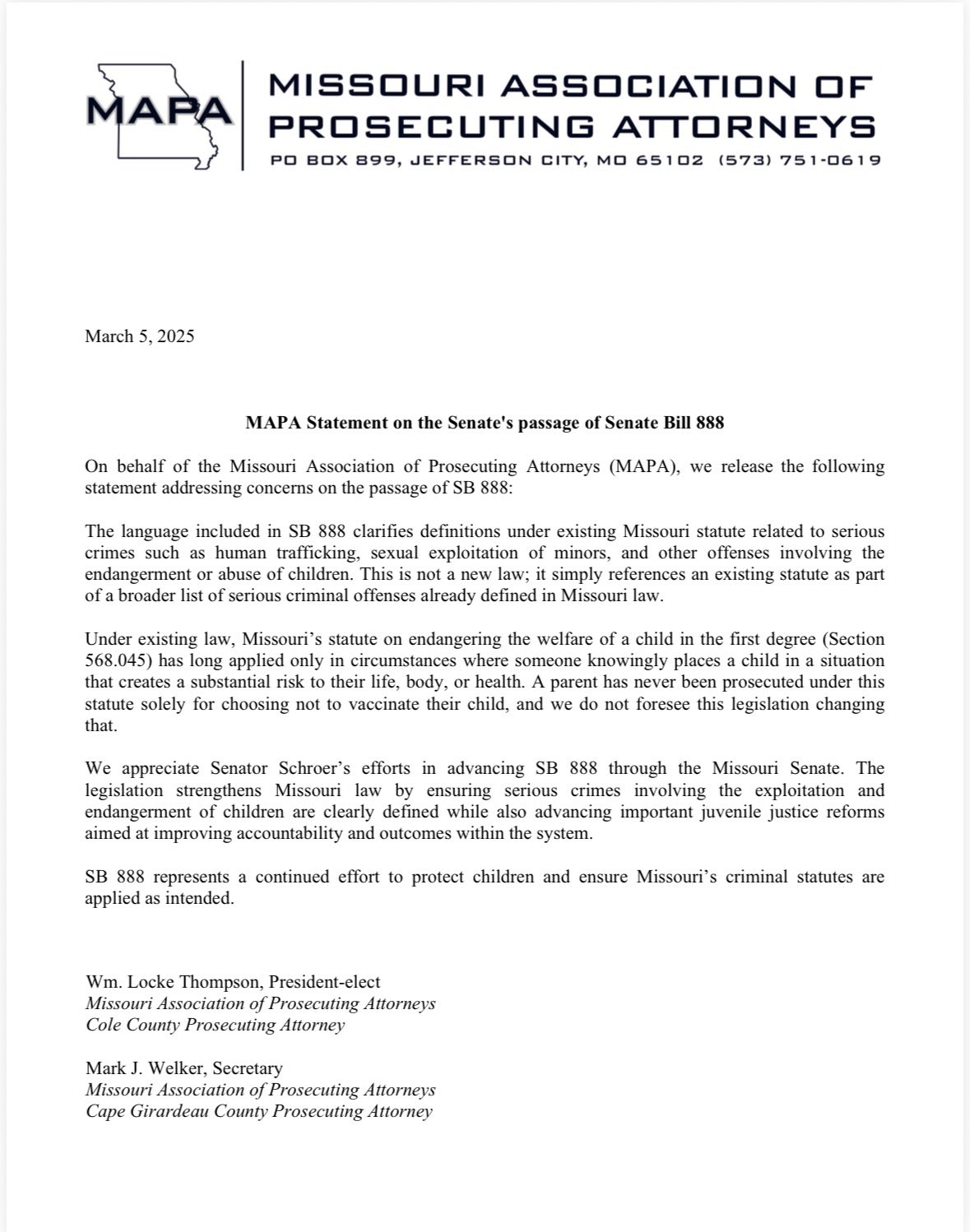
The MAPA letter has been treated as if it ends the debate. It does not. In fact, the word “solely” is part of the problem.
If the defense is that a parent has never been prosecuted solely for choosing not to vaccinate a child, that still leaves open the possibility that vaccination status could be introduced alongside other allegations. The floor exchange made that even clearer when supporters discussed a case where vaccination records appeared as part of the broader medical file even though they were not the main reason for the charge.
That is exactly why the grassroots concern has never really been about whether the statute says the word “vaccine.” The concern is about vague standards, future overreach, and the absence of a direct statutory firewall. A family should not have to trust that every future prosecutor, judge, agency lawyer, and caseworker will read the law the narrow way. Lawmakers had the chance to draw that line clearly. They refused.
This is about more than one amendment
This episode is another window into how the General Assembly too often operates. A real concern is raised. A simple fix is offered. Instead of resolving the issue cleanly, leadership-minded members look for reasons to keep the vehicle moving. The system rewards momentum, not careful correction.
The official timeline makes that pressure easy to see. The Senate passed SB 888 on March 5. The House moved it to Corrections and Public Institutions and set a hearing for March 10. By the next day, the House Journal showed it had already been sent on to Fiscal Review. That is exactly why members who wanted a clean clarification were running into a process machine that wanted the bill kept on schedule.
That is especially frustrating here because the issue had been on the table long before the House committee vote. Sen. Schroer could have added a clean clarification before sending the bill across the rotunda. The Senate still spent hours negotiating and amending the bill before passage. The House still had the power to make the bill cleaner and safer. But once the priority became “get it to the Governor,” the pressure shifted from fixing the concern to talking people into ignoring it.
That is backwards. Lawmakers are supposed to get the bill right before they ask citizens to trust it.
Watch both clips for yourself
The committee clip shows Davis offering the amendment, Hovis objecting in part because it would send the bill back to the Senate, Elliott demanding a roll call, and the amendment failing 8-8.
The House floor clip shows that the concern was still alive even after the committee vote. Rep. Holly Jones raises it directly, and Rep. Brad Christ responds with the MAPA letter, Attorney General research, and the Ashcroft case discussion.
The bottom line
Rep. Mike Davis tried to solve the problem. Rep. Keith Elliott made sure the committee had to own its choice. Both men deserve praise for that.
What happened next is the real indictment. Instead of adding one sentence that would have reassured parents and narrowed the chance of future misuse, the system chose speed, convenience, and talking points. That may be good enough for people who trust the government to use broad laws wisely. It is not good enough for citizens who believe laws should be written with clear limits before power is exercised.
If lawmakers truly believe §568.045 will never be used against parents in the way grassroots Missourians fear, then they should have had no problem saying so in black and white.