
School Finance • Tax Policy • HJR 173
What Is Missouri Proposition C — and How Might HJR 173 Affect It?
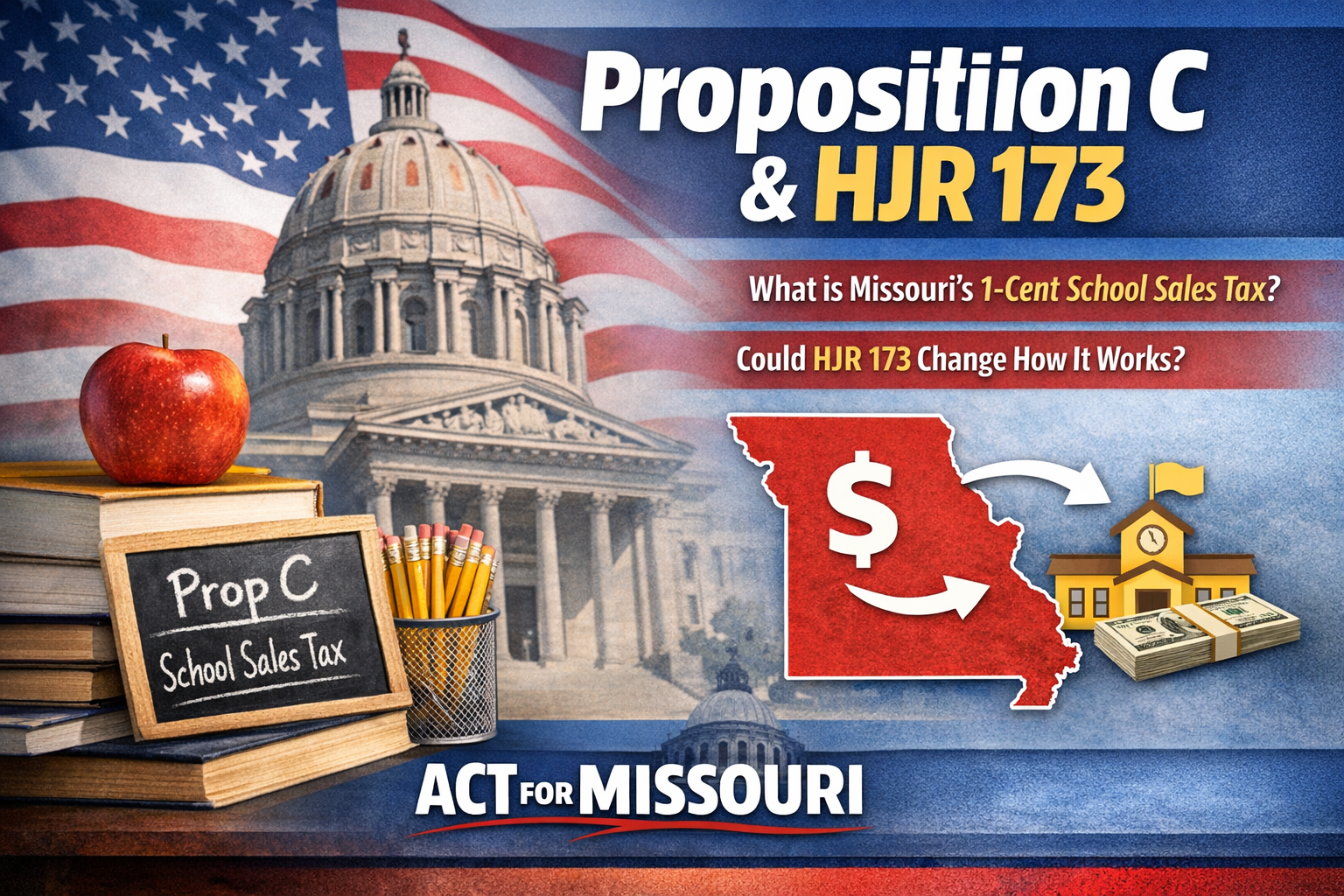
Proposition C is Missouri’s statewide 1-cent school sales tax. It has been part of Missouri school finance for decades, but many citizens have no idea what it is, how it works, or how a proposal like HJR 173 could interact with it.
This guide is written for two audiences at once: citizens who want a plain-English explanation, and policy watchers who want enough detail to follow the real legislative and fiscal questions.
Listen to this article
Audio version
Prefer to listen instead of read? Use the player below for the narrated version.
Bottom line
HJR 173 does not appear to directly cut Proposition C on day one.
But
It could change the constitutional environment for later tax-base expansion.
Why that matters
Voters would be approving the framework before seeing the real implementation bill.
What is Proposition C?
Proposition C is Missouri’s statewide 1-cent sales and use tax for schools. In simple terms, every time the state collects that penny on taxable transactions, the money goes into a special fund used for public-school finance.
That fund is called the School District Trust Fund. The money is then distributed to school districts under Missouri’s school-funding laws. Proposition C is not a local school levy passed county by county. It is a statewide tax stream that feeds school funding across Missouri.
Sidebar: Plain-English definition
What does “statewide 1-cent school sales tax” mean?
It means Missouri applies an extra 1% sales and use tax under state law, and that penny is earmarked for school finance through the School District Trust Fund.
If a taxable purchase is $100, then $1.00 of state tax under Proposition C goes to that school-funding stream. That does not mean your local district keeps the exact dollar from your receipt. The money is pooled and then distributed under Missouri’s school-funding formula.
How did Proposition C come about?
Proposition C was adopted by Missouri voters in 1982 through an initiative petition. That matters because it was not created as a temporary add-on. It became part of the school-finance structure that Missouri has lived with for decades.
Since then, Proposition C has become a familiar but often poorly understood part of school funding. Many people hear the name, but very few can explain where the money goes, how districts receive it, or how it interacts with the broader formula.
How does Proposition C actually work?
At the highest level, it works in three steps.
- The state collects the tax. Proposition C is part of Missouri’s state sales and use tax system.
- The money goes into the School District Trust Fund. That fund exists specifically to hold and distribute the revenue.
- The state distributes the money to school districts. The distribution is made under school-finance rules tied largely to weighted student attendance.
One of the more confusing parts is that Proposition C is a statewide tax, but for funding-formula purposes Missouri treats it partly like local revenue. That sounds strange, but it is how the school-funding statutes are written.
Sidebar: Example
How the money flows
Imagine the statewide Proposition C pot for a given period is $500 million.
Now imagine one district accounts for roughly 2% of the statewide weighted attendance used in the formula. All else equal, that district would receive roughly 2% of the distributed Proposition C money, or about $10 million.
That example is only to show the mechanics. The exact formula for any real district can involve additional factors. But it helps explain the main point: Proposition C money is pooled statewide and redistributed by formula.
What does it mean to “expand the base” of a tax?
This is one of the most important ideas in the HJR 173 debate, and it is also one of the least understood.
The “base” of a tax means the things the tax applies to. A tax rate tells you how much is charged. The tax base tells you what gets taxed in the first place.
Sidebar: Easy example
Rate vs. base
Scenario A: The state taxes only a limited list of goods at 4.225%.
Scenario B: The state keeps the same rate, but now taxes many more transactions — including services that were not taxed before.
In Scenario B, the rate did not go up, but taxpayers can still pay much more because the base got broader.
That is why people can be misled if they focus only on tax rates. A lower income-tax rate does not automatically mean a lower total burden if lawmakers are also broadening the tax base somewhere else.
In the context of HJR 173, this matters because the proposal is not mainly about changing one rate today. It is about changing the Constitution so future lawmakers can choose a broader tax base later.
So what does HJR 173 do?
HJR 173 is presented as a path toward eliminating Missouri’s personal income tax. But the current version does not automatically eliminate that tax on passage, and it does not itself impose a new tax on services.
What it does do is create constitutional authority for future legislation to expand state and local sales and use taxes, or similar transaction-based taxes, to transactions involving goods and services that are not taxed today.
That is why the proposal is controversial. Supporters talk about income-tax relief. Critics point out that the actual mechanism also opens the door to taxing more transactions later.
Sidebar: What HJR 173 does not do
No automatic service tax on day one
This is important to say clearly and fairly: HJR 173 does not itself impose a tax on haircuts, lawn care, legal work, funerals, tax preparation, or any other specific service.
Instead, it changes the Constitution so future legislation could expand taxes to those kinds of transactions later. That means the public would be voting on the framework before seeing the finished implementation bill.
How might HJR 173 interact with Proposition C?
The safest way to put it is this:
HJR 173 does not appear to directly cut Proposition C in its current text, but it could affect Proposition C indirectly depending on what future enabling legislation does.
There are two main reasons for that conclusion.
1. Proposition C does not seem to be one of the constitutional tax rates automatically adjusted under Section 26.4
The HJR includes a mechanism dealing with certain sales and use taxes imposed directly by the Constitution. Proposition C, however, is generally treated as a statutory school-funding stream rather than a tax imposed directly by the Constitution itself. That means the clearest reading is that Proposition C is not automatically ratcheted down by that particular provision.
2. But HJR 173 could still affect the tax base underneath Proposition C later
Because Proposition C is part of Missouri’s state sales and use tax structure, a future implementing bill that broadens the state sales-tax base could potentially let the Proposition C penny apply to more transactions than it does now.
That would not happen automatically just because the amendment passed. It would depend on how later lawmakers write the enabling bill. But that is exactly the problem critics keep raising: voters are being asked to approve a framework before seeing the real details.
Sidebar: Why this matters to normal citizens
Same rate, bigger tax burden
Suppose a family pays sales tax today on taxable goods, but not on many of the services they use.
If lawmakers later broaden the base so more services are taxed, the family could pay more in total taxes even if the formal sales-tax rate stayed the same.
That is why “broadening the base” is not a technical detail. For ordinary people, it can mean paying tax in more places, more often, on more parts of daily life.
Could HJR 173 increase school-related sales-tax revenue?
Potentially yes, but only if later legislation is written that way.
If the state broadens the taxable base and Proposition C rides on that broader base, then more revenue could flow through the School District Trust Fund. But that is a future legislative choice, not an automatic result spelled out in the amendment itself.
That uncertainty cuts both ways. Supporters can say school funding might be protected or even helped. Critics can say voters are still being asked to approve the constitutional authority before they can inspect the actual implementation bill.
What is the real issue for voters?
The biggest issue is not that Proposition C is clearly being slashed on day one. The biggest issue is that Missouri voters are being asked to approve a constitutional restructuring first and find out the real tax mechanics later.
That is a problem whether you support HJR 173 or oppose it. A voter should be able to answer basic questions before amending the Constitution:
- What goods or services might be taxed later?
- Would existing state taxes, including school-related taxes, ride on the broader base?
- Would local sales taxes ride on the broader base too?
- How much revenue would really be replaced by cuts, growth, or broader taxation?
Right now, the public does not have those answers in a final implementation bill. That is why this debate is bigger than one slogan about eliminating the income tax.
Bottom line
Proposition C is not some obscure footnote in Missouri finance. It is a major school-funding stream with a long history, a dedicated purpose, and real consequences for districts across the state.
HJR 173 does not appear to directly dismantle Proposition C in its current text. But it could change the constitutional rules that shape the tax base underneath it later, depending on how future lawmakers write the enabling legislation.
For the average citizen, the takeaway is simple: this is not just a debate about one tax going away. It is a debate about what gets taxed, who pays, and whether voters are being asked to approve a framework before they can see the finished plan.
Act for Missouri takeaway
If the people are going to decide, they deserve the whole truth up front.
Missourians should not have to guess how a constitutional amendment might interact with existing school taxes, local taxes, and future service taxes. The honest course is to show citizens the real implementation plan — not just the framework — before asking them to vote.