
The Men Who Built Missouri
Founding Era · 1820
In the summer of 1820, Missouri stood at the edge of statehood. The territory had the land, the settlers, and the ambition. What it needed was a government — and three men in particular determined what kind of government that would be.
They did not agree on everything. But on the essentials — that government must be limited, that power must be accountable, that the common settler deserved as much protection from concentrated financial power as from any foreign enemy — they were unified. They planted those convictions into Missouri's soil in 1820, and Missourians have been living on that inheritance ever since.
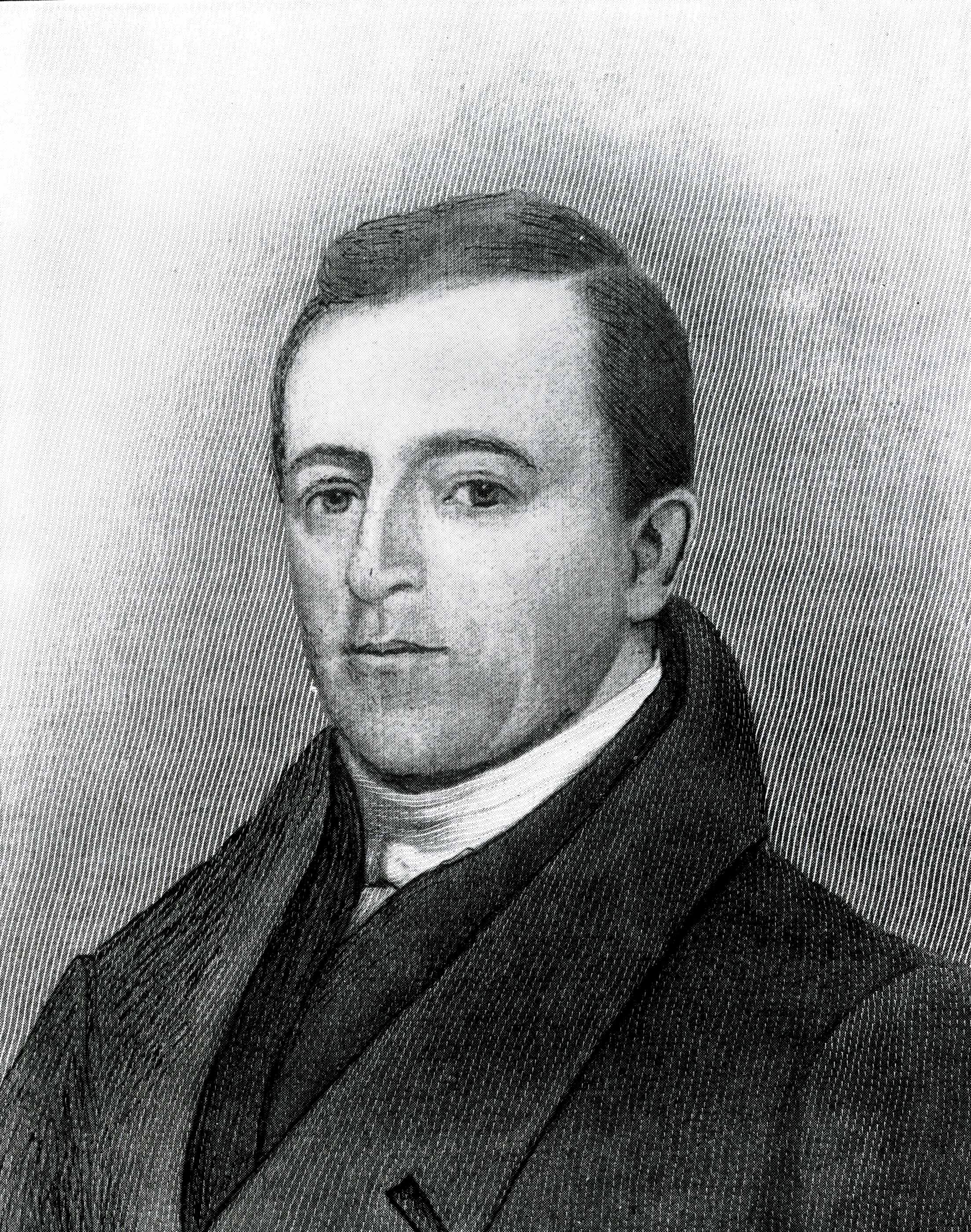
Signed
David Barton (1783–1837)
Architect of Missouri's Constitution · Missouri's First U.S. Senator
Barton's story begins with a simple fact: Missouri's founding constitution was shaped so profoundly by one man that historians called it "the Barton Constitution." A frontier Baptist minister's son who studied law in Tennessee and made his way to the Missouri Territory in 1809, Barton rose quickly — attorney general, territorial legislator, circuit judge. By 1820, when Missouri's 41 delegates gathered in a St. Louis hotel to write a state constitution in 38 days, David Barton presided over it all.
His most consequential early act — before the convention even met — was instrumental in getting the territorial legislature to establish English Common Law as the basis of Missouri law. This was not a technical detail. English Common Law, as every founding-era lawyer knew from Blackstone's Commentaries, was rooted in the principle that all human law must conform to God's natural law. No government edict could legitimately violate what God had written in the nature of things. Barton planted that foundation before Missouri was even a state.
The constitution he helped write was described by contemporaries as "a model of moderation and political sagacity." It lasted 45 years — longer than any other Missouri constitution — and enshrined the principle that became Missouri's governing creed: that government exists to secure the rights of the people, and that when it fails to do so, it has failed its chief design.
Barton grounded Missouri's legal system in natural law — the idea that human law must conform to principles higher than any legislature or governor. That foundation is still written into Missouri's constitution: Article I, Section 2 defines government's purpose as securing the people's rights. When government steps outside that purpose, Barton's constitution says it has failed. Period.
Barton's insistence on English Common Law as Missouri's legal foundation created a direct lineage from Blackstone through Missouri's courts. William Blackstone — the legal textbook that every founding-era lawyer, including Jefferson, Adams, and Hamilton, studied — grounded all law in God's natural law: "The law of nature... is of course superior in obligation to any other. No human laws are of any validity if contrary to this."
When Barton put Common Law at the base of Missouri's legal system, he was saying: the courts of this state will be grounded in something higher than politics. Human law must conform to God's law — not the reverse. That principle is why Missouri's constitution opens every version — 1820, 1865, 1875, 1945 — with acknowledgment of the "Supreme Ruler of the Universe." It is not ceremony. It is the legal foundation.
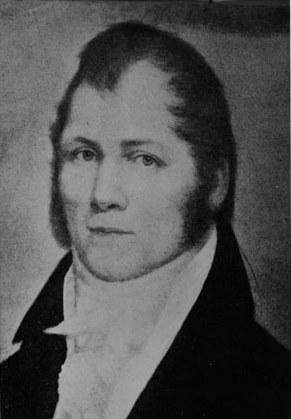
Victory 1820
Alexander McNair (1775–1826)
Missouri's First Governor · Son of a Revolutionary War Martyr
Alexander McNair's father fought with George Washington at Trenton and Princeton in the winter of 1776–77, and died of his wounds before his son was two years old. The son never forgot the price of what had been purchased. When he ran for Missouri's first governor in 1820, he ran not on promises of what government would do for the people — but on a demand that government answer to the people.
His opponent was William Clark — the famous explorer, the celebrated hero, the choice of Missouri's political establishment. McNair beat him 72% to 28%. The margin tells the story: ordinary settlers across Missouri's out-state counties backed the man who criticized the constitutional convention for holding secret proceedings, who opposed high salaries for public officials (including himself), and who championed the small squatter's land claim over the wealthy speculator's portfolio.
On September 19, 1820, McNair delivered his inaugural address in St. Louis. It was 443 words. He talked of "the happy change which has taken place in our political affairs" — the transition from territory to statehood — and charged the first General Assembly to "act with a degree of prudence and deliberation, comporting with the importance of the duties to be performed."
443 words. Missouri's first governor said everything that needed to be said about launching a state government in less than a page and a half. No sweeping programs. No promises of government-provided abundance. Prudence and deliberation. The brevity itself was the message.
In Missouri's very first year as a state, a recession hit. The Panic of 1819 had devastated the frontier economy. Debtors were underwater. Property foreclosures were spreading. The new governor faced enormous pressure to use government to "do something." His response was to acknowledge the suffering — and then hold the constitutional line. He offered no specific programs. He told the legislature they could act only if it could be done without violating founding principles. The legislature acted on its own initiative; McNair held the executive line. That restraint was not weakness. It was precisely the governing philosophy Missouri's founders had built into the constitution.
McNair was not a one-term aberration. He was the first of five consecutive governors considered Jeffersonian Republicans who believed in limited government. For nearly 25 years — from Missouri's founding in 1820 through the late 1840s — the state's chief executive office was held by men who shared his conviction: government's job is to secure rights, not to provide material abundance.
His successor Frederick Bates, inaugurated in 1824, sounded the same note, warning against political manipulation of the judiciary: "The officers of that department should be placed, if possible, beyond the reach of those temporary excitements, so often discoverable in other classes of our fellow-citizens. An able and upright administration of the laws is among the first and greatest of political blessings."
McNair set the culture. The next four governors carried it forward. This was not a political accident — it was a governing consensus that lasted a generation.
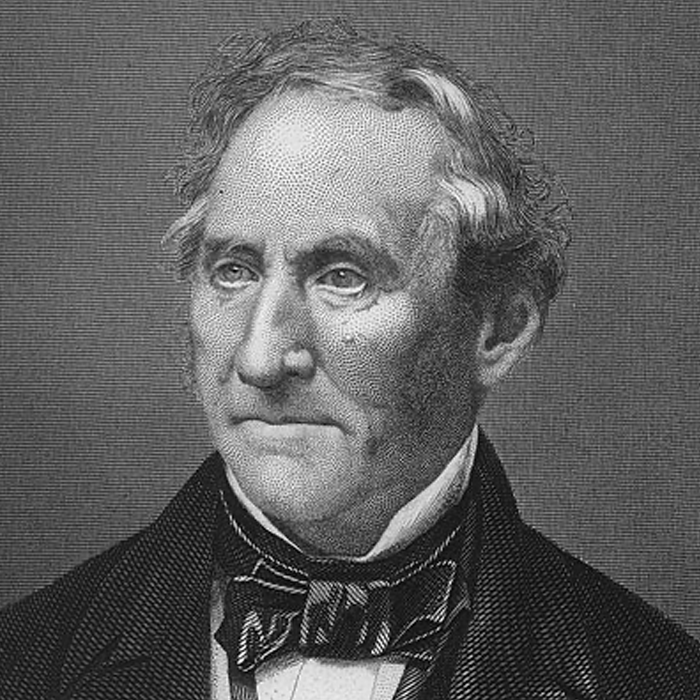
U.S. Senate
Thomas Hart Benton (1782–1858)
"Old Bullion" · Missouri's Voice in Washington for Three Decades
While Barton built Missouri's constitutional framework and McNair set its governing standard, Thomas Hart Benton stood watch in Washington. For 30 years — longer than any U.S. Senator before him — he fought a single, consistent battle: keep government limited, keep money honest, and keep concentrated financial power from using the machinery of the state to crush the common man.
Benton arrived in Missouri in 1815, a frontier lawyer who had absorbed Jeffersonian democracy not as an abstraction but as a survival philosophy on the western edge of the republic. He saw with his own eyes how paper money and banking manipulation worked against ordinary settlers and tradespeople. When he arrived in the U.S. Senate in 1821, he carried those observations with him — and he never stopped acting on them.
His great crusade was against the Bank of the United States — not because he opposed commerce, but because he saw the Bank as precisely what the founders had feared: a concentration of financial and political power, partly owned by foreign interests, that could make and break fortunes at will and bend elections to the interests of the monied class. His nickname, "Old Bullion," came from his insistence that honest money meant gold and silver — the constitutional standard — not paper issued by a private banking corporation answerable to no one but its shareholders.
In 1854, at the end of his career, Benton published Thirty Years' View — a two-volume history of American government drawn from 30 years of Senate debates and private correspondence. His stated motive: "Justice to the men with whom I acted, and to the cause in which we were engaged." He was determined that the principles he had spent his life defending would not be forgotten.
Benton wrote his memoir not as self-promotion but as a deliberate act of preservation. He feared that the principles he had spent 30 years defending were being eroded — that future generations would inherit a government that had drifted far from its constitutional foundations without even knowing what had been lost. The full text is in the public domain and freely available. It reads, in many passages, as if written for 2025.
Benton authored the first Homestead Act, granting land to settlers willing to work it and live on it for five years. Before his Pre-emption Act, settlers who had cleared and improved public land could be outbid at government auction by wealthy speculators who had never set foot on the property. Benton ended that. His principle was simple: the man who works the land should own the land — not the man with the most paper money to deploy at an auction. This is the founding vision of "every man under his vine and fig tree" translated into federal law.
The Thread That Held
1820s–1850s
Founding principles are not self-executing. They require people willing to defend them — in legislatures, in executive offices, and on Senate floors — year after year, against forces that never stop pressing for more power, more spending, and more entanglement between government and wealth.
For the first generation of Missouri's history, enough people held the line.
A Generation of Principle: Key Moments
Barton's constitution signed. English Common Law established as Missouri's legal foundation. McNair elected governor, 72–28, on a platform of government transparency and accountability.
Missouri officially admitted to the Union. Governor McNair faces his first test — the Panic of 1819 depression. He holds the constitutional line: government may act only "without trenching out the fundamental principles." Benton takes his Senate seat.
Benton leads the Senate fight against the Bank of the United States alongside President Jackson. Hard money policy vindicated: the economy flourishes when government keeps its own gold and stays out of paper banking.
Benton's Pre-emption Act passes — giving working settlers the right to buy land they had improved, before speculators could outbid them at auction.
Benton denied a sixth Senate term. His principled refusal to bend on the slavery extension question — opposing Missouri's dominant political faction — costs him his seat. He is JFK's example of political courage in Profiles in Courage.
Benton publishes Volume I of Thirty Years' View — his deliberate effort to preserve the founding principles for future generations. "Justice to the men with whom I acted, and to the cause in which we were engaged."
Missouri begins issuing state bonds to finance railroad construction — the first crack in the founding principle that government must not entangle itself with private corporate power.
⚠️ The Warning Ignored
Benton spent 30 years warning that "moneyed corporations, united with a political party, were in the field as a political power, to govern the elections." In the 1850s, Missouri's legislature proved him right — handing state bonds to railroad corporations that would fail to pay them back, leaving ordinary taxpayers holding the loss. This was precisely the pattern Benton had fought his entire career. And it was just getting started.
When Missouri Forgot
1850s–1874
The 1850s brought railroads, and with them, an irresistible temptation. Missouri's legislature began issuing state bonds to finance railroad construction — handing the public's credit to private corporations, exactly what Benton and the founding generation had spent their careers opposing.
The pattern that followed was as predictable as Benton had made it. The railroads accepted the bonds. They built their lines. They struggled to repay. When the Civil War came, they claimed wartime devastation as justification for defaulting on obligations to the state — to the taxpayers of Missouri. Governor Silas Woodson, elected in 1873 as the first post-war Democrat, attempted to hold the Pacific Railroad accountable and force repayment of $2 million in state-issued debt. He largely lost in court.
It was the founding vision of Missouri — the common man's interests protected against concentrated financial power — inverted. Government had not protected the common man from the speculator. Government had become the speculator's instrument.
This is not ancient history. The question Benton asked — does this policy benefit the small farmer or the wealthy speculator? — is alive in Missouri right now.
In March 2026, the Independence City Council voted 5–2 to give $6.26 billion in tax breaks over 20 years to Nebius — a Netherlands-based tech company — for a massive AI data center on the city's eastern edge. Residents packed the chambers for a five-and-a-half-hour meeting. More than 45 people testified against it. The council voted yes anyway. The property would be worth roughly $6.9 billion in taxes over 20 years — but under the deal, the city collects just $55,000 over that same period. Residents are now attempting to force a public vote.
This is not an isolated deal. Missouri already operates a statewide Data Center Sales Tax Exemption Program through the Department of Economic Development, offering up to 15 years of sales tax exemptions to qualifying operators. Studies have consistently shown these subsidies do not reliably produce lasting local jobs or economic growth. One Microsoft data center in Illinois received more than $38 million in exemptions — and created just 20 permanent jobs.
The pattern has a name: crony capitalism. Missouri has lived it before. In the 1850s it was state bonds for railroad corporations. Today it is billion-dollar tax exemptions for global tech giants — many of them foreign-owned. The consequences in the 1850s were a state debt, a constitutional crisis, and a complete rewriting of Missouri's fundamental law. Benton's warning still stands: "The moneyed corporations, united with a political party, were in the field as a political power, to govern the elections... by operating on the interests of men, seducing some, alarming and distressing the masses."
Government ensures equal rules for all. The working settler gets the same legal protection as the wealthy merchant. No special deals. No picking winners. Hard money — gold and silver — that cannot be manipulated by powerful interests.
State bonds issued to private railroad corporations. Public credit pledged for private gain. When the railroads failed, the loss fell on ordinary Missouri taxpayers — exactly the pattern Benton had warned against for 30 years.
Missouri Reclaims Its Principles
The Constitution of 1875
On October 30, 1875, Missouri voters went to the polls and overwhelmingly ratified a new state constitution. They knew exactly what they were doing — and why.
The 1875 Constitutional Convention had been called specifically to restore what had been lost: the conservative political principles that had defined Missouri before the Civil War and its aftermath. Delegates who gathered in Jefferson City from May through August focused on a single overriding theme — government must be constrained from ever again entangling itself with private financial power at the public's expense.
The new constitution increased restrictions on the state government's actions. It limited the legislature's power to use tax funds for private interests. It tightened the procedures for passing bills. It limited taxation. And it codified something the founders had always believed but had not felt the need to write explicitly: that the principles of self-governance, fiscal accountability, and constitutional restraint were not default settings that the legislature could override whenever it was convenient — they were hard limits, inscribed in the fundamental law.
"We, the people of Missouri, with profound reverence for the Supreme Ruler of the Universe, and grateful for His goodness, do establish this Constitution for the better government of the state."
That preamble is not a ceremonial flourish. It is a statement of constitutional order. God above government. Gratitude, not arrogance. Power exercised for the people's good — not for the benefit of those who hold it. The delegates of 1875 knew they were writing that language in the shadow of what had gone wrong, and they wanted future generations to know where authority ultimately rests.
What the 1875 Constitution Actually Changed
The 1875 convention placed explicit limitations on the assembly's power to dispose of tax funds — directly targeting the practice of handing public money and credit to private railroad and banking interests. Historians of Missouri constitutional law describe this as "the zenith of nineteenth-century restraint." The legislature could no longer simply vote to subsidize a private corporation and call it public benefit.
The new constitution placed constitutional limits on the tax rate — making it harder for a legislature to raise taxes to cover debts created by bad dealings with private corporations. The taxpayer's protection was written into the fundamental law, not left to the goodwill of whoever happened to hold power.
Convention delegates focused specifically on financial and judicial reform — tightening the procedures for enacting legislation, requiring clearer accountability for public funds, and restructuring the balance of power among the branches of government. The goal was to make it structurally harder for any single branch — especially the legislature — to act impulsively in favor of concentrated private interests.
The 1875 preamble was not inherited from the 1865 "Draconian Constitution" — which had been written during Reconstruction and was widely seen as punitive and illegitimate. The 1875 delegates wrote their preamble deliberately, as a restoration. They were reaching back past the turmoil of the Civil War to the founding vision: a government constituted with "profound reverence for the Supreme Ruler of the Universe." This language was then carried verbatim into Missouri's current 1945 constitution, where it remains in force today.
The official Missouri state records describe the purpose of the 1875 constitution clearly: it "aimed to restore the conservative political principles that had defined the state before the Civil War." Missouri's citizens did not invent new principles in 1875. They went back to the ones Barton, McNair, and Benton had established in 1820 — and this time, they wrote the safeguards in harder ink.
The Covenant Still Holds
What Missouri's Constitution Still Requires of Every Elected Official — and Every Citizen
The principles in Missouri's current constitution are not museum pieces. They are the living law of this state, still in force, still binding on every legislator, every governor, every agency.
"All political power is vested in and derived from the people; all government of right originates from the people, is founded upon their will only, and is instituted solely for the good of the whole."
First written 1820 · Reaffirmed 1875 · Still in force today
"To give security to these things is the principal office of government, and when government does not confer this security, it fails in its chief design."
The standard David Barton built into Missouri's founding document · Still binding law
"We, the people of Missouri, with profound reverence for the Supreme Ruler of the Universe, and grateful for His goodness, do establish this Constitution for the better government of the state."
Written 1875 · Reaffirmed 1945 · The anchor of Missouri's constitutional order
These words are not decorative. They are obligations. When the Missouri legislature funds programs outside these principles — when it hands tax money to private corporations, when it spends money the state does not have, when it creates dependencies rather than securing rights — it is not just bad policy. By Missouri's own constitution, it is a failure of the state's "chief design."
Barton built the framework. McNair held the line in the first crisis. Benton watched the walls for 30 years and recorded everything he saw so that future generations would know. The people of 1875 repaired the breach when the walls finally fell.
Every generation has to decide whether to hold the line or let it slip. The question for Missouri citizens today is the same question those founders faced. The history is clear. The principles are written. The constitution is in force.
Will Missouri be the state its founders built?
Know Your Founders. Know Your Rights. Act.
The history in this article is your heritage. These principles are not partisan talking points — they are the foundation of Missouri's constitution, written by the men who built this state and reaffirmed by the people who saved it. Share this article. Talk about it with your neighbors. And hold your elected officials to the standard Missouri's founders set.