
Missouri Contracting · September 2026
A Law Without a Cause
Why a county health contract still makes vendors swear they will not boycott Israel
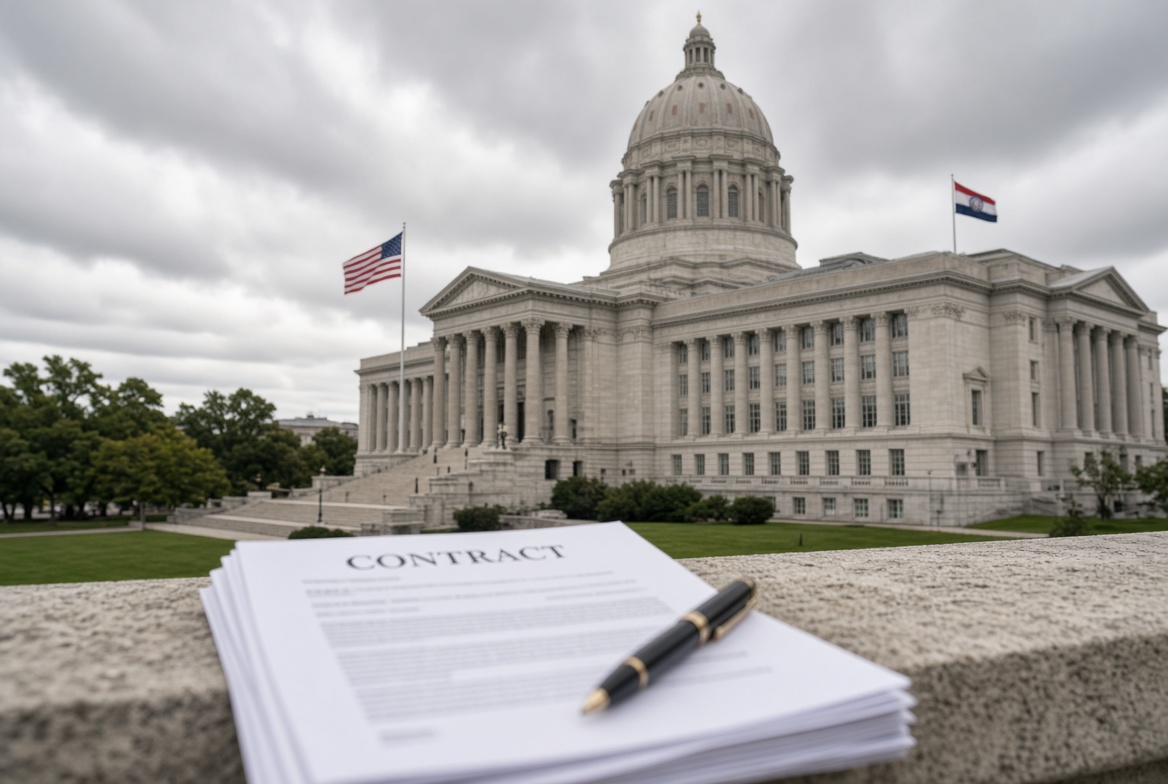
A Maternal Child Health Services agreement between the Missouri Department of Health and Senior Services and a local public-health agency is, on its face, ordinary. The term runs a single federal fiscal year. The cap is a little more than $31,000 in Title V funds. The work is prenatal care, children’s services, and local capacity in a mid-Missouri county seat.
Buried in the state’s boilerplate is a clause that has nothing to do with mothers or infants. If the contractor is a “company” with 10 or more employees, it must certify that it is not engaged in, and will not engage in, a boycott of Israel or of firms doing business with Israel.
That is not a public-health policy. It is RSMo § 34.600, the Anti-Discrimination Against Israel Act, enacted in 2020 as Senate Bill 739 and signed by Gov. Mike Parson. The statute forbids public entities from entering contracts for services, supplies, information technology, or construction unless the company certifies it will not boycott Israel. Contracts that omit the certification are “void against public policy.” The two exceptions are contracts under $100,000 and contractors with fewer than 10 employees.
Those exceptions are why a reader might assume the clause never reaches a small county health department. That assumption is wrong in two directions.
First, the state still inserts the language even when the dollar amount is well under the floor. Second, “public entity” in the statute is not only Jefferson City. It is “the state of Missouri or any political subdivision thereof, including all boards, commissions, agencies, institutions, authorities, and bodies politic and corporate.” A county health department that buys services or supplies from a qualifying vendor is inside the same net. A $31,000 DHSS award may itself sit under the statutory floor. The next local vendor contract that county signs may not. The paperwork travels with the public dollar.
There is no central list of who signed. The certification lives in each contract file. After award, those files are generally public records under Chapter 610, RSMo. The Office of Administration posts many statewide awards. DHSS, MoDOT, cities, counties, and school districts keep their own. You sunshine the awarding body. You do not pull a statewide “Israel compliance roll,” because none exists.
A statute in search of a Missouri problem
The House summary of SB 739 does not cite a Missouri contractor that boycotted Israel, a cancelled state bid, or a local procurement fight. Supporters said Missouri has a “strategic alliance” with Israel, that BDS “creates a national security issue,” and that the bill reaches companies rather than individual speech. Rep. Holly Rehder, who carried the bill in the House, tied her sponsorship to travel in Israel and to “the level of threats that they are under.” Gov. Parson’s line after signing was: “Missouri is proud to stand with Israel.”
That is alliance politics and a national campaign. It is not cleanup after a documented Missouri vendor problem. Call it what it is: a law without a cause in this state.
Previous versions failed in 2018 and 2019, including a Senate filibuster by then-Sen. Rob Schaaf, who objected that Israel was being singled out. SB 739 passed the Senate 28–1 and the House 95–40. Missouri became roughly the 32nd state with such a measure.
And still no case
Six years later, there is still no reported Missouri judgment voiding a contract under § 34.600, no published enforcement action against a boycotting vendor, and no First Amendment challenge filed against this statute in a Missouri court. The law operates as an exhibit vendors sign so the file is complete.
Absence of cases is not proof every vendor agrees with the policy. It is proof the statute has not been stress-tested here. Agencies treat it as compliance theater. That is a thin justification for a viewpoint-specific condition on public contracting.
Callout: Why only Israel?
Missouri has no parallel contracting statute that requires vendors to swear they will not boycott the United Kingdom, Canada, Japan, Australia, or South Korea. Those countries are U.S. allies too. The text is written around one state and the firms tied to it.
If the justification is “ally,” the comparison has to be other allies. If the justification is “BDS is unique,” that is a political claim about one movement—not a reason the purchasing code should contain a one-country loyalty test.
Supporters say the Boycott, Divestment, and Sanctions movement singles out the only Jewish state, that BDS is discriminatory or a security problem, and that taxpayer money should not underwrite a campaign they consider antisemitic. They also note Israel is a U.S. ally and a Missouri trading partner.
Critics say a boycott is political speech, that writing Israel alone into the purchasing code is a content- and viewpoint-based rule, and that the state is free to buy what it wants—but not free to demand a pledge about one foreign conflict as the price of a public contract.
Callout: The First Amendment fight
In NAACP v. Claiborne Hardware Co. (1982), the U.S. Supreme Court protected a politically motivated consumer boycott. That is the case opponents of these statutes always cite.
Missouri has never tested § 34.600 in court. The federal circuit that includes Missouri has. In 2022 the Eighth Circuit, sitting en banc in Arkansas Times LP v. Waldrip, upheld Arkansas’s similar certification law. The majority treated refusals to deal as “purely commercial, non-expressive conduct.” The dissent said the statute reaches expressive boycott activity outside the contract.
Early district courts in Kansas, Arizona, and Texas went the other way. That is why later statutes—including Missouri’s—added dollar and employee floors. Those carve-outs were litigation design, not evidence that a county health office needed the clause. A circuit opinion can be controlling and still be wrong on Claiborne.
Model legislation, from the groups one expects—and from ALEC
This did not start in Cole County.
South Carolina’s 2015 contractor bill, sponsored by then-Rep. Alan Clemmons after a trip to Israel, and Illinois’s 2015 pension-divestment statute became the two templates. The Israel Allies Foundation announced it had combined those bills into “one piece of model legislation.” Clemmons called IAF’s Joseph Sabag his “wordsmith-in-chief.” George Mason law professor Eugene Kontorovich helped draft and later defend the model. AJC, local Jewish federations, AIPAC-aligned advocates, the Israeli-American Council in some states, and Christians United for Israel pushed versions through legislatures. That part is unsurprising. Those groups exist to move U.S. policy toward Israel.
The less obvious author is the American Legislative Exchange Council. In 2016 ALEC’s Federalism and International Relations Task Force circulated a draft “PEACE Israel Act”—Protection and Enforcement against the Commercial Exclusion of Israel Act. The archived summary said BDS’s objective was “economic punishment and ultimately, the destruction of the state of Israel,” and that the model would create “disincentives” to coordinated secondary boycotts of Israeli or Jewish entities. ALEC later reused the same certification machine for fossil fuels, firearms, and ESG in its “Eliminate Political Boycotts Act.” The Israel bills were the prototype. The later culture-war bills were the copy.
Center for Public Integrity’s 2019 “copy-paste legislate” reporting showed how little of this language is homegrown. Missouri’s 2020 text is the national template with Missouri citations attached.
Party is a pattern, not a monopoly
About 36 to 38 states now have some anti-BDS statute, executive order, or investment rule. The Jewish Virtual Library keeps a running list. Contractor-certification states that look like Missouri include Texas, Florida, Arizona, Georgia, Arkansas, Kansas, Oklahoma, Tennessee, and Ohio. Illinois (Democratic legislature, Republican governor) passed the first major investment law in 2015, often described as unanimous. Jerry Brown signed California’s version. Andrew Cuomo issued New York’s executive order. Minnesota, New Jersey, Rhode Island, and Colorado are not red trifectas. The densest cluster is Republican. The first wave was bipartisan. The West Coast and northern New England are the usual holdouts.
So the map is not “only Republicans.” It is “states where the Israel-ally coalition could pass a model bill, then states that copied it.”
What the statute leaves a health department
A local public-health agency sits on both sides of this statute. It is a contractor when it takes a DHSS award. It is a public entity when it buys supplies or services from a local vendor. Section 34.600 is short. The options it leaves are shorter.
When the law does not require the pledge
The General Assembly wrote two exits and no others:
- The contract’s total potential value is less than $100,000, or
- The contractor has fewer than ten employees.
A vendor that is not a “company” as defined—any for-profit or nonprofit organization, association, corporation, partnership, joint venture, LLC, or affiliate—also sits outside the certification duty. A true sole proprietor with no company form is not what the statute is aimed at. A county health department that is itself a public entity is not a “company” when it is only receiving state funds, though state agencies still drop the clause into the packet.
That is why a $31,000 maternal-and-child-health award can look like it should be exempt. By the statute’s own dollars, it is. The department may still be asked to sign, because agencies copy the exhibit into every file rather than run the two-part test. Signing a form the law does not require is a choice. Refusing a form the law does not require is also a choice. The statute does not punish either one on a sub-$100,000 deal.
When the health department turns around and buys from the community, the same two exits apply. It can keep a contract under $100,000. It can use a shop with fewer than ten employees. It can split work only if it is not evading a single larger deal—the statute looks at “total potential value.” Those are the lawful ways to avoid demanding the pledge.
When the law leaves no local option
If the vendor is a company, has ten or more employees, and the contract can reach $100,000, the health department must put the written certification in the contract. Subsection 4 is blunt: any contract that fails to comply “shall be void against public policy.”
The county cannot write its own exception. The city attorney cannot waive it. The board cannot vote it away because the work is prenatal care. Subsection 5 lets the commissioner of administration issue rules only if they stay consistent with the statute and do not create any exceptions. A local health department has less room than that. It can document that an exception applies. It cannot invent a third one.
What the department cannot do, once the statute attaches, is award the contract to a qualifying company that will not certify. What it also cannot do is enforce a boycott test the statute does not describe. The form asks whether the company is engaged in a boycott of Israel as the statute defines it. It does not ask the vendor’s opinions about Gaza, the West Bank, or foreign policy. Stretching the exhibit into a speech screen is not in the text.
For citizens, that is the educational point. The health department is not free to ignore § 34.600 on a large vendor deal. It is also not required to treat every small local purchase as if the Capitol had no dollar floor. The two exceptions are the only discretion the law wrote. Everything else is boilerplate habit—or a void contract.
Option 1: Reject the grant?
If a health department disagrees with the statute and does not want to make its vendors sign the pledge, turning down the DHSS award is not the only option—and it is not even enough.
The grant and the statute are different documents. Walking away from Title V money avoids whatever flow-down language DHSS put in that agreement. It does not repeal § 34.600. The moment the same agency spends county or city money on a qualifying vendor contract, it is again a “public entity” under the statute. The duty comes from the Revised Statutes, not from Jefferson City’s grant packet.
What actually reduces the duty is staying inside the two statutory exits: keep the vendor deal under $100,000, or use a contractor with fewer than ten employees. Those options remain whether the department takes the grant or not. Rejecting the grant only trades prenatal-care funding for a political statement. It does not buy the department the right to award a $200,000 contract to a 50-person company that refuses to certify.
The only complete escape is a change in state law. A local board cannot vote § 34.600 off the books.
Option 2: Rewrite the clause to cover “all allies”?
Keeping the Israel language and adding the United Kingdom, Canada, Japan, Australia, and South Korea would not solve the problem the statute creates. It would stack a new one on top of it.
On a state contract, the health department cannot rewrite Section 3.5. DHSS terms are take-it-or-leave-it. Crossing out Israel, or diluting the required certification, would leave a contract that fails subsection 2. Subsection 4 still says that contract is void against public policy.
On a local vendor contract the department writes itself, adding other allies while leaving the Israel sentence intact might still satisfy § 34.600’s Israel requirement. The extra countries are not an “exception” to the statute. They are extra policy the General Assembly never authorized. “Ally” is not a legal category in Chapter 34. Who counts, and who drops off the list after the next election, would be a local political fight with no statute to referee it.
The First Amendment problem does not get better by becoming more inclusive. Claiborne protected a boycott as political speech. Multiplying the number of foreign governments a vendor must pledge not to boycott multiplies the viewpoint tests attached to public money. The Eighth Circuit upheld Arkansas’s Israel-only commercial certification. A homemade “all allies” rider has no Missouri statute behind it and would be easier to attack as a local speech code.
In short: you cannot subtract Israel. Adding everyone else does not make the singling-out disappear. It just writes a longer loyalty list into a prenatal-care file.
What the local file actually shows
The special treatment is not that Israel is discussed in Missouri politics. It is that Israel is the only foreign country written into the standard terms of a public contract for local maternal and child health work.
The need was not a Missouri vendor scandal. The enforcement record is empty. The constitutional question is live even if the Eighth Circuit currently answers it for the state. The authors were the expected Israel-advocacy network and, less expected by people who only watch Jefferson City, a national bill mill that later pointed the same weapon at other boycotts.
People who never bid on a highway project still meet this statute when a county health department, a school district, or a small city attaches Exhibit F or Section 3.5 to a packet and asks a local vendor to sign.
That is how model legislation works. It does not stay in the Capitol. It shows up in a contract about prenatal care because someone in 2015 wrote a template and Missouri, five years later, adopted it—without a local cause, and so far without a case.
Read it yourself
- RSMo § 34.600 — full statute
- SB 739 as truly agreed and finally passed
- House summary of SB 739 (proponent / opponent testimony)
- NAACP v. Claiborne Hardware Co., 458 U.S. 886 (1982)
- Arkansas Times LP v. Waldrip (8th Cir. 2022)
- ALEC draft PEACE Israel Act summary (archived)
- Center for Public Integrity: how the model bill spread
- Missouri OA awarded contract search
- Missouri Independent (2023) on the contracting clause