
What We Know So Far: The La Strada Whistleblower Lawsuit Against Secretary of State Denny Hoskins
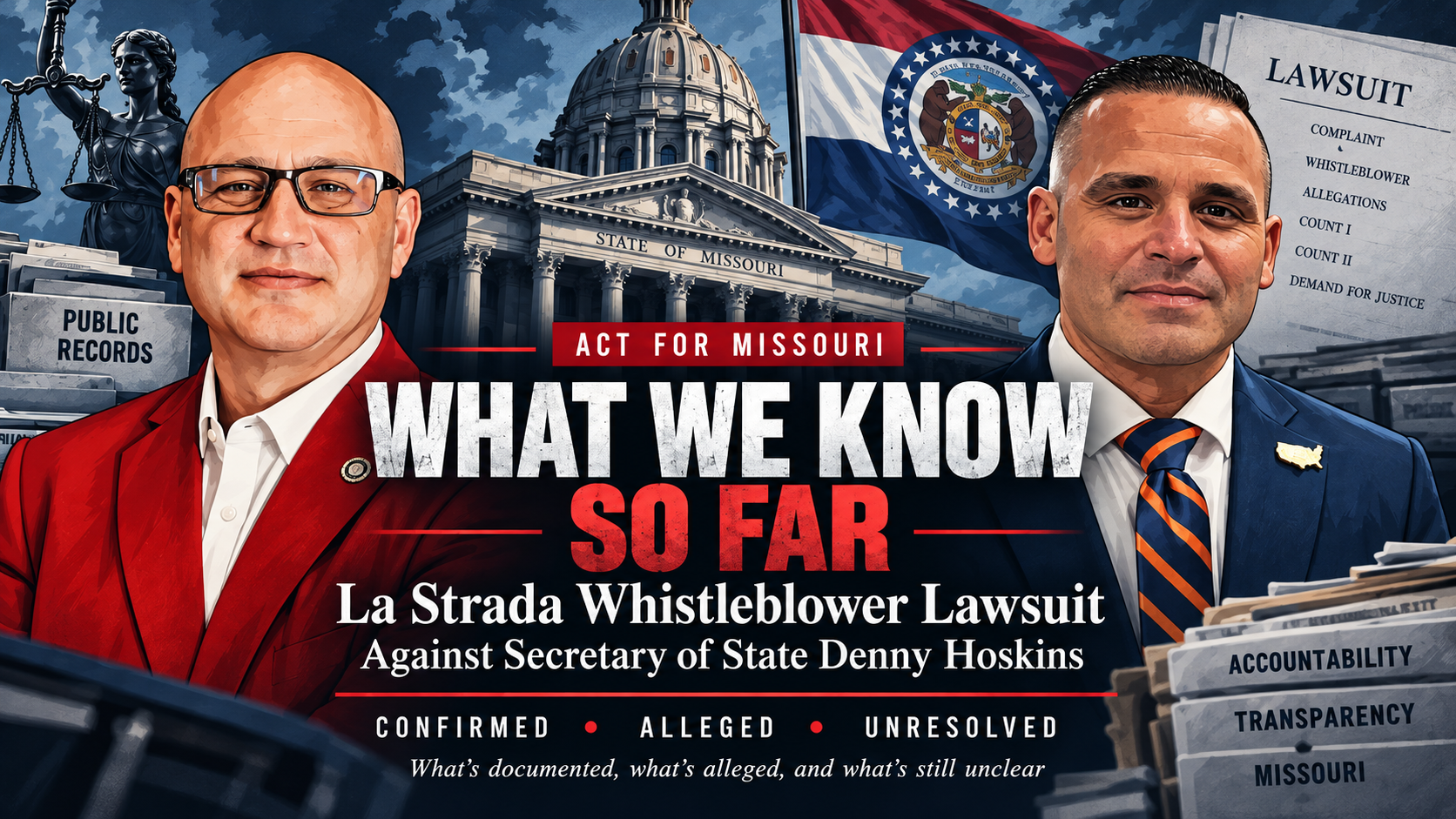
A former state election-integrity director says he was fired for reporting misconduct. His old boss hasn't answered in court yet. Here's what's confirmed, what's alleged, and what's still spin.
Updated September 15, 2026
On September 14, 2026, attorneys for Nicholas La Strada — Missouri's former Director of Election Integrity — filed a whistleblower lawsuit against Secretary of State Denny Hoskins and his office in Cole County Circuit Court. The case, filed alongside a press conference, has already produced a lot of confident claims from the plaintiff's side. Hoskins' office, through a spokeswoman, has declined to comment.
Below, we've tried to separate three things that are easy to blur together in coverage like this: what's documented and verifiable, what's alleged but not yet proven, and what's genuinely unclear. We've also included the press conference video and links to the underlying court records so you can check our work.
The Lawsuit at a Glance
Case: La Strada v. Hoskins and State of Missouri, Office of Missouri Secretary of State, No. 26AC-CC00592, Circuit Court of Cole County, Missouri.
Claim: A single whistleblower-retaliation count under RSMo § 105.055.7, the state law protecting public employees who report legal violations, mismanagement, or abuse of authority.
Plaintiff's counsel: Baldwin & Vernon Trial Attorneys, LLC, and Dennis Egan of the Popham Law Firm.
Relief sought: Declaratory and injunctive relief, damages (alleged to exceed $25,000), and attorneys' fees. A jury trial has been demanded.
It's worth stating plainly: a "Petition for Damages" is written entirely by one side. Every fact, quote, and framing choice in it was chosen by the plaintiff's attorneys to make the most persuasive case possible — that's not a flaw, it's simply what a legal petition is for. None of it has been cross-examined, tested against contrary evidence, or weighed by a judge or jury, and as of this writing, Hoskins' office has not filed a public response. That means the record right now is, by definition, one side of a two-sided story — and a one-sided account written in sworn legal language can feel more settled than it actually is. The honest position at this stage isn't "La Strada is right" or "La Strada is wrong." It's "we don't have enough yet to know" — and it's worth being suspicious of anyone, on either side of this or any similar story, who sounds more certain than that.
Watch the Press Conference
Plaintiff's attorneys held a news conference outside the Cole County Courthouse the day the suit was filed. We're including it here in full so you can hear their framing directly, rather than take our word for it.
The Allegations, in Order
1. The political-mail complaint
La Strada says that in 2025 he flagged the office's use of public funds for a mailer opposing a ballot measure ("Proposition B") as a possible election-law violation, and recommended it go to a prosecutor. Shortly after, he says his administrative access to the statewide voter-registration system was cut off, and his emails asking who authorized that went unanswered.
Unclear
Neither the petition nor the press conference identifies which "Proposition B" is meant. When a reporter pressed on this at the press conference, attorney Dennis Egan called it an "evidentiary fact" they weren't ready to discuss, floated the St. Louis County Prop B, then added they weren't sure one had actually appeared on a ballot yet. We have not been able to independently confirm any part of this allegation.
2. The Marshall Ward 3 election dispute
La Strada alleges that after Saline County certified the City of Marshall's Ward 3 council race on April 13, 2026, the Secretary of State's office — rather than referring a tabulation complaint to the courts — retabulated the write-in votes itself, directed city officials to seat a different winner, and threatened to investigate any official who didn't comply. He says he told Hoskins directly that only a judge can change a certified result, and was ignored.
The underlying vote dispute is real and documented, separate from the lawsuit. Saline County's official April 13, 2026 canvass certified Aaron Gibson as the Ward 3 winner with 39 write-in votes to Michael Varner's 38, with several other spelling variants ("Mike Varner," "M. Varner," "Aron Gibson," etc.) tallied as distinct lines.
Four days later, on April 17, the City of Marshall issued a public statement (reported by KMMO) saying the Secretary of State's Elections Division had communicated a different outcome: combining name variants under Chapter 115's voter-intent rules for write-ins produced 45 votes for Varner, 41 for Gibson, and 35 for Mike Mills — flipping the winner. The city's statement said it had "no authority" to recount or reinterpret results itself and would simply seat whoever the state's determination named — which was set to be Varner.
This is the same episode described in the lawsuit — it lines up on dates and facts. What's disputed is the characterization: was this a routine, statutorily-authorized correction under Missouri's write-in voter-intent rule, or — as La Strada alleges — an improper, coercive override of a certified local result that bypassed the courts? Both readings are plausible on the public record so far, and we haven't seen anything that resolves which one is accurate.
3. The alleged fabricated whistleblower complaint
This is the most serious claim in the suit. La Strada says that on April 15, 2026, he was on a call with the Secretary's chief of staff, a deputy general counsel, and the state auditor's chief of staff, where the group (not including La Strada) discussed creating a fake whistleblower complaint about the state's voter-registration system — routed through an "IP scrambler" and a "burner phone" to hide its source — to submit as evidence at an upcoming federal hearing.
He says he objected, then reported it to the office's General Counsel, who reportedly told him a false report sent that way "could be a federal crime." La Strada says he then reported it to Hoskins directly, twice.
Unclear
At the press conference, a reporter asked directly whether there's any evidence this fabricated document was actually created or submitted. Counsel said they had not yet seen the hearing record and had no evidence yet — that discovery, the formal evidence-gathering phase of the lawsuit, hasn't happened. Right now, this is one person's account of a conversation he says he overheard, not a document anyone has produced.
4. The federal hearing and the firing
La Strada says that on April 24, 2026, a federal judge ordered him to testify at a hearing in a separate federal case, and that just before the hearing, Hoskins had his Capitol building access shut off. He got in anyway, testified, and 19 minutes later received a text asking him to call Hoskins before returning to work. Four days later, Hoskins fired him.
The federal hearing referenced is Kramer v. Hoskins, No. 2:25-cv-04257-MDH (W.D. Mo.), a real, public case. It's a pro se lawsuit by Constance Kramer under the Help America Vote Act (HAVA), seeking to force the Secretary of State's office to hold an administrative hearing on a complaint about the state's centralized voter-registration list. On March 5, 2026, Judge M. Douglas Harpool granted Kramer a preliminary injunction ordering Hoskins to give her that hearing and to preserve related voter-registration and audit-log records. The April 24 hearing La Strada describes appears to be the compliance hearing that order required — which is also, notably, the same records system (MCVR) the alleged fake whistleblower complaint was reportedly about. Read the court's order →
What the Kramer HAVA Case Was Actually About
La Strada's petition mentions the April 24 hearing only in passing — as the backdrop for the badge/access allegation. But it's worth understanding on its own terms, because it's a substantively argued case, not a formality, and it's the same records system (MCVR) at the center of the audit-log dispute. We obtained and reviewed the full 408-page official transcript, filed publicly as an exhibit to the case docket.
The core dispute: Kramer, representing herself, argued that Missouri couldn't identify one single, exact, preserved statewide voter record that supported its election certifications — pointing to three official sources (the EAC's EAVS survey, the Secretary of State's results page, and MCVR's voter-history total) that reported different turnout numbers for the same 2022 and 2024 elections. She was explicit, repeatedly, that she wasn't alleging the different numbers proved fraud or asking to overturn any election — she wanted a written finding on whether the state could reconcile its own figures and produce the underlying records (audit logs, snapshots, county transfer files) to prove it.
The state's defense: Bryant, representing Hoskins' office, argued Kramer was misreading what HAVA §303 actually requires — a continuously updated list, not a static one — and that the three figures measure genuinely different things (total participation vs. votes cast in the top race, for example) rather than reflecting errors. Director of Elections Chrissy Peters and St. Louis County's Eric Fey spent most of the day walking through, in granular technical detail, exactly how a voter registration moves from county to state and how history gets attached after an election.
The one real rebuttal moment: Peters' strongest counter-example involved a single Boone County voter record that had been mistakenly merged into a Kansas City voter's record — briefly creating what looked like a double-voting discrepancy on the complainant's data analysis. She walked through how the audit log showed the error, and how it was caught and corrected via provisional ballot. She used it as her best illustration that a data discrepancy isn't the same thing as fraud, and that the audit-log system does catch and document mistakes when they happen.
Who testified: Peters and Fey for the state; Nick La Strada (on MCVR list-maintenance mechanics only — nothing about the badge, the alleged fabrication scheme, or his firing, none of which are mentioned anywhere in the transcript); Daniel Hume, a volunteer data analyst who testified he ran hash-verified snapshot comparisons and couldn't reconcile the numbers, but explicitly declined to call that proof of fraud; and Kramer herself.
How it ended: The hearing officer didn't rule immediately — written findings were due within a 90-day window set by the federal court's earlier order. Hoskins' office filed a status report on May 13; Kramer, unsatisfied, filed a motion to enforce on June 15, arguing the state still hadn't complied. Judge Harpool denied that motion on July 9, and the case was closed on July 13, 2026. So while Kramer won the right to a hearing in March, her push for further enforcement afterward did not succeed.
Worth being precise about the connection to La Strada's suit: this case establishes that MCVR's audit-log system was a live, contested subject in court just weeks before La Strada says he witnessed a plan to submit fabricated audit-log evidence — but the transcript itself contains no mention of that alleged plan. The two things are related by subject matter and timing, not because the transcript corroborates the fabrication allegation.
What's Still Genuinely Unresolved
- The Proposition B mailer allegation has no public corroboration yet.
- Whether the "fabricated whistleblower submission" was ever actually created, submitted, or used in the federal hearing.
- Whether the Ward 3 retabulation was a lawful statutory correction or an improper end-run around the courts — both are legally arguable readings of the same sequence of events.
-
A gap worth naming directly in the badge/hearing account:
- La Strada testified at the April 24 hearing — called by Kramer, not the state — but only on MCVR mechanics.
- He had already reported the alleged fabrication scheme to General Counsel and to Hoskins directly beforehand.
- Despite that, the transcript shows no attempt by him to raise it under oath that day, in the one setting where he had a sworn, on-the-record opportunity to do so.
- This doesn't disprove his account — but it's the same kind of internal-consistency question raised about the other allegations here, and it shouldn't get a pass just because it comes later in the story.
- Hoskins' office's version of events. As of this writing, there is no public response, motion to dismiss, or answer on the docket.
A Note on Spin
This story is easy to slot into a pre-existing narrative, and every version of that narrative should be resisted until there's more on the record.
From the plaintiff's side: The press conference leaned hard on La Strada's Republican credentials and framed the case in "no one is above the law" language, at one point invoking an unrelated Missouri Supreme Court ruling against Hoskins as rhetorical reinforcement — not as legal precedent for this case. That's a communications strategy, not evidence. A civil petition is written to be persuasive; it is not a verdict.
From the other direction: Because Hoskins' office has declined to comment, there is currently no counter-narrative to weigh against La Strada's — which means it would be just as much a mistake to assume the office's silence is an admission. Employment disputes routinely look very different once the other side files its answer.
A third version worth naming directly: within hours of the filing, some online commentators who have made some outragious claims, including calls for the Secretary of State's arrest and removal before any court has ruled on anything, and serious personal claims about named individuals that we could find no independent confirmation of. We are not repeating or linking to that material here. It is a textbook example of the spin problem this article is trying to help you avoid: a real, documented lawsuit getting stretched into a much bigger and far less grounded story within a single afternoon.
The one piece of this story that is independently documented outside the lawsuit itself — the Ward 3 write-in recount — actually illustrates the problem well: the same set of facts supports two very different stories (a lawful correction vs. an improper override), and which one is true depends on legal questions this article can't settle.
Court Records & How to Follow This Yourself
- State case: La Strada v. Hoskins, No. 26AC-CC00592, Cole County Circuit Court, Missouri. Look it up on Missouri Case.net (search by case number or party name; some filings require a login to view in full).
- Federal case: Kramer v. Hoskins, No. 2:25-cv-04257-MDH, U.S. District Court for the Western District of Missouri. Read the March 5, 2026 preliminary injunction order →
- April 24, 2026 HAVA hearing transcript: filed on the docket as Document 37-2 (Exhibit A to the Affidavit of Jacqueline Bryant), May 13, 2026. Available via PACER on the same case docket; not separately hosted online.
- Official election results: Saline County's certified April 7, 2026 election summary →
- Additional reporting: Missouri Independent, Sept. 14, 2026 → and KMMO, April 17, 2026 →
This is a factual explainer, not legal advice or an editorial endorsement of either party's claims. We will update it as the case develops.