
The Grassroots Divide: Constitutional Idealism vs. Pragmatic Warfare
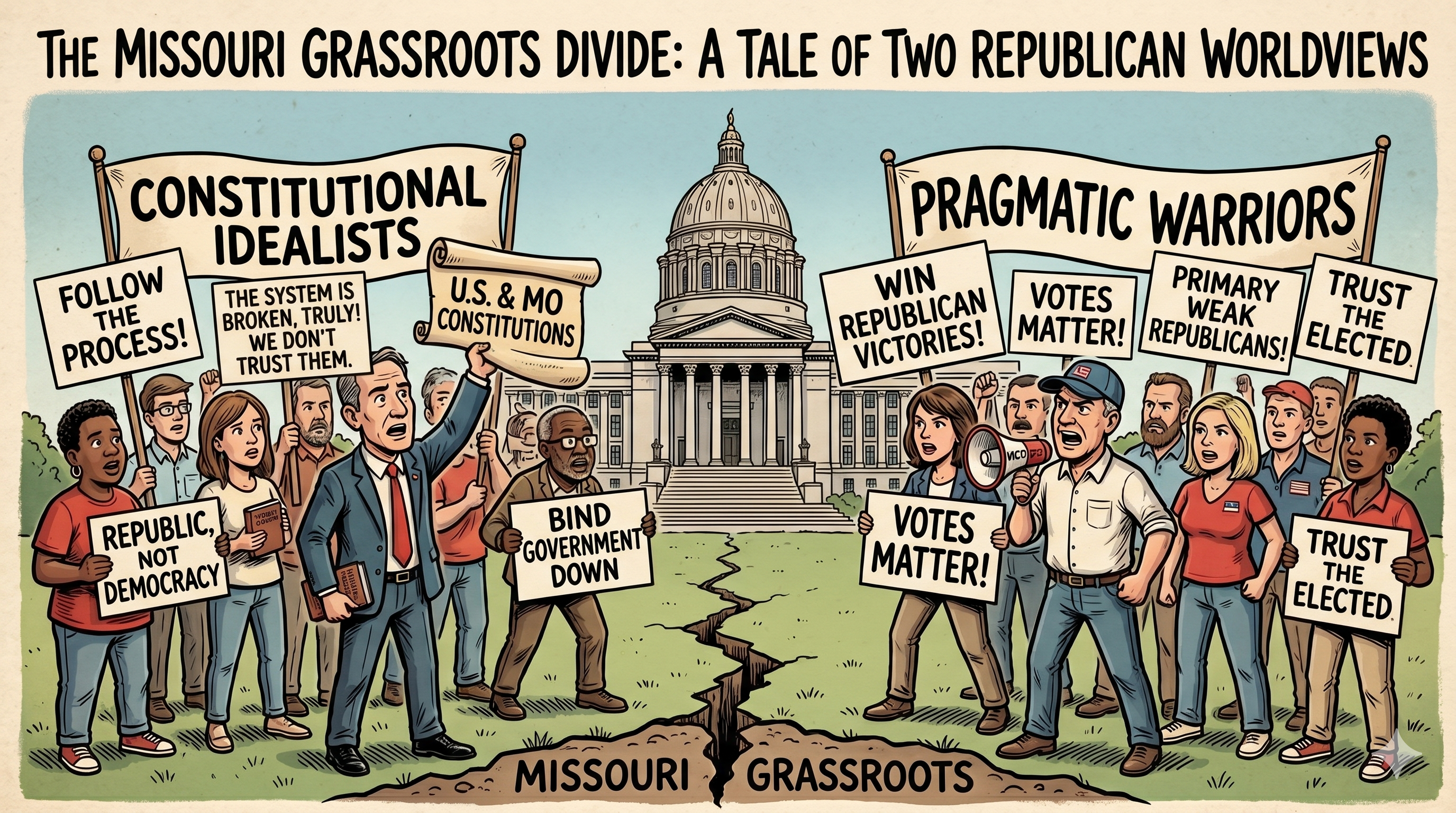
It is one of the most perplexing questions in Missouri politics right now: How are groups that all claim the mantle of the "Conservative Grassroots" finding themselves on completely opposite sides of the biggest legislation facing the state?
From the recent battle over Amendment 3, to the upcoming fight over the Initiative Petition process (Amendment 4), to the debate over eliminating the state income tax (HJR 173), people who ostensibly share the exact same political mindset are reaching vastly different conclusions on what to support and what to oppose. How can this be?
It is easy to dismiss this infighting as simply "pro-establishment" versus "anti-establishment" bickering. But if you listen closely to leaders across the state, the root of the disagreement is much more profound. Both sides share a bedrock belief famously articulated by John Adams: "Our Constitution was made only for a moral and religious people. It is wholly inadequate to the government of any other." Furthermore, both sides hold a deep distrust of pure "direct democracy" or mob rule.
The true divide is a strategic one: Do we protect the state by locking down the system to ensure Republican victories, or do we protect the state by fiercely guarding the constitutional process, regardless of the political fallout?
The Litmus Test: Do You Trust the Legislature?
To see this divide in action, we don't have to look hard. A perfect case study unfolded recently on Ryan Hite's radio program, The Reckoning.
On back-to-back days, Hite interviewed two prominent grassroots leaders—Byron Keelin and Ron Calzone. The starkest difference between the two men emerged not over abstract theories, but over a specific piece of legislation: HJR 173, the amendment proposing to eliminate the state income tax.
Because the plan to replace the revenue relies on future legislative action, supporting HJR 173 ultimately boils down to a single question: Do you trust the legislature to do the right thing? Their deeply contrasting answers to this question serve as a masterclass in understanding the two worldviews currently driving Missouri politics.
The Pragmatic Warrior: Trust the Representatives
The first worldview sees the current political system being actively weaponized by the left. For this group, the priority is securing the right outcome by locking the gates against progressive policies and electing legislative fighters.
Byron Keelin of the Freedom Principle Missouri perfectly articulates this view. When asked about HJR 173, Keelin acknowledged that the bill essentially gives the legislature "permission" to figure out the tax replacement later. For a Pragmatic Warrior, this is acceptable because they fundamentally believe in the representative system—they just believe it needs better personnel.
Byron Keelin on trusting the legislature to do the right thing: "If we're not going to trust the people that we elect..."
For this camp, the solution to bad governance isn't to tie the legislature's hands, but to change the lawmakers. Groups like the Missouri 82 Alliance are actively targeting incumbent Republicans who have poor voting records on conservative legislation.
"If HDR 173 does pass, that we elect good people. If we're not going to trust the people that we elect to represent us, then why are we having elections at all?" – Byron Keelin
This worldview extends to their support for Amendment 4, which is driven by a fundamental mistrust of the electorate's ability to vote correctly on complex issues. Because they believe the general public is easily manipulated by deceptive language and out-of-state advertising—resulting in voters simply "getting it wrong"—they want to empower the trusted legislature to act as a protective filter, making it incredibly difficult for outside groups to bypass lawmakers and amend the constitution directly.
Byron Keelin: Only the legislature should have the power to amend the constitution, because they can vet ideas.
The Constitutional Idealist: Trust the Guardrails
The second worldview warns that playing fast and loose with the rules—even for a conservative victory—always leads to tyranny. For this group, adhering strictly to the Constitutional process is the ultimate principle and our primary defense against government overreach. They recognize that human nature makes the day-to-day legislative process inherently vulnerable to corruption, lobbyists, and backroom deals, no matter who is currently holding the seat. Therefore, the only way to protect the republic is to keep the government strictly bound by the Constitution's original rules.
Ron Calzone of Missouri First is a textbook Constitutional Idealist. When asked about HJR 173, his reaction was the exact opposite of Keelin's. Calzone pointed out that the amendment requires voters to suspend their Hancock Amendment protections and simply trust the politicians to figure out the rest. For a Constitutional Idealist, demanding blind trust is a red flag.
Ron Calzone rejecting the "Just Trust Us" narrative regarding HJR 173
While the Pragmatic Warriors believe elections are sufficient to hold politicians accountable, Constitutional Idealists vehemently disagree. They argue that voters are often forced to pick the "least bad person" on the ballot. Therefore, the rules restricting government power cannot be suspended.
"The whole idea of constitutional government, like a constitutional Republic, is that the people don't trust government... there's some things I would never ever ever say 'just trust me' [to], and I think this is one of the things that the legislature should not be saying to the people." – Ron Calzone
This is exactly why this camp fiercely opposes Amendment 4. To be clear, Constitutional Idealists do believe that amending the state constitution should require more than a simple 50-percent-plus-one majority. They support a higher hurdle, but not one set so impossibly high that citizens can never actually meet it. Most importantly, they insist that whatever threshold is established for the people must apply equally to amendments proposed by the legislature. There can be no special rules for politicians. They see Amendment 4 as a dangerous "double standard" that strips power from the citizens while leaving the legislature unchecked, ultimately threatening the people's "second amendment-like" political power (the Initiative Petition) to rein in a government that stops listening to them.
Where Act for Missouri Stands
We recognize the very real threats identified by the Pragmatic Warriors. Out-of-state money is a problem, and electing principled leaders is essential. However, Act for Missouri ultimately falls into the camp of Process over Politics.
Our focus has always been on legislative transparency and demanding strict adherence to constitutional guardrails. When we allow the government to operate with double standards, rush major legislation through in the dead of night, or ask the citizens to suspend their protections and "just trust" the politicians, we surrender the very republic we are trying to save. Accountability does not end at the ballot box; it requires constant observation and unyielding demands that the rule of law be respected.
We encourage every Missourian to weigh these two philosophies carefully as you head to the polls and as you engage with your local representatives.