
Approved annual increase
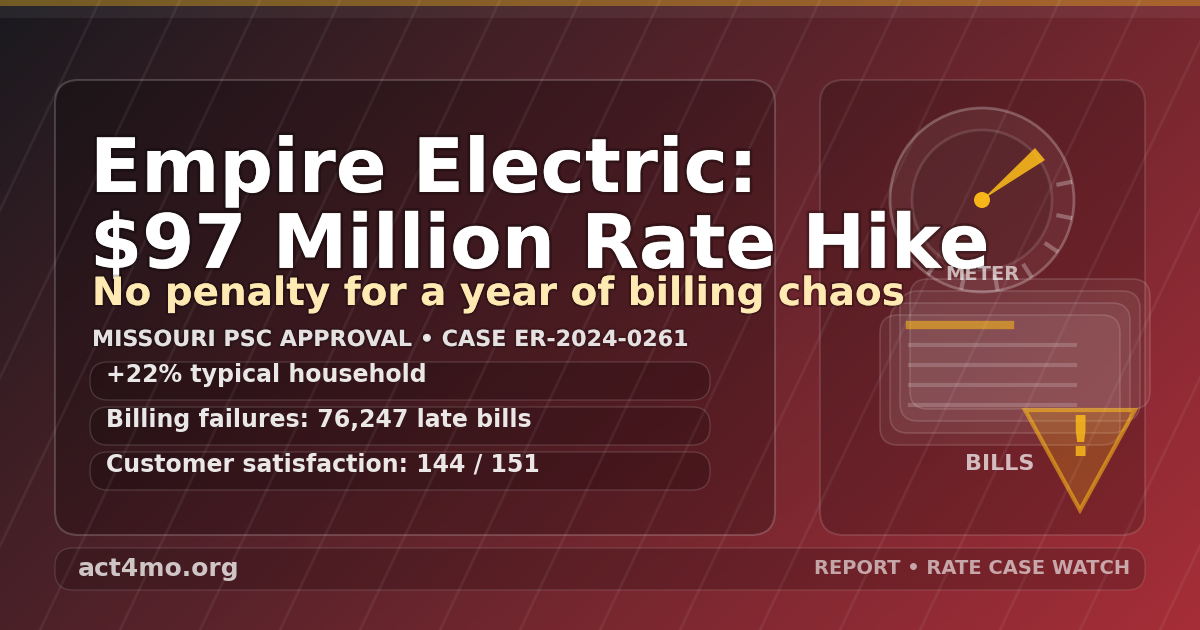
$97M
Phased in over 3 years
Past billing chaos
No penalty
No reimbursement mechanism
Debt forgiveness
$8.5M
Targeted arrears relief
Customer satisfaction
144 / 151
J.D. Power 2024 ranking
Key takeaway
The PSC tied the rate hike to future billing performance. But customers who spent months fighting duplicate bills, missing bills, and “catch‑up” charges are not being compensated for the time, stress, or financial harm already inflicted.
No Penalty for Past Failures
Empire Electric customers endured more than a year of billing nightmares—duplicate bills, months without bills, and sudden waves of back‑bills. Yet the order approving the $97 million annual increase attaches financial consequences only to future failures. The year‑plus of customer frustration, wasted time, and financial stress has no price tag attached.
Notable testimony: “Residential customers incurred costs due to their time and energy spent addressing the various billing issues,” testified Geoff Marke for the Missouri Office of Public Counsel (OPC). The order provides no mechanism to reimburse customers for those losses.
The settlement requires Empire to absorb $6.4 million in Customer First‑related expenses, but that amount does not reflect what many customers experienced:
- Customers accumulating thousands in charges after long gaps in billing (then receiving many bills in rapid succession).
- Approximately 10,000 business customers receiving 8–11 duplicate bills in a single month.
- 76,247 bills issued outside the required billing window in one year (vs. 1,286 over the previous seven years combined).
- Business owners testifying that billing errors hurt their bottom lines.
- Countless hours spent on hold trying to resolve problems.
What This Means for Your Monthly Bill
The approved rate increase is phased in over three years, but it will not begin until Empire demonstrates proper billing and customer service for three consecutive months. Below are the commonly cited examples from the case narrative (approximate figures):
Interactive estimator (approximate)
Move the slider to estimate the phased‑in change. Uses the article’s approximate ranges and a simple per‑kWh approximation for illustration.
Current (est.)
$145–$150
Year 1
$156–$161
( +$11 )
Year 2
$167–$172
( +$22 )
Year 3
$178–$183
( +$33 )
Reminder: this estimator is illustrative, based on approximate figures stated in the article narrative and a simplified calculation. Actual bills vary by tariffs, riders, usage patterns, fees, and taxes.
The Catch: No Rate Increase Until Service Improves
The rate hike will not start until Empire meets all of these standards for three consecutive months:
- No more estimated bills for new or disconnecting customers
- Bills must arrive with at least 21 days to pay
- Billing periods must be the standard 26–35 days
- No more bills without usage information
- All meters properly connected to the correct customer accounts
- At least 99.7% of bills issued on time
Tracking began January 1, 2026. The earliest possible rate increase would be April or May 2026—but only if Empire maintains perfect scores long enough to satisfy the three‑month requirement.
A Year of Billing Chaos
The performance conditions stem from Empire’s rollout of its Customer First billing system in April 2024.
The numbers
- Customer satisfaction ranking: 144 out of 151 utilities nationally (J.D. Power 2024)
- 76,247 bills sent outside proper billing windows in 12 months vs. 1,286 over the prior 7 years
- 88 “high bill” complaints filed in 14 months vs. 33 in the prior 36 months
- Over 700 customer comments filed with the PSC
- 219 customers testified at eight public hearings
Horror stories
Customer owed $3,000 after months of missing bills
A customer received untimely bills from April–June 2024 on August 15, then did not receive July–August bills until October. No further bills arrived until February 2025, when months of back‑bills came in waves—resulting in more than $3,000 owed.
10,000 customers received 82,000 bills in 10 days
A software bug caused approximately 10,000 customers to receive 82,000 bills over 10 days—most customers received 8–11 duplicate bills for the same billing period.
Wrong charges, missing credits, incorrect taxes
Customers reported wrong charges, bills tied to other accounts, missing solar credits, incorrect taxes, and even charges for periods when power was out. Autopay customers reported funds withdrawn a month late.
“Staff’s view is that the implementation of Customer First has compromised Empire’s ability to provide safe and reliable service at just and reasonable rates,” testified PSC Staff witness Tyron Thomason.
Why the Rate Increase at All?
Despite the billing debacle, the case record cites significant infrastructure investments since Empire’s last rate case:
Generation facilities (over $84 million)
- Upgraded hydro plant cranes and headgates at Ozark Beach
- Modernized combustion turbines at State Line Combined Cycle (improved output and efficiency)
- Purchased spare transformers for multiple generation sites
- Replaced a cracked turbine rotor to prevent unit de‑rating
Transmission & distribution (over $190 million)
- Physical security at 20+ substations (~$20 million)
- Circuit breakers to improve reliability (~$34 million)
- Autotransformer replacements (~$17.5 million)
- Rebuilt a transmission line built in 1928 (~$13.6 million)
- Rebuilt multiple transmission lines (~$107 million)
The PSC rationale, summarized: the utility must recover prudent investments to maintain financial stability and access to capital. Empire reportedly requested $190 million, Staff recommended $128.8 million, and the settlement landed at $97 million (the lowest option discussed).
Some Relief for Customers (Now)
$8.5 million in debt forgiveness
- Empire must forgive customer arrears through a targeted relief initiative.
- Priority for customers ineligible for federal assistance, at high risk of disconnection, or struggling with payment plans.
- Empire must file monthly status reports on design and implementation.
- Eligibility and application details were not yet published at the time of this write‑up.
Disconnection moratorium for billing-issue customers
- Customers experiencing billing issues cannot be disconnected or charged late fees.
- Empire must develop a communication plan before resuming shutoffs.
Third-party audit
- An independent audit of billing accuracy and customer service is required within one year.
- Up to $500,000 in audit costs must be borne by Empire shareholders.
Zero return on Customer First investment (until metrics met)
- Empire earns $0 on its Customer First system until the billing metrics are met.
- After metrics are met, Empire can record roughly $1.1 million/month for possible future recovery.
Who Supported vs. Opposed the Settlement
Supported the $97 million settlement
- Empire Electric
- PSC Staff
- Midwest Energy Consumers Group
- Renew Missouri
- IBEW Local 1474
Objected — wanted zero rate increase
- Missouri Office of Public Counsel (residential customer advocate)
- Consumers Council of Missouri
Public Counsel and the Consumers Council argued Empire should receive zero increase until service quality is restored and maintained for an extended period. The PSC rejected that position, approving the rate hike with conditions tied to future performance.
Timeline (What to Watch Next)
April 2024
Customer First billing system rollout begins; widespread billing failures follow.
January 1, 2026
PSC starts formal tracking of Empire’s billing and service performance.
March 31, 2026
Deadline for Empire to complete realignment of joint and collective billing accounts.
April/May 2026 (earliest)
Earliest possible start of Year 1 rates—only if metrics are met for three consecutive months.
May 31, 2026
Deadline for parties to agree on long‑term performance metrics.
Rate-case pause
Empire is prohibited from filing another rate case for 24 months after new rates take effect.
Additional Provisions (For Readers Who Want the Details)
Fuel Adjustment Clause (FAC)
The order continues a 95/5 sharing ratio (customers pay 95% of fuel cost changes). The base factor increases from $0.00870/kWh to $0.01397/kWh. (In plain language: the FAC is a rider that can move bills as fuel costs move.)
Property tax and pension trackers
Existing tracking mechanisms continue.
Low-income programs
- Weatherization program continues at $550,000 annually
- $50 customer match pilot program continues
What Customers Should Do
- Monitor your bills carefully. Report errors to Empire immediately; if not resolved, file a PSC complaint.
- Watch for arrearage forgiveness details. If you fell behind due to billing errors, you may qualify for relief.
- Track compliance. The PSC is tracking performance; watch for public reporting on whether metrics are being met.
- Know your rights. If you’re experiencing billing problems, you should not face disconnection or late fees tied to those billing issues.
- Watch for notices. Empire must notify customers before each phase begins.
The Bottom Line
Empire customers are getting some protections and debt relief now, but will eventually pay significantly higher rates—about 22% more over three years for an average household—if Empire proves it has fixed its billing system.
The controversial aspect remains: strict conditions for future performance, but no financial penalty for the year‑plus of chaos customers already endured. The stress, wasted time, incorrect charges, and business losses have no compensation attached.
Where to Learn More / File a Complaint
If you believe you have been harmed by billing errors and Empire does not resolve the issue, contact the Missouri Public Service Commission at 1‑800‑392‑4211 or visit psc.mo.gov. To review the full ruling, look up Case No. ER‑2024‑0261 on the PSC website.