
What We Know: The Eighth Circuit Fight Over Missouri's Congressional Map
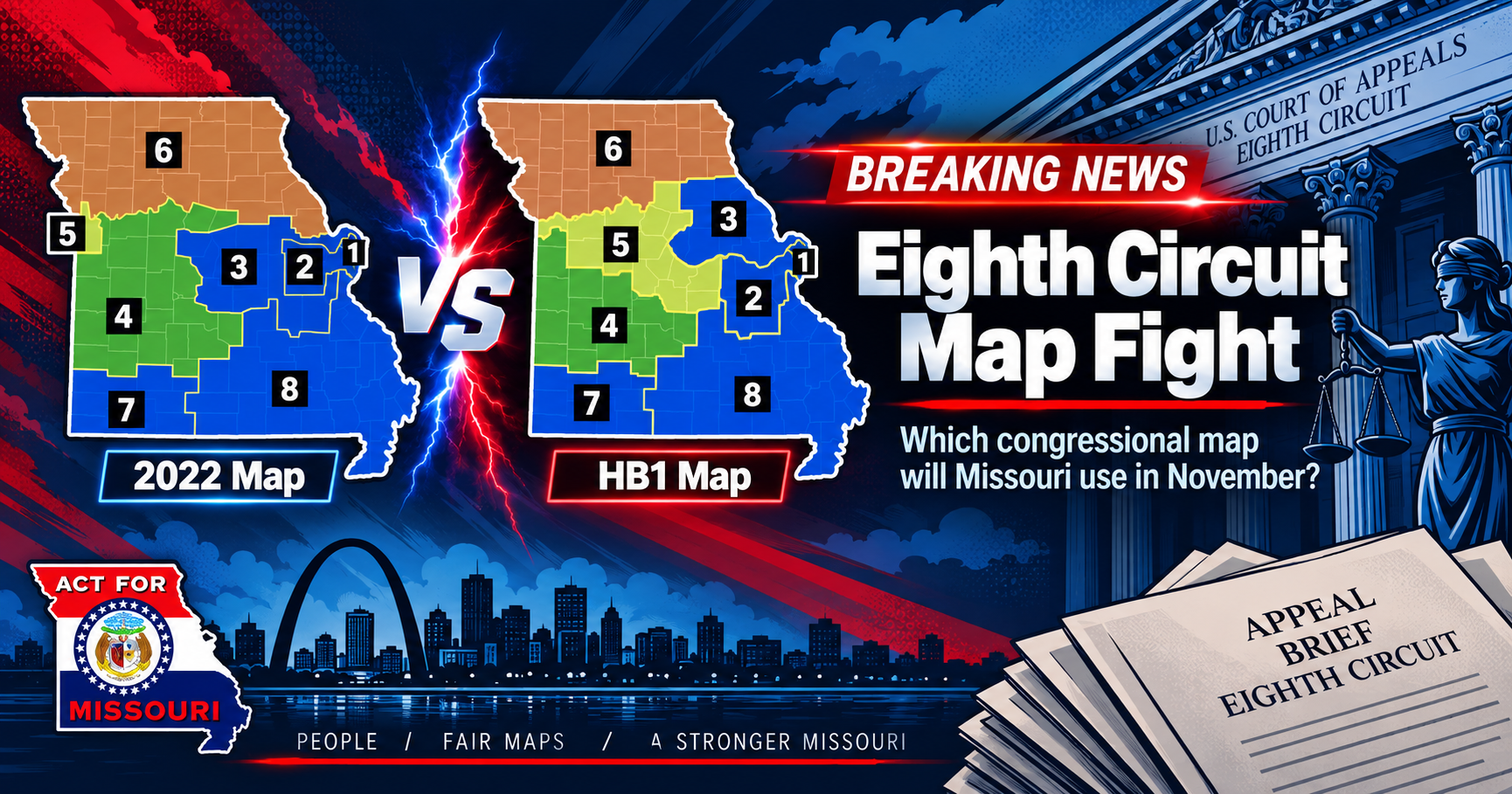
A federal appeals panel heard expedited oral argument today over which congressional map Missouri uses in November — and the state is asking the court to go much further than that.
Published September 17, 2026 — updated as this develops. No ruling had been issued as of publication.
On the morning of September 17, 2026, a three-judge panel of the U.S. Court of Appeals for the Eighth Circuit heard just over an hour of expedited oral argument in the case that will decide which congressional district lines Missouri uses this November — and, potentially, whether Missouri's citizen referendum process can ever again be used to block a legislature-drawn map.
This one is moving fast, and it's tangled — state court, federal district court, and now a federal appeals court have all weighed in within about two weeks. Here's the backstory, what was actually argued today, and what's still genuinely up in the air.
The Backstory
In 2025, the Missouri legislature passed HB1, a new congressional map — sometimes called the "Missouri First" map — redrawing the state's lines to favor Republicans in 7 of 8 districts. People Not Politicians (PNP), led by Richard von Glahn, gathered enough signatures to force a statewide referendum on whether HB1 should stand. Signature verification stretched out to August 4, 2026 — primary day — meaning the August primary was conducted under the new HB1 map before the referendum question was even finalized.
On September 3, the Missouri Supreme Court ruled 7-0 in Von Glahn v. Hoskins: because a valid referendum had been submitted, HB1 legally never took effect, and Missouri's 2022 map governs the November general election instead. The court issued an injunction to that effect.
What followed was chaotic. On September 8 — the last legal day to set the ballot — Hoskins first told county clerks to use the 2022 map, complying with the state ruling. Hours later, Chief U.S. District Judge Stephen Clark issued a federal temporary restraining order (TRO) in a separate lawsuit brought by U.S. Rep. Bob Onder, state Sen. Rick Brattin, and two voters, ordering Hoskins not to use any map except HB1. Hoskins reversed himself again, telling clerks the federal order "takes precedence." Local news outlets counted three map changes in a single week.
The Part That Reads Like Fiction: Hoskins Tried to Stop His Own State's Supreme Court From Holding a Hearing
After Hoskins told clerks to follow the federal order instead of the state one, PNP asked the Missouri Supreme Court to hold him in contempt. The court agreed, issuing a late-night order demanding Hoskins personally appear the next morning to explain himself.
Rather than simply show up, Missouri's Solicitor General, representing Hoskins, asked the federal judge — Judge Clark — to block the Missouri Supreme Court from holding its own contempt hearing at all, arguing the federal order controlled under the Supremacy Clause. Clark refused, reasoning that nothing would be gained by disturbing the balance of federalism and comity between the state and federal courts.
The contempt hearing went forward. Facing it, Hoskins reversed course again and told officials to use the 2022 map after all. The Missouri Supreme Court found he had been in contempt but ruled he'd purged it by backing down. Separately, the full U.S. Supreme Court — not just the single justice who'd earlier declined to intervene — stayed Judge Clark's federal TRO that same day, pending the outcome of this Eighth Circuit appeal.
How unusual is it for a state's own executive branch to ask a federal court to block its own state supreme court from holding a hearing? We couldn't find a clean historical parallel for it, and we're not alone in that: Chuck Hatfield, the attorney for People Not Politicians, put it plainly on the record — calling it unprecedented for a state attorney general's office to challenge what its own state supreme court says the law is, and then take that fight to the U.S. Supreme Court. That's an opposing lawyer's characterization, not a neutral fact — but the underlying legal doctrine backs up the "rare" part regardless of who's saying it: federal courts operate under strong, long-standing norms (often called "Our Federalism" or comity) against interfering with a state's own judicial proceedings, precisely because doing so is understood to be an extraordinary intrusion, not a routine one. Judge Clark's own stated reason for declining — that nothing would be gained by "upsetting the federalism and comity principles at hand" — is essentially that doctrine in a single sentence.
What Was Actually Argued Today
We listened to the official audio of today's roughly 63-minute hearing, released by the Eighth Circuit. Everything below is what was said in argument by lawyers — advocacy aimed at winning, not findings of fact — except where we've separately verified it against reporting.
- Standing. Judge Strauss repeatedly pressed PNP's attorney, Chuck Hatfield, on whether the group has any concrete legal interest beyond a "generalized grievance" — they've already secured their referendum on the ballot, so is the fight over which interim map applies really theirs to bring? Hatfield leaned on specific language in the Missouri Constitution (Article III, §52(b)) that a referred law doesn't take effect until voters approve it, arguing that's a distinct right his client is owed, not just a general interest shared by everyone.
- Federalism (Rooker-Feldman). Hatfield argued the state, unable to directly challenge its own supreme court's ruling, effectively got Rep. Onder to bring the federal case in its place — and asked the panel to treat that as improper. He also directly accused Hoskins of bad faith, saying he "never intended to follow Missouri law from the beginning"
- Purcell / Merrill v. Milligan. Both sides fought over whether courts should avoid changing election rules this close to voting. Judge Loken pushed back hard on the state's reading of the U.S. Supreme Court's own stay order at one point, telling counsel bluntly that his interpretation ignored its plain language.
- Mootness. Judge Smith raised whether this dispute is "capable of repetition, yet evading review" — relevant because if a small share of voters can freeze any future map via referendum every redistricting cycle, letting each fight moot out before resolution means it never gets a real answer.
- The big ask: the Elections Clause. Missouri Solicitor General Lou Capozzi asked the panel to go beyond just picking a map — to rule that Missouri's referendum mechanism, as applied to congressional redistricting, is unconstitutional under the U.S. Constitution's Elections Clause, which vests redistricting authority in state legislatures. He argued that roughly 3.3% of voters signing a petition can currently freeze a legislature's map for two years, calling that outcome fundamentally undemocratic and leaning on Moore v. Harper and the Arizona independent-redistricting-commission case.
What This Could Mean, Beyond This One Map
This is the detail worth sitting with: the state isn't just asking the Eighth Circuit to put HB1 back in effect for November. Solicitor General Capozzi's brief and argument asked the court to declare that Missouri's referendum power cannot be used to block a legislature's redistricting decision at all — a ruling that, if the panel reaches it, would reshape a tool voters have used to check legislative map-drawing, not just resolve this year's fight.
It's worth being precise about just how steep that request is. The U.S. Supreme Court has actually addressed this exact question — whether a state's referendum power can override a legislature's congressional map under the Elections Clause — three separate times, and ruled against the state's position all three times: in 1916 (Ohio ex rel. Davis v. Hildebrant, upholding Ohio's referendum power over a congressional redistricting law), in 2015 (Arizona State Legislature v. Arizona Independent Redistricting Commission, upholding an independent commission created by referendum), and again in 2023 (Moore v. Harper, which reaffirmed Hildebrant directly while rejecting the broader "independent state legislature" theory). A federal appeals court is generally bound by that line of precedent, not free to overrule it — so Capozzi isn't just asking the Eighth Circuit to rule his way; he's asking it to either distinguish this case from a century of consistent precedent or effectively invite the U.S. Supreme Court to revisit and overturn it. That's not disqualifying — parties ask courts to revisit precedent all the time — but it's a considerably heavier lift than the rest of the state's argument, and worth keeping separate from the more fact-specific standing and mootness questions the panel spent most of its time on.
What's Still Genuinely Unresolved
- No ruling had been issued as of publication. Given the panel's own urgency, one could come within days.
- Whether the panel resolves this on the narrow standing question, sidestepping the map fight and the Elections Clause issue entirely.
- Whether the court reaches Capozzi's broader Elections Clause argument at all, or decides this case without ruling on referendum power generally.
- Two hard deadlines are bearing down regardless of what the court does: the UOCAVA military/overseas ballot deadline around September 18-19 (though a waiver process exists), and September 22 — both the TRO's expiration and the first day of absentee voting under Missouri law.
- Any ruling here is very likely headed to the U.S. Supreme Court on appeal, so "Eighth Circuit decides" may not mean "this is over."
A Note on Spin
This is an unusually partisan-coded fight, and it's worth being honest about that rather than pretending otherwise: Republicans drew and defended the HB1 map for partisan advantage, and Governor Kehoe has publicly backed Hoskins' position. But the underlying question — can a small share of citizens use the referendum process to check a legislature's map-drawing power — doesn't sort neatly by party in principle, whatever it does in this specific case. A "principle over party" reading has to hold the state's Elections Clause argument (legislatures should control redistricting) and PNP's constitutional argument (referred laws don't take effect until voters decide) as both being genuine constitutional positions, not just partisan cover — even while noting which side benefits politically from each outcome here.
Worth flagging directly: several outlets covering this have run with headlines along the lines of Republicans still seeing a path forward while "legal experts see little hope" for the state's position. That may well prove accurate — Judge Loken's tone toward the state's reading of the Supreme Court's stay order was genuinely skeptical in today's argument. But a judge pushing hard on one side's argument during oral argument is not a reliable predictor of the outcome, and treating today's questioning as a preview of the ruling would be the same mistake we've flagged elsewhere in our coverage: reading more certainty into an unfinished process than it actually supports.
Sources & How to Follow This Yourself
- Case: Onder v. Hoskins (with People Not Politicians as intervenor), U.S. Court of Appeals for the Eighth Circuit, on appeal from E.D. Mo. Case No. 4:26-cv-01424 (Judge Stephen Clark). Related state case: Von Glahn v. Hoskins, Missouri Supreme Court (Sept. 3, 2026, 7-0).
- Official audio of the September 17 oral argument (Eighth Circuit) →
- Von Glahn's opposition brief to Hoskins' emergency stay application, U.S. Supreme Court No. 26A304 →
- Missouri Independent, Sept. 16, 2026 — the state's brief asking the court to reach the Elections Clause →
- Missouri Independent, Sept. 10, 2026 — the contempt finding →
- Democracy Docket, Sept. 10, 2026 — Judge Clark's denial of the request to block the state court hearing →
- KCUR, Sept. 15, 2026 — background heading into today's argument →
This is a factual explainer on a fast-moving case, not legal advice or an editorial endorsement of either side's position. We will update it once the Eighth Circuit rules.