
The Property Tax Promise a Court Already Rejected
Fact-checking the Amendment 5 ad campaign — and how to spot claims like it before August 4
Listen to this Article
Audio version · about 14 minutes
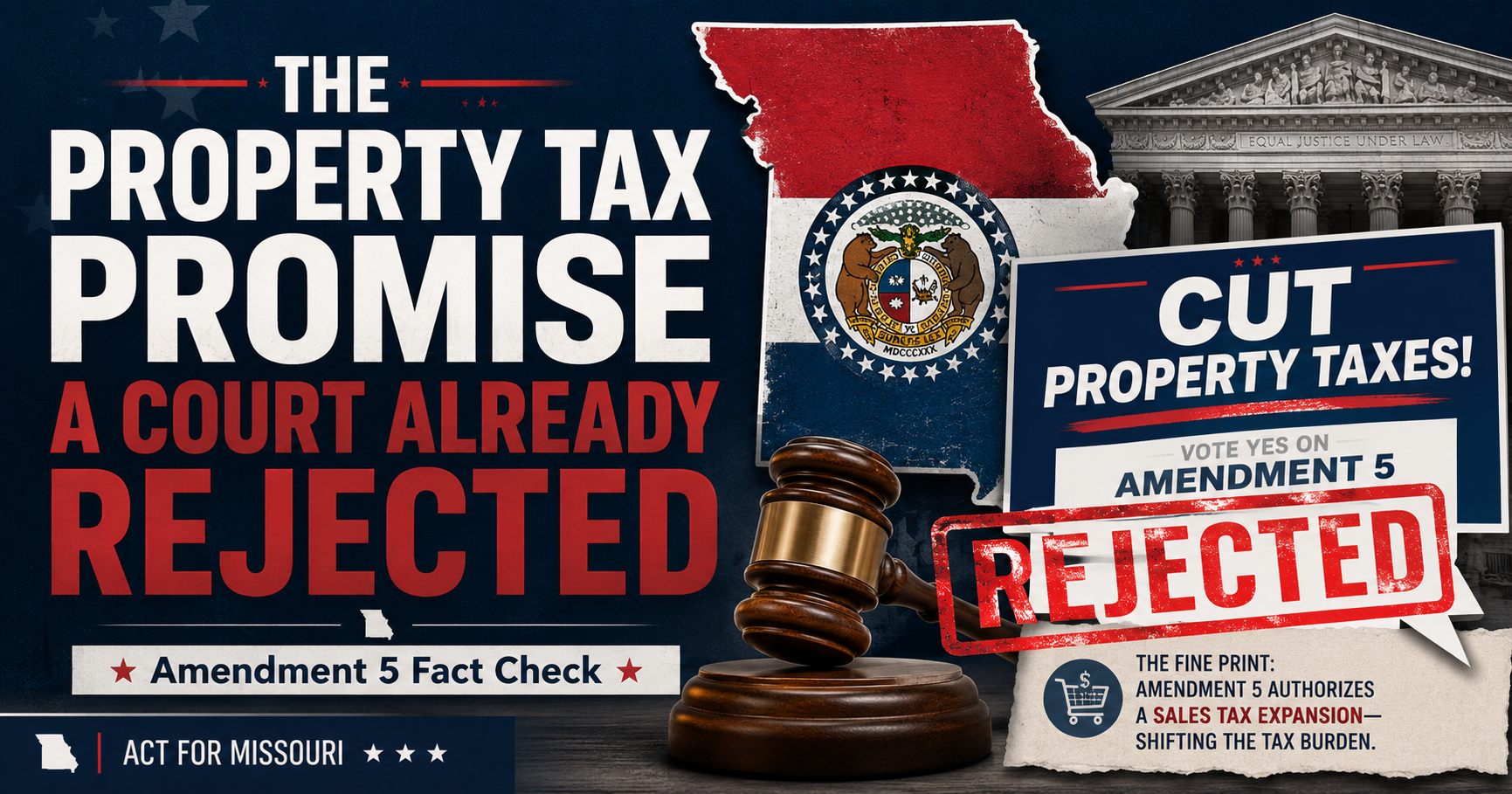
A thirty-one second radio and video ad now running in support of Amendment 5 tells Missouri voters the measure will "phase out taxes on paychecks and cut property taxes." Days before that ad reached our feeds, the Missouri Court of Appeals ruled that a nearly identical property tax claim — written by the General Assembly itself — was too misleading to appear on the August 4 ballot. The court found the original language unfair and insufficient and certified revised language. The campaign is now making the promise the court rejected, in paid advertising, to the same voters.
Act for Missouri supports eliminating the state individual income tax. We have said so repeatedly, and we mean it: through spending discipline and real economic growth, the way our neighbors are actually doing it. What we do not support is selling a constitutional tax swap to Missouri families with claims that the courts have already examined and found wanting. This article walks through what the ads and social media graphics are claiming, what the amendment's own text says, and what two courts actually ruled. At the end, we offer something we hope outlasts this election: a short field guide for catching deceptive ballot-measure claims yourself, no matter which side they come from.
A note on names. The advertisement quoted below was published by a political action committee that intervened in court to defend Amendment 5, and the social media graphic discussed later was circulated by an aligned advocacy account. We name them once here for the record — Missouri Promise PAC and Freedom Principle MO — and refer to them afterward simply as Amendment 5's proponents. This is not about two groups. It is about a pattern of claims that any group could repeat, and that every voter should be equipped to test.
What the Ad Says
Here is the ad, transcribed in full with timestamps:
(0:00–0:14) "This race is really heating up. Jobs, investment, quality of life, it's all on the line. Tennessee is in front. Oklahoma and Arkansas close behind. Blazing down the track now to phase out income taxes. Missouri is getting lapped."
(0:15–0:26) "Income and property taxes are really holding Missouri back. And costing families. To take the lead, Missouri needs Amendment 5. This August, phase out taxes on paychecks and cut property taxes."
(0:26–0:31) "X the tax and unleash prosperity with Amendment 5."
Thirty-one seconds. Two promises: paychecks untaxed, property taxes cut. And one omission we will come back to, because a court of appeals just held that the same omission made the official ballot language unfair to voters.
"Cut Property Taxes": The Four Links the Ad Skips
Missourians are frustrated with property taxes, and rightly so. The ad's authors know it — that is exactly why the promise is there. But for a Missouri homeowner to see a property tax reduction under Amendment 5, every link in a four-link chain has to hold. The ad mentions none of them.
Link one: the legislature has to act first
Amendment 5 does not cut a single tax by itself. In the very ruling Amendment 5's proponents have been citing all month, Cole County Circuit Judge Christopher Limbaugh described the measure plainly: the revised Section 26 "authorizes, but does not require, the General Assembly to expand the sales and use tax base." The Court of Appeals went further, agreeing that the original ballot summary was inaccurate precisely because it suggested the measure was self-executing when, in reality, it "grants legislative authority to enact legislation to achieve specified purposes rather than the Resolution itself imposing such an effect." No future legislation, no local tax adjustment. Ever.
Link two: a twelve-month clock
Even after the General Assembly passes a sales tax expansion, the local adjustment mechanism in Section 26.3(1) does not begin until twelve months after that legislation takes effect. The ad says "this August." The amendment says: someday, maybe, at least a year after a future legislature acts.
Link three: property tax is one option on a menu — and your city picks
This is the link that breaks the promise outright. When the adjustment finally triggers, Section 26.3(1) requires each political subdivision to reduce "one or more" of five tax rates: its sales and use tax rate, three categories of property levies, or its earnings tax rate. A city or county can satisfy the requirement entirely by trimming its own sales tax rate — and never touch property taxes at all.
You do not have to take our word for it. The Missouri Court of Appeals, Western District, said it directly in its June 5 opinion: because the menu of local rates "include[s] some property tax rates and some non-property tax rates, even if a local tax rate reduction were to occur, there would be no assurance that it would relate to property taxes."
No assurance. That is the controlling appellate court of this district, ruling on this amendment, days before the ad promised voters a property tax cut.
Link four: even the best case is a one-time offset, not a cut
Suppose every prior link holds and your county chooses a property levy from the menu. What does the amendment actually require? A "one-time adjustment" reducing revenue by an amount substantially equal to 97 percent of the additional sales tax revenue produced by the base expansion. Read that carefully. The "cut" is a partial offset of a brand-new tax the same families just started paying on goods and services that have never been taxed in Missouri — delivered once, with three percent of the new money retained. That is not property tax relief. That is a rebate on a tax increase, rounded down.
The Court Already Settled This Exact Question
Here is what makes the ad's property tax promise remarkable rather than merely optimistic. The General Assembly tried to make the same claim in the official ballot summary — promising voters the amendment would "reduce personal property and other local taxes when local revenues increase." Opponents challenged it. Proponents defended it. And on June 5, the Court of Appeals struck it.
Compare the language the legislature wrote with the language the court ordered in its place:
What the legislature wrote: "Reduce personal property and other local taxes when local revenues increase."
What the court certified instead: "Require local tax rate cuts without reducing school funding if local sales tax revenue increases."
Notice what disappeared: the words "personal property." The court removed the property tax promise because the amendment cannot guarantee it. And notice what else the court added to the ballot — language the legislature's version never breathed a word about: that the amendment would "authorize the expansion of sales and use taxes" and "curtail constitutional limits on taxing goods and services."
So the sequence is this: a court examined the property tax claim, found it could not be promised, and removed it from the ballot. A paid advertising promised it to voters anyway — in stronger terms than the language the court rejected.
The Race That Isn't
The ad opens with a race: Tennessee in front, Oklahoma and Arkansas closing fast, Missouri getting lapped. As a piece of rhetoric it works. As a description of reality it undermines the ad's own argument.
Tennessee is not "blazing down the track" to phase out a tax on paychecks. Tennessee has never taxed wages. The tax it phased out — the Hall tax, fully repealed by 2021 — applied only to interest and dividend income. There is no Tennessee precedent for what Amendment 5 proposes, because Tennessee never had the problem Amendment 5 claims to solve.
Oklahoma and Arkansas are the more interesting cases, because they are real — and because of how they are doing it. Oklahoma's phase-out took effect this January through ordinary legislation: House Bill 2764 cut the top rate from 4.75 to 4.5 percent and set quarter-point reductions that trigger only when revenue benchmarks are met, with a safeguard that automatically cancels any cut if a revenue failure is declared. Arkansas has cut its top individual rate four times since 2023 — most recently to 3.7 percent in a special session this May — each time funded by budget surpluses, with Governor Sanders saying she will phase out the income tax only "if it can be done responsibly."
Neither state amended its constitution. Neither state expanded its sales tax to cover "any goods and services." Neither state suspended a taxpayer-protection provision to do it. The states the ad holds up as the competition are eliminating income taxes the way Act for Missouri has argued from the beginning that Missouri should: through spending discipline, surplus management, and growth-triggered rate cuts passed by accountable legislators — not through a constitutional tax swap. The ad's own examples are an argument against the ad.
The Words the Ad Won't Say
Listen to the ad again. Thirty-one seconds about taxes being phased out, cut, and X'd — and not one mention of the words "sales tax." Yet the expansion of sales and use taxes to transactions involving any goods and services is, in the Court of Appeals' words, "the contemplated and planned means" by which everything else in the amendment happens. At oral argument, the State itself acknowledged the sales tax expansion was "certainly the plan."
This omission is not a quibble. It is the precise defect that caused the court to rewrite the official ballot language. The court held that it "is not fair and sufficient to repeatedly suggest to voters that various tax obligations will be reduced and eliminated without informing them, at any point or in any manner, of the expansive authority that will be granted regarding sales and use taxes." The legislature's summary failed that test, and a court corrected it. The campaign's advertising fails the same test — and no court can correct an ad. Only an informed voter can.
A Pattern, Not an Accident
The ad is not an isolated case. A social media graphic circulating in Missouri political groups this week claims that "Judge Limbaugh's ruling debunks anti-Amendment 5 myths" — including the supposed myth that the amendment affects the Hancock Amendment, which the graphic says the court "busted" by upholding the measure "with taxpayer protections intact."
Two problems. First, Judge Limbaugh never ruled on the Hancock Amendment. The question was not before him; his judgment addressed multiple-articles, single-subject, and ballot-language challenges, and you can read all ten pages without finding a Hancock holding. Second, the Court of Appeals did address Hancock — and reached the opposite of what the graphic claims. The court identified Article X, Section 18(e), the Hancock provision that caps revenue growth without voter approval, as a constitutional limit on taxation "that would be curtailed by enactment of the Resolution," noting that Amendment 5's own text exempts the new sales tax revenue from Section 18(e) for five years. That exemption is not an opponent's talking point. It is Section 26.2(2), written by the General Assembly, in the amendment voters are being asked to approve.
And the trial ruling the graphic celebrates? Reversed in part on June 5 — on exactly the question of whether voters were being told the truth. A campaign citing a partially reversed ruling as vindication, while ignoring the appellate opinion that reversed it, is making a bet: that voters will read the meme and not the rulings. We think that bet deserves to lose.
How to Spot a Deceptive Ballot-Measure Claim: Five Questions
Act for Missouri exists to educate, not just to argue. So set Amendment 5 aside for a moment. Between now and August 4 you will see dozens of ads, memes, and posts about four constitutional amendments — some honest, some not, on every side. Here are five questions that would have caught every problem documented in this article, and will catch the next one too.
1. Does the measure act, or merely allow? Read the actual text and watch the verbs. "Shall" commands; "may" permits. An ad that says a measure "will cut" something the text only authorizes a future legislature to address is selling you a possibility as a promise. Amendment 5's property tax language fails this test four separate times.
2. Who pays for the promise? Every tax cut in an ad has a funding source the ad may not mention. If thirty seconds of messaging describes only benefits and never names the revenue that replaces them, the omission is the message. When a court has to add the words "expansion of sales and use taxes" to a ballot because the authors left them out, you have your answer.
3. Did a court actually rule on that question? "The court upheld it" is doing a lot of work in campaign messaging. Courts rule on the specific legal questions in front of them — often narrow, procedural ones — not on whether a policy is good or whether every campaign claim about it is true. Before accepting that a judge "debunked" anything, find the ruling and search it for the actual subject. If the word "Hancock" never appears in a holding, the judge did not rule on Hancock.
4. Is the citation current? Court decisions get appealed, reversed, and superseded. A quote from a trial court means little if an appellate court has since reversed the relevant part — and a campaign that keeps citing the old ruling after the reversal is not confused. Check the date of the decision against the date of the post.
5. Compare the claim to the court-certified ballot language. For Amendment 5, a court has now written the neutral summary: require legislative phase-out of the income tax based on revenue growth and authorize the expansion of sales and use taxes; curtail constitutional limits on taxing goods and services; and require local tax rate cuts, without reducing school funding, if local sales tax revenue increases. That is the most fought-over, judicially scrubbed description of the measure in existence. Any ad whose claims cannot survive contact with those three bullet points is telling you something — about the ad.
Where We Stand
None of this requires you to oppose eliminating the income tax. We don't oppose it — we want it done, and done right: the Oklahoma way, the Arkansas way, through legislators who must answer for every budget they pass, not through a constitutional rewrite that expands the sales tax to everything, suspends a Hancock protection for five years, and asks voters to approve it on the strength of a property tax promise a court has already struck from the ballot.
The Court of Appeals put the principle better than we can: for the Missouri Constitution to remain a document reflecting the will of the people, "voters must be sufficiently informed of the purposes and central features of proposed changes to the Missouri Constitution so that they may exercise a voluntary choice." The courts have done their part — the ballot you see on August 4 will tell you the truth. The ads will not be under the same obligation. Read the rulings, not the press releases. Then vote like the constitution belongs to you. Because it does.
Sources: Full text of SS for SCS for HCS for HJR 173 & 174 (Amendment 5) · Missouri Court of Appeals, Western District, Owens v. Hoskins, WD88981, opinion filed June 5, 2026 · Circuit Court of Cole County judgment, Case No. 26AC-CC00237, June 1, 2026 · Oklahoma HB 2764 (2025) and HB 4072 (2026) · Arkansas HB 1001 / SB 1, First Extraordinary Session (2026). Transcript of the Amendment 5 advertisement on file with Act for Missouri.