
Amendment 4 Isn't Reform — It's a Power Grab
August 2026 Ballot | Missouri Constitutional Amendment 4
🎧 Listen to this article
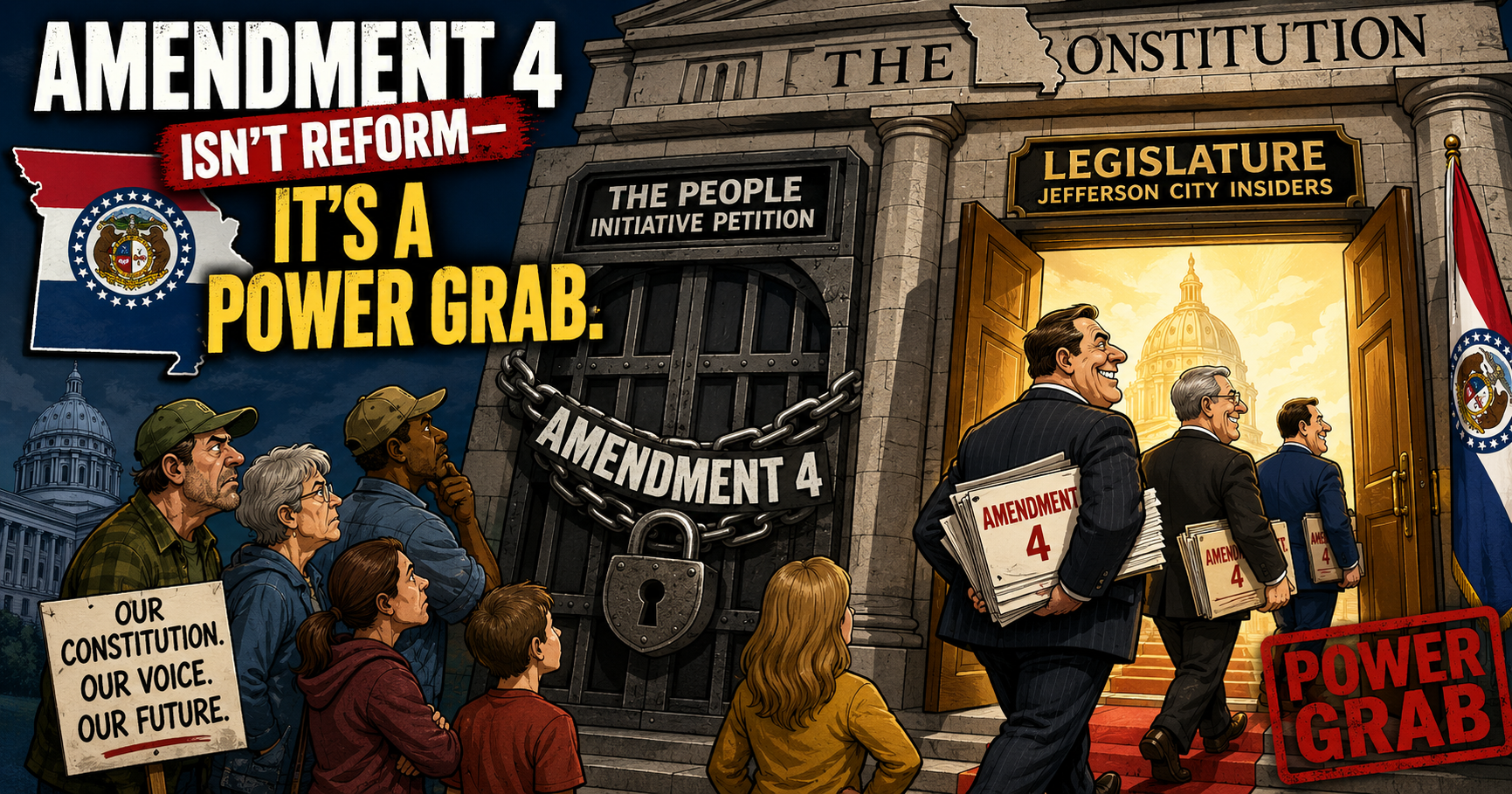
Missourians have wanted one thing for years: make it harder to put radical, out-of-state-funded measures into our State Constitution. Our Republican supermajority heard that frustration — and used it against us. Amendment 4, appearing on your August 4th, 2026 ballot, doesn't fix the problem. It eliminates the people's path to the Constitution while leaving the legislature's own path completely untouched.
That's not reform. That's a consolidation of power dressed up as one.
What Missourians Actually Wanted
Let's be honest about what the frustration was always really about. When Missourians watched well-funded out-of-state campaigns use the initiative petition process to enshrine things like abortion access and marijuana legalization directly into our Constitution, the reaction was: why is it so easy to permanently change our foundational governing document?
That concern is legitimate, and Act for Missouri shares it. Our State Constitution is not a policy manual. It should be hard to change — not impossible, but meaningfully difficult. The initiative petition process has real abuses worth addressing: foreign money, signature fraud, a lack of transparency.
But here's the distinction that got lost: the problem was never just the initiative petition process. The problem was the low threshold for amending our State Constitution at all — whether the amendment comes from the people or from the legislature. Missourians wanted constitutional amendment reform. What they got instead was initiative petition restriction — a very different thing, with very different consequences.
What Amendment 4 Actually Does
Amendment 4 contains several provisions wrapped in the appealing name "Protect Missouri Voters." Some of those provisions deserve scrutiny even before we get to the big one.
Take the foreign money ban. It sounds airtight — but it's narrower than advertised, and it addresses a loophole that already exists in federal law in a way that leaves other loopholes open. Here's what most people don't realize: under federal campaign finance law (FECA), foreign nationals are already prohibited from contributing to candidate elections. But federal courts have ruled that ballot measure campaigns are classified as "issue advocacy" — meaning foreign nationals, foreign corporations, and even foreign governments can legally contribute to ballot measure campaigns under current federal law. That's a real problem, and it's worth fixing.
Amendment 4, however, only bans contributions from "foreign adversaries of the United States" and "foreign nationals" — meaning individuals who are not U.S. citizens or lawful permanent residents. It does not address foreign-owned domestic corporations or domestic subsidiaries of foreign companies, which remain a significant vehicle for foreign money to enter American political campaigns. So the foreign money provision fills part of a real gap, but it's more limited than the name "Protect Missouri Voters" implies — and a narrower fix than what's actually needed.
Criminalizing petition signature fraud and requiring the full text of a measure to be available to voters are genuinely fine provisions. No argument there.
But the centerpiece of Amendment 4 — the provision that makes this amendment disqualifying — is Section 6:
Statewide ballot measures to amend the constitution that are proposed by initiative petition are approved only if affirmative votes are cast by a majority of voters in each congressional district in effect at the time of the vote.
Read that carefully. To pass a constitutional amendment through the initiative petition process, you would now need to win a majority in every single one of Missouri's eight congressional districts. All eight. Miss even one — even by a single vote — and the measure fails, regardless of how overwhelming the statewide vote is.
Meanwhile, the legislature may still place constitutional amendments on the ballot with a simple majority vote of both chambers and get those amendments ratified by a simple majority of statewide voters. No district-by-district requirement. No supermajority. No change whatsoever to the path they control.
This is a double standard written into the Missouri Constitution.
The Deck Is Already Stacked — This Stacks It Further
Missouri currently has eight congressional districts. Six of those districts lean Republican. Two — anchored by Kansas City and St. Louis — lean Democratic. Under Amendment 4, any initiative petition would need to carry all six Republican-leaning districts and both urban Democratic-leaning districts simultaneously.
In practical terms, that means virtually no initiative petition could ever pass again. Any measure with strong rural support but limited urban appeal fails. Any measure with strong urban support but limited rural appeal fails. This effectively blocks the people from ever putting forth an amendment that would be a check to the power of State government.
The initiative petition, as a check on an unresponsive legislature, would become a dead letter.
Our GOP Supermajority Did This
It's worth pausing on that. Missouri's Republican Party has held supermajorities in both chambers of the General Assembly for over a decade. They hold every statewide office. They have had unchecked control of state government for years — and during that time, Missouri has seen soaring property taxes, utility rate increases, cronyist tax incentive packages for corporate insiders, and a long list of conservative priorities left unaddressed.
The same supermajority that couldn't summon the will to rein in spending, audit special-interest tax credits, or protect Missourians from runaway property taxes found plenty of energy to pass Amendment 4 in a special session — because Amendment 4 benefits them. It closes the one door the people could still use to go around them.
And they did it without even allowing a full debate. When HJR 3 reached the Missouri Senate floor, Republican leadership used a procedural maneuver known as the "previous question" motion — the Senate's version of a nuclear option — to shut down debate and force an immediate vote. Leadership justified it as necessary to prevent a Democratic filibuster. But it wasn't only Democrats who were upset. Republican Sen. Joe Nicola of Independence was direct in his criticism: "This chamber should be very thoughtful and deliberate. We should have some honest debate." A bill that fundamentally alters how Missouri's Constitution can be amended — and that will be presented to voters as a permanent change — was pushed through the Senate without the honest debate even some Republicans said it deserved.
As we've said before and will say again: we are not interested in rubber-stamping legislation just because it has an "R" behind it. The Republican supermajority does not get a pass on a power grab simply because they also put a handful of legitimate reforms in the same package — and they certainly don't get a pass for ramming it through without debate.
It Doesn't Even Solve the Stated Problem
Proponents of Amendment 4 argue it will stop Kansas City and St. Louis from imposing their values on rural Missouri through the ballot box. It's a compelling scare tactic. But it doesn't hold up under scrutiny — for two reasons.
First, under the congressional district majority requirement, Kansas City and St. Louis could still block anything the rest of the state wants. The two urban-anchored districts would have veto power over every initiative petition, just as the six rural-leaning districts would. Amendment 4 doesn't give rural Missouri more power — it gives every congressional district veto power over every other. That's gridlock, not protection.
Second — and this is the point Amendment 4 supporters don't want to discuss — the legislature's path remains wide open. If Democrats ever regain control of the General Assembly, they can place gun control, expansive abortion language, or any other progressive priority onto the ballot as a legislative referral, with no district-by-district requirement. They'd only need a simple majority of legislators and a simple majority of statewide voters. The very outcomes Amendment 4 supporters say they fear are still perfectly achievable — just not by the people. Only by whoever controls Jefferson City.
Amendment 4 doesn't protect Missouri's Constitution from radical change. It just determines who gets to make radical changes. And the answer is: whoever runs the legislature.
What Real Reform Would Have Looked Like
Act for Missouri believes it should be meaningfully harder to amend Missouri's Constitution. We've said that consistently. But the reform has to be fair — applied equally to the people and to the legislature.
The approach we believe is most principled: require a majority of State House districts to approve any constitutional amendment — whether it comes from the people through initiative petition or from the legislature as a referral. That gives smaller communities and rural Missouri real representation in the process, while still preserving a realistic path for the people to act when the legislature won't.
Other approaches could work too — a higher statewide vote threshold, or using State Senate districts — as long as the same standard applies to both paths. What is completely unacceptable is a system where politicians can amend the Constitution easily and the people cannot.
During the special session that produced HJR 3 — now Amendment 4 — there was an alternative. Representative Bryant Wolfin introduced HJR 4, which would have required a two-thirds supermajority for any constitutional amendment, from the people or the legislature alike. It was the only truly equal proposal. It received no meaningful hearing. The Governor's preferred script was already written, and it didn't include equal standards.
That tells you everything you need to know about what Amendment 4 is really about.
The Missouri Constitution and the People's Authority
Missouri's own Constitution — the document Amendment 4 would alter — begins with this:
That all political power is vested in and derived from the people; all government of right originates from the people, is founded upon their will only, and is instituted solely for the good of the whole.
— Missouri Constitution, Article I, Section 1
And just a few lines later:
The people of this state have the inherent, sole and exclusive right to regulate the internal government and police thereof, and to alter and abolish their constitution and form of government whenever they may deem it necessary to their safety and happiness.
— Missouri Constitution, Article I, Section 3
These are not rhetorical flourishes. They are the foundational principles of Missouri's government. The initiative petition process is the mechanism by which these principles become actionable — the people's check on a legislature that is unresponsive or captured by special interests.
Amendment 4 does not reform that check. It effectively eliminates it — while leaving the legislature's own path to the Constitution untouched. That is precisely the kind of shift of power away from the people and toward government that Act for Missouri exists to oppose, regardless of which party is doing it.
Our Position: Vote NO on Amendment 4
We do not oppose every element of Amendment 4. The foreign money ban and the anti-fraud provisions are legitimate. But they are bundled with a structural change — the congressional district majority requirement — that is neither fair nor effective. And that structural change would do lasting damage to the people's ability to govern themselves in Missouri.
A vote for Amendment 4 is a vote to make the legislature the only realistic path to the Missouri Constitution. That is more power for Jefferson City insiders, not less. It is the opposite of what Missourians wanted when they called for reform.
We urge every Missourian who believes that political power belongs to the people — not to the party that happens to hold supermajority status at any given moment — to vote NO on Amendment 4 on August 4th, 2026.
Act for Missouri is a volunteer-led, principled conservative civic organization. We do not rubber-stamp legislation because it has an "R" behind it. We believe in principle over party. To read our previous coverage of HJR 3 during the 2025 special session, see Special Session or Political Theater? and Selling Us a Lemon. To learn more about who we are and what we believe, visit our About page.