
November 2026 Ballot - Amendment 7
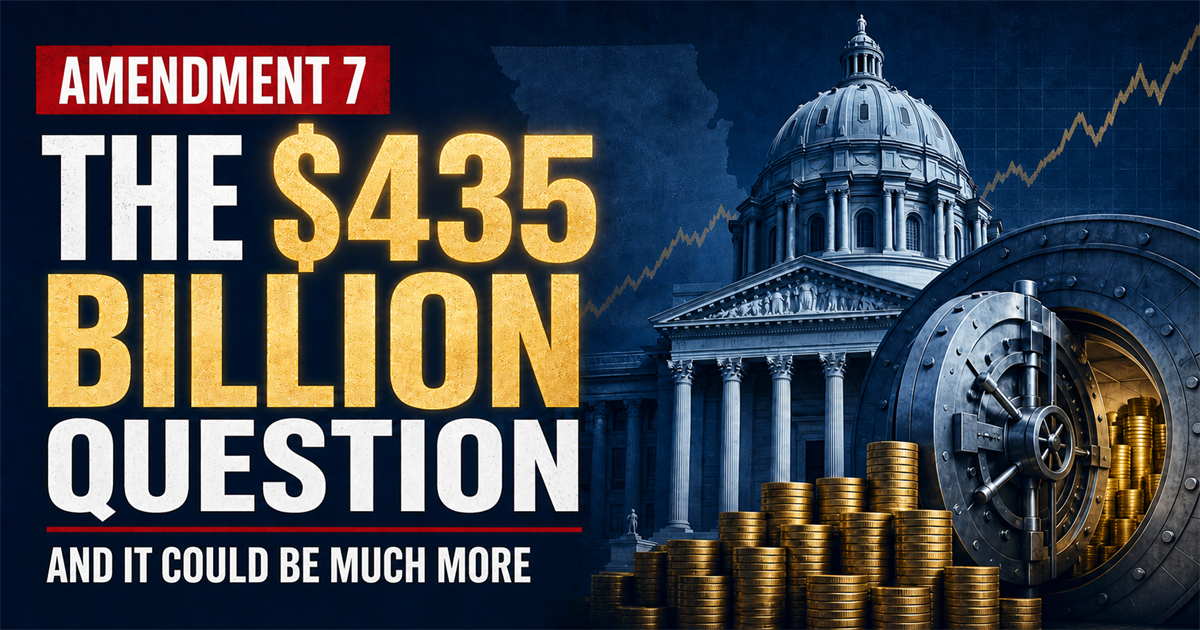
The $435 Billion Question—and Why Amendment 7 Could Require Even More
August 11, 2026 | Act for Missouri
Audio version
Listen to This Article
The $435 Billion Question—and Why Amendment 7 Could Require Even More
Having trouble playing the audio? Download the MP3.
Amendment 7 promises a future in which investment earnings support Missouri government and state taxes disappear. The appealing promise leaves voters with a much harder question: How much public money must be locked away, for how long, and who benefits while Missouri waits?
Act for Missouri's assessment
Vote NO on Amendment 7.
The proposal places an enormous and undefined financial commitment in the Missouri Constitution before answering essential questions about funding, tax replacement, investment-provider selection, fees, and accountability.
What Amendment 7 would create
Amendment 7 is the ballot version of Senate Joint Resolution 95. It would create the Show-Me Prosperity Fund, described as a permanent public endowment. The General Assembly could appropriate money into the fund, and the fund could also accept gifts, donations, grants, and bequests.
The State Treasurer would invest the money in exchange-traded funds that track the performance of the S&P 500, or a comparable successor index later designated by law. The proposal also says those investments must be made consistently with fiduciary standards applicable to public trust funds.
The fund's principal could not be appropriated, pledged, or borrowed against. Its balance and performance would have to be published at least quarterly, and the State Auditor would review compliance at least once every three fiscal years.
Citizen callout: What is an ETF?
An exchange-traded fund, or ETF, is a basket of investments whose shares trade on a stock exchange. An S&P 500 ETF is designed to follow the performance of 500 large American companies.
An ETF provider normally charges an annual management fee. The percentage can look tiny, but a tiny percentage of hundreds of billions of dollars can produce tens or hundreds of millions of dollars in annual fees.
No tax relief until the fund can replace all the listed taxes
The first major concern is the trigger. Amendment 7 says no money may be appropriated from the fund until the Treasurer notifies the General Assembly that the previous fiscal year's net investment earnings are sufficient to replace the revenue generated by all of the taxes listed in the amendment. The General Assembly must then approve that notification by concurrent resolution.
Those taxes include:
- The individual income tax;
- The state sales and use tax;
- The corporate income tax; and
- All other state-imposed taxes, with priorities to be determined later by law.
This matters because supporters may describe the plan as eliminating one tax at a time. The amendment may allow lawmakers to decide how tax elimination is implemented after the trigger, but it does not permit the fund to begin replacing even one tax until its earnings pass the all-taxes test.
The official fiscal note confirms this interpretation. The Department of Revenue concluded that no money could be appropriated until the fund was large enough to cover the listed taxes. Only then could the General Assembly begin using fund earnings to replace them.
"We are back to the question of TRUST."
Calzone called attention to the scale of the endowment and the trust voters would place in future legislatures. His observation is important because money deposited today could remain unavailable for tax relief or any other public purpose for generations.
Missouri voters have already sent a message about trust
Trust is not an abstract concern. In the August 2026 election, Missouri voters rejected two other legislatively referred constitutional amendments by overwhelming margins. More than 80% voted against Amendment 4, which would have raised the approval threshold for citizen-initiated constitutional amendments. Roughly 83% voted against Amendment 5, which would have directed the legislature to phase out the individual income tax and left major implementation decisions to lawmakers.
Amendments 4 and 5 were different proposals, and their defeats do not automatically decide Amendment 7. But the results are a clear warning against a “trust us; the details can come later” approach. Amendment 7 again asks citizens to approve the permanent constitutional structure first and trust future legislatures to decide how much money to commit, when to commit it, which taxes to eliminate first, and what protections should govern the investment-provider selection.
Why the trigger may require $435 billion—and possibly much more
An $8 billion illustration would cover only part of Amendment 7's requirement. The amendment does not allow the trigger to be based on the individual income tax alone. It requires enough net investment earnings to replace the revenue generated by the individual income tax, state sales and use tax, corporate income tax, and all other state-imposed taxes.
Missouri's June 2026 General Revenue report provides a useful current benchmark. For fiscal year 2026, it reported $9.14 billion in gross individual income tax collections, $3.40 billion in sales and use tax collections, and $763.1 million in corporate income and franchise tax collections. It also reported $576.2 million in pass-through entity taxes and $1.07 billion in other collections. After $1.89 billion in refunds, total net General Revenue collections were approximately $13.05 billion.
The constitutional text and fiscal note do not provide an official dollar total for the all-taxes trigger. Accordingly, $13.05 billion should be treated as a conservative benchmark, not a definitive forecast. The actual target would change with tax collections, tax laws, economic conditions, and the interpretation of “all other state-imposed tax.”
Citizen callout: Fees move the trigger
Without fees, approximately $163.1 billion earning 8% would produce $13.05 billion. But a 0.06% annual management fee would subtract about $97.9 million, leaving only about $12.95 billion before any other expenses.
Under those simplified assumptions, the fund would need approximately $164.4 billion to produce $13.05 billion after that fee. Fees also reduce the net earnings used for the trigger and slow the fund's growth while Missouri waits.
Amendment 7 contains a second rule: annual appropriations may not exceed 3% of the fund's average market value during the preceding five fiscal years. Under that limit, producing $13.05 billion of spendable money would require a five-year average fund value of approximately $435 billion.
Conservative illustration: replacing $13.05 billion annually
| Calculation | Approximate fund needed |
|---|---|
| One-year earnings test at 8% gross, after a 0.06% fee | About $164.4 billion |
| One-year earnings test at 6% gross, after a 0.06% fee | About $219.7 billion |
| Amount needed under the 3% spending limit | $435 billion |
This illustration uses FY2026 net General Revenue as a conservative proxy. It is not an official estimate of Amendment 7's all-taxes trigger.
Citizen callout: Why $435 billion may still be too low
General Revenue is not the same thing as every state-imposed tax. Missouri also collects state taxes that support dedicated funds. The Department of Revenue's fiscal year 2025 report lists approximately $18.57 billion in state taxes administered after excluding local sales and use taxes.
If that broader figure approximated the constitutional trigger, the 3% spending limit would require a fund of approximately $619 billion.
That does not establish the final legal number; the amendment and fiscal note do not calculate one. It demonstrates why $435 billion is best understood as a conservative benchmark—and why the actual requirement could be substantially higher.
The two constitutional tests do not line up. A strong stock-market year could allow the Treasurer to certify that annual earnings were sufficient, while the five-year spending limit could still prevent the fund from replacing the same amount of tax revenue.
Citizen callout: Why use a five-year average?
A five-year average smooths out market swings and helps protect the fund from spending too much after one unusually good year. That is a reasonable safeguard. The problem is that Amendment 7 uses one measurement for the trigger and a different, more restrictive measurement for the amount that can actually be spent.
The investment manager could collect very large fees
Amendment 7 does not name a particular ETF company. It directs the Treasurer to invest in ETFs tracking the S&P 500 and leaves the selection of qualifying investments to the Treasurer, subject to fiduciary standards and any applicable laws.
The amendment expressly defines net investment earnings after investment-management fees and expenses. It therefore anticipates that private firms will be paid from fund assets. Yet the amendment itself does not impose a fee cap, require selection of the lowest-cost qualifying fund, mandate competitive bidding, limit how much can be placed with one provider, or require an independent board to approve the selection.
The unanswered question: Who gets selected?
At the fund sizes contemplated here, the choice of ETF provider could direct tens or hundreds of millions of dollars in annual fees to a private firm. Amendment 7 itself does not require a public competitive-bidding process or write special conflict-of-interest protections into the Constitution.
Existing law may govern parts of a future selection, and the Treasurer would remain subject to fiduciary duties. But voters are not being guaranteed a public request for proposals, objective scoring, disclosure of political contributions and financial relationships, independent approval, or a mandatory recusal process.
Without those protections, how would Missouri prevent the selection from becoming a political reward—or even creating the appearance of one?
At a minimum, implementing law should require an open competitive process; published standards for fees, tracking accuracy, liquidity, and risk; disclosure of relevant political and financial relationships; mandatory recusals; independent review; and annual public reporting of every provider and every dollar of fees. Lawmakers could add those protections later, but Amendment 7 does not guarantee them, and a future legislature could change ordinary statutes.
Here is what several small annual fee rates would mean at different fund sizes:
Illustrative annual management fees
| Annual fee rate | On $435 billion | On $619 billion |
|---|---|---|
| 0.03% | $130.5 million | About $185.7 million |
| 0.06% | $261 million | About $371.4 million |
| 0.10% | $435 million | About $619 million |
These figures are illustrations, not predictions of the fee a Treasurer would negotiate or the amount any particular firm would receive.
Citizen callout: What does 0.06% mean?
A 0.06% fee equals six one-hundredths of one percent - or $6 a year for every $10,000 invested.
That sounds modest. Applied to a $435 billion public fund, however, the same percentage is approximately $261 million every year. At $619 billion, it would be approximately $371 million.
What the fiscal note does - and does not - tell voters
The final fiscal note, dated May 29, 2026, does not estimate how much Missouri would deposit, how long accumulation would take, how much foregone tax relief or public spending would result, or how much investment managers would receive.
Instead, the Oversight Division reports future General Revenue appropriations as $0 or unknown because the timing and amount would be left to future legislatures. It also says those discretionary appropriations could exceed $250,000 in a fiscal year.
Citizen callout: How can the ballot say "no costs or savings"?
The official ballot information says state and local governmental entities estimate no costs or savings. That does not mean the endowment can be built for free.
It means agencies could not calculate future discretionary deposits or later tax changes from the amendment alone. The fiscal note separately acknowledges that General Revenue transfers to the new fund could be substantial but are presently unknown.
The fiscal note also reports that the Treasurer's Office assumed no additional administrative fiscal impact. That is different from saying no private management fees will be paid. The constitutional text specifically subtracts management fees and expenses when defining net earnings.
A permanent endowment during a state budget squeeze
Amendment 7 does not require an immediate deposit. That makes the initial cost unknown, but it does not remove the tradeoff. Every future General Revenue dollar placed in the fund would become permanent principal that could not be appropriated, pledged, or borrowed against—even if the state later faced a budget emergency.
That deserves special attention now. In June 2026, the Missouri State Auditor warned that the budget then authorized by the General Assembly was projected to spend more than $1.7 billion above ongoing revenue in FY2027—nearly $2 billion. After vetoes and spending restrictions, the governor signed what his office described as a balanced FY2027 budget, but the administration still acknowledged that lawmakers had used $179.1 million in one-time cash for ongoing costs and that Missouri faced a projected FY2028 shortfall of more than $500 million.
Citizen callout: Saving is not free
A permanent endowment can be valuable when deposits come from genuine surpluses. But depositing money while recurring spending exceeds recurring revenue can force a choice among service cuts, other tax decisions, or using one-time money elsewhere in the budget.
Before authorizing this structure, voters should ask where the contributions would come from and whether Missouri can lock that money away without worsening an already difficult budget outlook.
There are safeguards, but important protections are missing
Amendment 7 contains several legitimate protections:
- The principal cannot be spent, pledged, or borrowed against.
- Annual appropriations are capped at 3% of the five-year average value.
- The fund's balance and performance must be updated at least quarterly.
- The State Auditor must audit compliance at least once every three fiscal years.
But the amendment leaves other essential protections unanswered:
- No dedicated funding source or contribution schedule;
- No deadline or realistic forecast for reaching the trigger;
- No constitutional fee ceiling;
- No constitutional competitive-selection process for ETF providers;
- No requirement to publish competing bids, expense ratios, tracking error, or total fees;
- No provider-concentration limit;
- No special disclosure or recusal rule for campaign contributions or financial relationships involving officials and investment providers; and
- No clear solution when the one-year earnings trigger is met but the five-year spending cap cannot replace the taxes.
The promise is simple. The commitment is not.
Eliminating taxes through investment earnings is an attractive goal. But Amendment 7 asks voters to place a permanent structure in the Missouri Constitution before lawmakers identify where the money will come from, how much will be required, how providers will be selected, or how fees and conflicts will be controlled.
Missourians could contribute enormous sums for decades - perhaps generations - without receiving any tax relief. Using current net General Revenue as a conservative proxy produces a $435 billion requirement under the 3% spending limit, while a broader measure of state taxes points above $600 billion. The target would keep moving as revenues change, and fees would be deducted before the trigger is tested. Meanwhile, the firms selected to manage the money could earn substantial annual fees long before the fund eliminates a single tax.
A sound constitutional amendment should resolve those questions before asking voters for permanent authority. Amendment 7 does not.
Act for Missouri recommendation
Vote NO on Amendment 7.
Missouri should not constitutionalize an undefined investment commitment that could approach or exceed half a trillion dollars without enforceable funding, fee, procurement, conflict-of-interest, and tax-replacement safeguards.
Read the source documents
- Final text of SJR 95 / Amendment 7
- Final fiscal note for SJR 95
- Missouri Secretary of State ballot language
- Ron Calzone's August 7 commentary
- August 2026 results for Amendments 4 and 5
- Missouri's June 2026 General Revenue report
- Missouri Department of Revenue fiscal year 2025 Financial and Statistical Report
- Missouri State Auditor's June 2026 budget warning
- Governor's FY2027 signed-budget announcement