
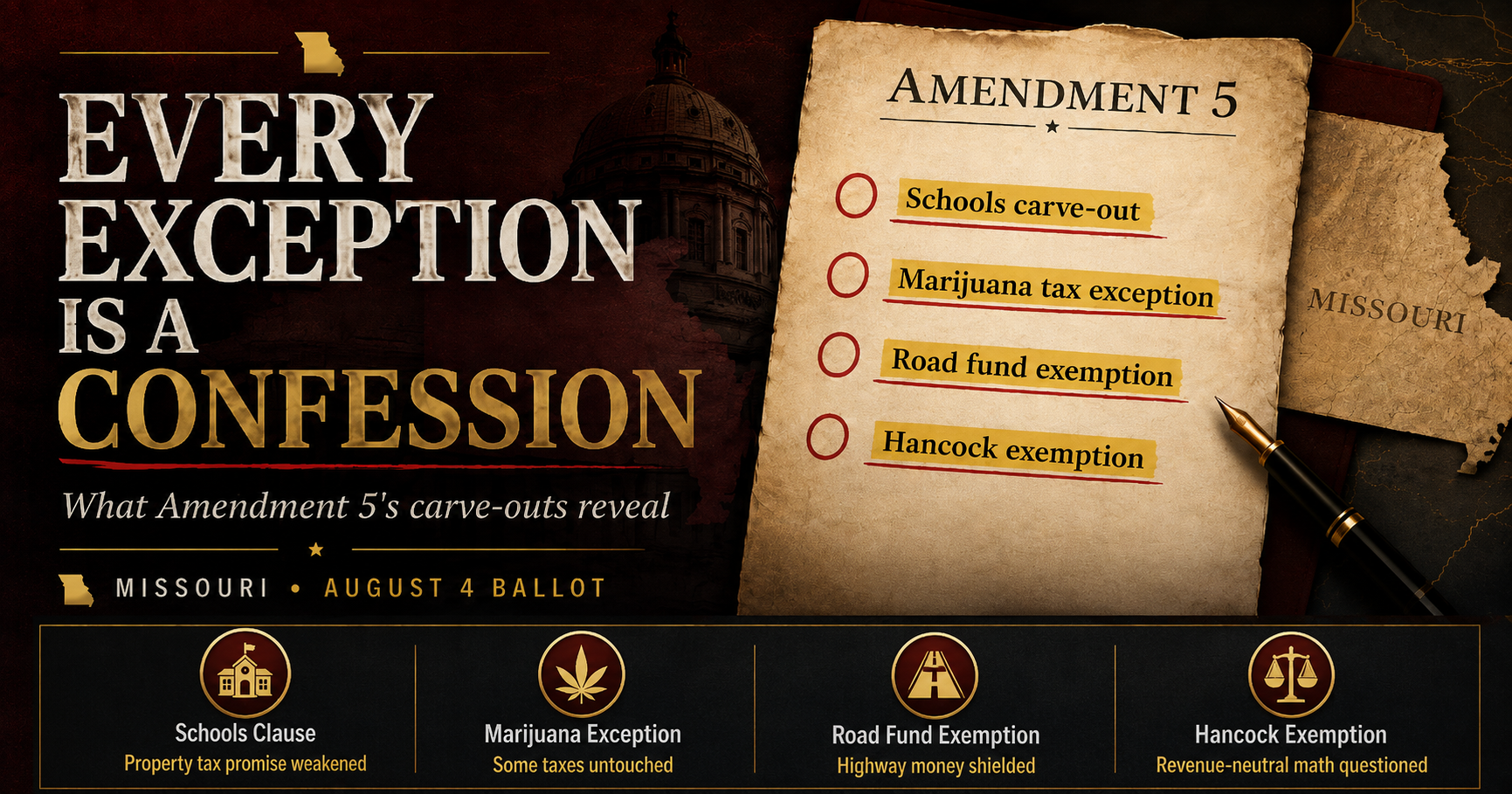
Every Exception Is a Confession
Amendment 5 on the August 4 ballot • Part two of our series on what the text of Amendment 5 actually says. Read part one here.
Audio covers the main article. Background boxes and source links are on this page below.
The Short Version
Four exceptions its drafters wrote in — and what each one admits. Tap any line to jump to it.
- 1. They shielded the schools. The one clause protecting school funding is also the reason the ads' promise of lower property taxes is unlikely to ever reach your bill.
- 2. They spared the marijuana tax. Every other sales tax rate in the constitution gets cut. Article XIV doesn't. Proof they went through the constitution line by line — nothing here is accidental.
- 3. They exempted your highway money. The amendment waives the constitutional guarantee that vehicle taxes fund roads — and says nothing at all about tolls, in a session when a toll bill was filed down the hall.
- 4. They exempted themselves from your vote. "Revenue-neutral" appears nowhere in the text. And a truly revenue-neutral plan wouldn't need the Hancock exemption they wrote for it.
- The pattern. They drafted protection for everything they cared to protect. You are not on the list.
Lawyers who write constitutional amendments do not include stray lines. Every "notwithstanding," every "except," every "shall not" is there because someone anticipated a specific consequence and drafted around it. So instead of asking what Amendment 5's supporters say it does, let's read what its exceptions admit it does.
The principle is simple: drafters don't spend words protecting against consequences they don't expect. When an amendment carves out a shield for one party, the carve-out is the drafters' own admission that everyone without a shield is exposed. In a constitutional amendment, every exception is a confession.
Amendment 5 contains four of them. Let's take them in order.
Exhibit One: The Schools Clause — a Confession of Harm
If you've watched the ads running across Missouri, you've heard the pitch: Amendment 5 won't just eliminate your income tax — it will lower your property taxes too. Two tax cuts for one vote. And it's that second claim doing the heavy lifting, because it lands on a number you can picture: the bill you pay every December.
Now here is what the ads don't tell you. Buried in Amendment 5's own text is an exception — a single sentence about public schools — that makes that promise unlikely to ever be delivered. To see why, you need two minutes with the amendment's local tax machinery. Stay with us; it is your property tax bill on the table.
Amendment 5 forces a rollback on local governments. Twelve months after the legislature expands the sales tax base, every political subdivision that imposes a sales or use tax must make a one-time cut to its local tax rates — its sales tax, its property tax levies, or its earnings tax — deep enough to give back 97% of the new revenue the expansion produces.
Background: How the local rollback works, in the amendment's own terms
Under new Section 26, subsection 3(1), beginning twelve months after the legislature expands the sales tax base, any political subdivision that imposes a sales or use tax must make a "one-time adjustment to one or more" of the following, cutting revenue by an amount "substantially equal to ninety-seven percent" of the new revenue the expansion produces for it:
- Its sales and use tax rate;
- Its levy on class 2 (agricultural) property;
- Its levy on subclass (1) of class 1 (residential) property;
- Its levy on all class 1 property, if it uses a single rate; or
- Its earnings tax rate.
Two details deserve attention. First, the trigger: the rollback applies only to subdivisions that impose a sales or use tax. Second, the phrase "one or more": the subdivision chooses which tax to cut — and the cut can land on a different tax than the one that produced the windfall. The manner of the adjustment is left to future legislation.
And then comes the exception. Subdivision (2) of that same subsection:
"...no political subdivision shall adjust its local tax rates in a manner that results in any reduction in funding to any public schools within, or serving, such political subdivision."
That sentence does more work than it appears to. Follow it through the machinery and it dismantles the ads' promise twice over.
First: the biggest line on your property tax bill is excluded before the process even begins. Missouri school districts do not impose sales or use taxes — their local funding comes overwhelmingly from property taxes. That means school districts are never even subject to the rollback trigger. And the schools clause then walls off school funding from every other subdivision's adjustments. Put the two together: the school levy — typically the largest single line on a Missouri property tax bill, often larger than everything else combined — is structurally guaranteed to be untouched. Whatever "local tax relief" this amendment produces, the biggest piece of your property tax bill is constitutionally out of its reach.
Background: Who pays for Missouri's public schools?
Local property taxes are the single largest funding source for Missouri's public schools, and school district levies typically make up the largest share of a Missouri property owner's total tax bill — commonly more than all other local levies combined. Schools also receive the proceeds of the statewide 1% Proposition C sales tax (approved by voters in 1982) and state foundation formula payments.
That is why the schools clause has the property tax consequence described above: the biggest piece of your property tax bill belongs to entities the rollback can never reach.
Second: the schools clause rigs the menu against the rest of your property tax bill too. A local government facing the rollback must choose which of its five listed rates to cut — and the schools clause makes the property tax options the ones no rational official will pick. Property taxes are the very instrument public schools live on. Any subdivision that adjusts a property levy is walking into the one guarantee in the amendment backed by a lawsuit: that nothing it does may reduce school funding by a dime. Trimming its sales tax rate sits right there on the same menu — clean and litigation-proof.
And consider what choosing the property tax route would actually mean where you live. Property levies are the funding backbone of the local services this amendment leaves unshielded — fire protection districts, ambulance districts, public libraries, county road and bridge funds. A subdivision that takes its required cut out of property levies is taking it out of firehouses and library hours; a subdivision that trims its sales tax rate spreads the cut thin across every purchase in town. Between a choice that risks a school-funding lawsuit and concentrates the pain on first responders, and a choice that does neither, the outcome is not hard to predict. Of the five options on the amendment's menu, property tax relief is the one its own design makes least likely to ever be chosen.
You don't have to take our word for the gap between the advertising and the text. The legislature wrote the promise into its own ballot summary — "reduce personal property and other local taxes when local revenues increase" — and Missouri's courts took it off the ballot. On June 5, 2026, the Western District Court of Appeals unanimously held that the legislature's summary was insufficient and rewrote it; the Missouri Supreme Court declined to disturb the rewrite three days later. The summary voters will actually see tells you the amendment would "curtail constitutional limits on taxing goods and services." The ads are still selling the version the courts refused to print.
Background: What happened to Amendment 5's ballot language?
The General Assembly wrote its own summary for Amendment 5 into the resolution, promising among other things to "reduce personal property and other local taxes when local revenues increase" and to "protect local funding for public schools and other purposes."
On June 5, 2026, the Missouri Western District Court of Appeals unanimously found that summary insufficient and replaced it. The court-written summary voters will see on August 4 instead says the amendment would "require legislative phase-out of the individual state income tax based on revenue growth, and authorize the expansion of sales and use taxes" and "curtail constitutional limits on taxing goods and services." Proponents appealed; on June 8, 2026, the Missouri Supreme Court declined to hear the case, leaving the court's language in place.
Keep that history in mind whenever a campaign ad quotes the friendlier phrasing: the version promising local tax relief is the version Missouri's courts refused to put in front of you.
So hold the ad against the machinery one last time. The biggest line on your property tax bill can never be touched. The remaining property levies are the options every local government has the strongest reasons to avoid. Whatever relief materializes, if any materializes at all, will almost certainly arrive as a small trim to a sales tax rate — while your property tax bill stays exactly where it is. The campaign promises what the fine print forecloses.
Now step back and read the schools clause the way this series reads everything: as a confession. Ask the obvious question — if the rollback machine doesn't cut anyone's funding, why does one entity need a shield from it? The exception exists because the drafters know what their own machine does. They know that when a county or city is forced to cut "one or more" of several different tax rates to offset a sales tax windfall, the levy that gets cut and the funds that receive the windfall may not belong to the same people. The drafters saw that risk clearly — clearly enough to build a shield against it.
They built exactly one.
Read the list of who is not on it. Fire protection districts. Ambulance districts. Public libraries. County road and bridge funds. Senior services levies. Law enforcement sales taxes. Every one of these is funded by the very instruments the rollback targets — and not one of them receives the protection the drafters deemed necessary for schools. When Amendment 5's supporters point to the schools clause as proof the measure is safe, turn the clause around: it isn't reassurance. It is the drafters' own damage assessment, with a single name shielded and every other local service left standing in the open.
So the schools clause tells you two things at once, and both of them are about trust. It is proof the drafters knew their machine cuts local funding — they wrote a shield against exactly that. And it is a measure of what this amendment's authors do when they actually mean something: they write it down, in enforceable words. School funding got a written constitutional guarantee. Your property tax relief got a television ad. When the same document offers you both, trust the ink.
Exhibit Two: The Marijuana Exception — a Confession of Deliberateness
Amendment 5's fourth subsection requires that every sales tax rate written directly into the Missouri Constitution be cut. The logic is windfall control: those constitutional rates ride on the general sales tax base, so when the base expands to services, they would suddenly apply to far more transactions and collect a windfall. The amendment orders their rates reduced by enough to cancel it, with the State Auditor calculating the new, lower rates. The conservation sales tax rate — cut. The parks and soils tax rate — cut. And then, mid-sentence, an exception:
"...each sales and use tax rate imposed directly by this constitution, with the exception of the rate imposed under Article XIV of this Constitution, shall... be adjusted..."
Article XIV is the marijuana article. The constitutional sales taxes on marijuana are the only rates in the entire constitution that Amendment 5 leaves untouched.
Background: The sales taxes written directly into Missouri's constitution
Most sales taxes in Missouri are statutory. A few are imposed by the constitution itself, which is why only a constitutional amendment can adjust them:
- Conservation sales tax (Article IV, Section 43(a)): one-eighth of one percent, approved by voters in 1976, funding the Department of Conservation. Rate cut by Amendment 5 to offset the windfall from the broader base.
- Parks, soils and water sales tax (Article IV, Section 47(a)): one-tenth of one percent, first approved in 1984 and renewed by voters since, most recently in 2016. Rate cut by Amendment 5 to offset the windfall from the broader base.
- Marijuana sales taxes (Article XIV): 6% on adult-use sales (approved 2022) and 4% on medical sales (approved 2018), with revenue directed to veterans' services, expungement costs, and other purposes. Exempted from the rate adjustment — left exactly as voters set them.
We are not going to speculate here about why. There are plausible, even boring, explanations — Article XIV has its own voter-approved structure, with revenue earmarked for veterans' services and other programs, and touching it invites litigation. Fine.
The point of this exhibit is not marijuana. The point is method. To write that exception, the drafters had to go through the constitution tax by tax, make a list, and decide the fate of each one. Conservation: cut. Parks: cut. Marijuana: spared. They found Article XIV. They weighed it. They wrote eleven words to protect it.
Hold onto that fact, because it controls how you read everything else in the amendment. Nothing in this document is accidental. Whatever the drafters exempted, they chose to exempt. And whatever they left out, they chose to leave out.
Which brings us to the third exhibit.
Exhibit Three: The Road Fund Exemption — a Confession About Your Highway Money
Why does a tax amendment reach into the transportation article of the constitution at all?
Amendment 5 declares that revenue from the sales tax expansion "shall be exempt from the provisions of Article IV, Sections 30(b), 30(c), and 30(d)." As we detailed in part one, those are the provisions that dedicate taxes on motor vehicles to roads and bridges, govern the transportation funds, and prohibit diverting highway-user money anywhere else. Missouri courts have enforced them with unusual strictness — even the interest on the road fund can't be diverted to general revenue.
You do not exempt yourself from a rule you never expect to trigger. The exemption is the drafters' admission that, without it, a real portion of the new sales tax money would constitutionally belong to Missouri's roads. Amendment 5 keeps it in general revenue instead — and, as part one showed, there is no date in the text on which that exemption ends.
And here is where the deliberateness proven by Exhibit Two pays off. Look at the precision of the carve-out: the amendment waives Sections 30(b), 30(c), and 30(d) — but not Section 30(a). Why? Because 30(a) governs the motor fuel tax, a per-gallon excise the sales tax expansion never touches. There was nothing in 30(a) for the new money to collide with, so the drafters didn't waive it. They waived exactly the three sections their revenue would otherwise run into — nothing more, nothing less. Surgical. These are people who account for every line.
So now consider the lines that are not there.
Missouri's wall against toll roads is not a talking point — it is history written by courts and voters alike. In 1968, the Supreme Court of Missouri unanimously struck down the legislature's first toll road law, holding in Pohl v. State Highway Commission that road fund revenue is dedicated to free public highways and cannot be diverted, or even made subject to diversion, to pay for a toll road. Missouri voters then rejected statewide toll road amendments outright — in 1970 and again in 1992. And when the legislature last asked voters to fund transportation through a general sales tax, 2014's Amendment 7, the drafters wrote the guarantee directly into the text: the highways and transportation commission "shall not authorize, own, or operate a toll highway or toll bridge on a state highway or bridge" while the tax was in effect.
That 2014 measure has a face you will recognize. The transportation sales tax was championed by then-Senator Mike Kehoe, who built the proposal around exactly those assurances — a frozen gas tax and a promise that existing roads could not be converted to toll roads. "There's nothing tricky that we're trying to hide here," Senator Kehoe said when he introduced the concept. Voters rejected it anyway. Twelve years later, it is Governor Kehoe's signature on the proclamation placing Amendment 5 on your August ballot — a far larger restructuring of how Missouri government is funded, reaching directly into the road fund's protections, with no toll guarantee anywhere in its text.
Is that omission theoretical? Consider what else happened in the Capitol this very session. In February 2026, House Joint Resolution 194 was filed. It would have authorized the expenditure of state funds to construct and operate toll roads on Missouri's interstates and four-lane highways — the very use of road money that Pohl held unconstitutional in 1968. Notice why that idea had to arrive as a constitutional amendment rather than an ordinary bill: Section 30(b) and its companion road fund provisions are the wall standing between Missouri and toll roads, and only an amendment can breach it. HJR 194 targeted that wall directly — and it would have exempted the toll revenue from the Hancock Amendment's definitions in Article X, including "new annual revenues" under Section 18(e). Now hold HJR 194 next to Amendment 5 and count what they have in common: both reach into the Article IV road fund protections, and both use the identical Hancock exemption toolkit. HJR 194 died in committee without a hearing. But it tells you something Amendment 5's supporters won't: the toll roads idea is not a scare story from the past. It was filed, in writing, in the same building, in the same session that sent Amendment 5 to your ballot — drafted with the same tools.
Let us be precise about what we are and are not saying, because precision is the entire point of this series. Amendment 5 does not authorize toll roads. HJR 194 affirmatively proposed toll authority; Amendment 5 only exempts qualifying legislation from the road fund's constraints. Whether that exemption could ever be stretched toward something toll-like is a genuinely open legal question — and here is the uncomfortable part: nobody, including the amendment's supporters, can tell you what legislation the General Assembly will pass inside the five-year window, or how creatively it might use the exemptions that window hands out. You are being asked to lower the constitutional wall first and find out what walks through it afterward. We are raising the question the drafting demands: these careful, thorough, line-by-line drafters found the marijuana tax, shielded the schools, and distinguished Section 30(a) from 30(b) with a scalpel. On the subject of tolls — a subject their own building took up this very session, and a subject the last such measure addressed with an express guarantee — they wrote nothing. If every line in this document has a purpose, what is the purpose of the missing one?
Background: Missouri's long record of saying no to toll roads
- 1968: The Supreme Court of Missouri unanimously strikes down the Missouri Turnpike Authority Act in Pohl v. State Highway Commission, holding that Article IV road fund money is dedicated to free public highways.
- 1970 and 1992: Missouri voters reject statewide toll road constitutional amendments at the ballot box — twice.
- 2014: The legislature's transportation sales tax proposal (Amendment 7) includes an express prohibition on the commission authorizing, owning, or operating toll highways or bridges. Voters reject the tax itself, 59% to 41%.
- 2026: HJR 194 is filed in the Missouri House, proposing to authorize state funds for constructing and operating toll roads on interstates and four-lane highways and to exempt toll revenue from Hancock Amendment definitions. It dies in committee without a hearing — in the same session that sends Amendment 5 to the ballot.
Exhibit Four: The Hancock Exemption — a Confession About the Math
The fourth confession is the quietest, and it may be the most important, because it concerns the amendment's central promise.
Listen to how each side describes this plan. Opponents call it a tax swap — new sales taxes traded for the income tax. Supporters prefer grander language: a "framework," or simply "the elimination of the income tax." And they lean on one reassuring phrase above all: revenue-neutral. New sales taxes in, income taxes out, no net increase to you.
Here is something worth knowing before we go any further: the words "revenue-neutral" appear nowhere in Amendment 5. Not once. Search the text yourself. The closest the amendment comes is a requirement that any sales tax expansion be offset in the same legislation by income tax cuts "at least substantially equal" to the new revenue. "Substantially equal" is not "equal" — it is a lawyer's cushion, and no one can tell you today how much slack a future court will find in it. The neutrality lives in the talking points; the text guarantees only "substantially."
Now read what the very same sentence does next: it declares that the new revenue "shall not be considered new annual revenue for the purposes of Section 18(e)" — the Hancock Amendment's requirement that large tax increases go to a vote of the people.
Here is what makes that exemption remarkable. Section 18(e) already nets tax increases against tax cuts: it counts only "the net increase in annual revenues... less all contemporaneously occurring tax or fee reductions." Legislation that is genuinely revenue-neutral — new sales tax in, equal income tax out, in the same bill — would net to approximately zero under Hancock's own formula. It would need no exemption at all.
The exemption has exactly one job: to cover the case where the new sales tax revenue exceeds the income tax cuts — the case where the plan is a net tax increase. That is the one scenario in which Section 18(e) would otherwise demand a public vote, and it is the one scenario the drafters made sure to immunize. They left "revenue-neutral" out of the text, wrote "substantially equal" in its place, and then bought insurance against the gap between the two. In a document where every line has a purpose, ask what this one is for.
Background: The Hancock Amendment — the two locks Missouri voters installed
In 1980, Missouri voters used the initiative petition to adopt the Hancock Amendment (Article X, Sections 16–24), named for its author, Springfield businessman and later Congressman Mel Hancock. Its core idea: state revenue should not grow faster than the incomes of the Missourians who fund it, and tax increases beyond set limits require the people's consent.
After lawmakers enacted major tax increases in the early 1990s without asking voters, Missourians added a second lock: on April 2, 1996, voters approved Section 18(e), which prohibits the General Assembly from enacting tax or fee increases producing new annual revenue above a threshold — for fiscal year 2025, about $150 million — without a statewide vote. Enforcement has real teeth on paper: any taxpayer or statewide elected official can sue, the Missouri Supreme Court has original jurisdiction, and courts must invalidate taxes that should have gone to a vote.
Amendment 5's tax swap would restructure revenue on the order of billions of dollars per year — dozens of times the annual threshold that normally triggers a mandatory public vote.
Supporters have a ready rebuttal here, and you should hear it before they offer it: the Hancock Amendment is broken anyway, so the exemption takes nothing from you. It's true that parts of Hancock have aged badly — the 1980 revenue ceiling is tied to obsolete formulas and hasn't produced a refund since 1999. But Section 18(e), the part Amendment 5 actually exempts, has a record worth examining — and the record shows a rule that works.
Background: Has Section 18(e) actually worked? The thirty-year record
Ask a simple question: since 1996, what large statewide tax increases has the General Assembly enacted without voter approval? The record, drawn from the State Auditor's annual Hancock compliance reviews:
- When the legislature wanted big transportation money, it asked the voters — referring the 2014 transportation sales tax (Amendment 7) and the 2018 gas tax increase (Proposition D) to the ballot. Voters said no both times.
- When the legislature raised the gas tax in 2021 without a vote, it engineered the bill around Hancock's text — five annual 2.5-cent steps, plus a refund mechanism letting any driver claim back the increase. Section 18(e) counts new revenue "less applicable refunds," so the refund design shrinks the revenue that counts against the cap. The bill's own House handler described the rebate as the way taxpayers could "essentially vote on the increase."
- When the legislature enacted the online sales tax the same year, it paired the increase with income tax cuts in the same bill — and Section 18(e) nets increases against contemporaneous reductions.
- Per the State Auditor, the Section 18(e) limit has been projected to be exceeded exactly once since 1996 — the 2016 session — and as recently as June 2026 the Auditor found the state in compliance.
In thirty years, the legislature has either asked permission or engineered careful compliance. Nobody tunnels under a fence that isn't there. The workarounds are the proof that Section 18(e) binds — and Amendment 5's express exemption is the final piece of that proof. Drafters do not waive dead letters.
So when someone tells you the Hancock exemption is harmless because Hancock no longer works, notice what they've done: they've pointed to the wounds in the taxpayer's protections as a reason to inflict another one. We'd draw the opposite lesson. The parts of Hancock that failed are the parts lawmakers found ways around. The part that still works — your vote on big tax increases — is the part Amendment 5 switches off.
Background: The 2021 online sales tax — the difference between enforcing a tax and inventing one
You might wonder how the 2021 online sales tax law got past the 2016 taxpayer protection (Article X, Section 26), which prohibits taxing any service or transaction that wasn't taxed on January 1, 2015. The answer: it didn't need to get past it. Goods bought from out-of-state sellers were already subject to Missouri's use tax, which has been on the books since 1959 — before 2021, the obligation simply fell on the consumer to self-report. The 2021 law changed who collects (requiring remote sellers and marketplaces to collect and remit, as the U.S. Supreme Court's Wayfair decision allows), not what is taxed. And cities and counties without a local use tax still had to pass one by a local vote to capture their share.
Here is the lesson. The 2016 protection has never blocked the legislature from enforcing or modernizing existing taxes — it blocks only new taxation, which was its entire point. Amendment 5 cannot work within that protection the way the 2021 law did, because taxing services for the first time is precisely what the protection prohibits. So Amendment 5 repeals it.
The Pattern — and the Question of Trust
Step back and look at the full list of who received drafted protection in Amendment 5:
The public schools got a shield from the local rollback. The marijuana tax got a shield from the rate cut. The general revenue fund got a shield from the constitution's highway earmark. And the "revenue-neutral" plan got a shield from the one provision that only matters if it isn't revenue-neutral.
The drafters anticipated their amendment's consequences with precision, and they drafted protection for everything they cared to protect. Your county's fire district is not on the list. Your library is not on the list. Your ambulance district, your road and bridge fund, your senior services levy — not on the list. The school share of your property tax bill can never be part of the promised relief, the toll guarantee that fit in 2014's text is missing from 2026's, and the public vote that would referee the math has been drafted out of the rulebook.
In a constitutional amendment, every exception is a confession — and every omission is a choice. The only party this document drafts no protection for is you.
One more thing, offered in the spirit of principle over party. The forty-year history of working around the Hancock Amendment belongs to no single party. The tax increases that provoked voters to add Section 18(e) in 1996 were enacted by a Democratic legislature and governor. The two recent bills engineered around Section 18(e)'s text — the 2021 gas tax and the 2021 online sales tax package — were the work of the current Republican supermajority, many of whose members still serve in the General Assembly that sent Amendment 5 to your ballot. That is precisely the point. Constitutional protections exist because no majority, of either party, can be trusted with unwatched power over your wallet — including the ones you voted for. A supermajority that has already demonstrated its skill at slipping the leash is now asking you to unbuckle it. The request itself is the reason to refuse.
And as we showed in part one, because all of this is being welded into the constitution rather than passed as a statute, none of it — not the rollback, not the exemptions, not anything the drafters got wrong — can be fixed without another statewide election.
Sources & read it yourself
Every clause quoted in this article is checkable against primary sources:
- Full text of SS SCS HCS HJRs 173 & 174 (Amendment 5), Truly Agreed and Finally Passed, from the Missouri House: documents.house.mo.gov (PDF) — the schools clause is Section 26.3(2); the Article XIV exception is in Section 26.4; the road fund and Hancock exemptions are in Section 26.2(2)
- The legislature's original ballot summary, from Section B of the same enrolled text — superseded by the Western District Court of Appeals' unanimous June 5, 2026 opinion rewriting the summary; the Missouri Supreme Court declined review on June 8, 2026: Missouri Independent coverage
- HJR 194 (2026), proposing toll authorization on interstates and four-lane highways: house.mo.gov
- Full text of HJR 68 (2014's Amendment 7), Truly Agreed and Finally Passed, including the toll prohibition in Section 30(e).4(2): house.mo.gov
- Pohl, Contractor v. State Highway Comm'n, 431 S.W.2d 99 (Mo. 1968) — road fund money cannot be diverted to toll roads: full opinion at law.justia.com
- The 1970 and 1992 statewide toll road defeats (Missouri Amendment 2 in each year): 1970 measure and 1992 measure on Ballotpedia
- Road fund provisions, Article IV, Section 30(b): revisor.mo.gov and Section 30(d): revisor.mo.gov
- Hancock Amendment, Article X, Sections 16–24: Article X on revisor.mo.gov, including Section 18(e) (adopted April 2, 1996)
- Missouri State Auditor, Review of Article X, Sections 16 Through 24, Constitution of Missouri, Report No. 2023-062 (Sept. 2023) and Report No. 2024-064 (Sept. 2024), and the Auditor's June 23, 2026 compliance release: auditor.mo.gov
- Conservation sales tax, Article IV, Section 43(a): revisor.mo.gov; Parks, soils and water sales tax, Section 47(a): revisor.mo.gov; Article XIV (marijuana): revisor.mo.gov
- Missouri public school funding data: Missouri Department of Elementary and Secondary Education, annual school finance reports: dese.mo.gov
- Part one of this series: Using the Constitution to Escape the Constitution