
Amendment 4 · August 4, 2026 Ballot
The Typo That Tells the Story
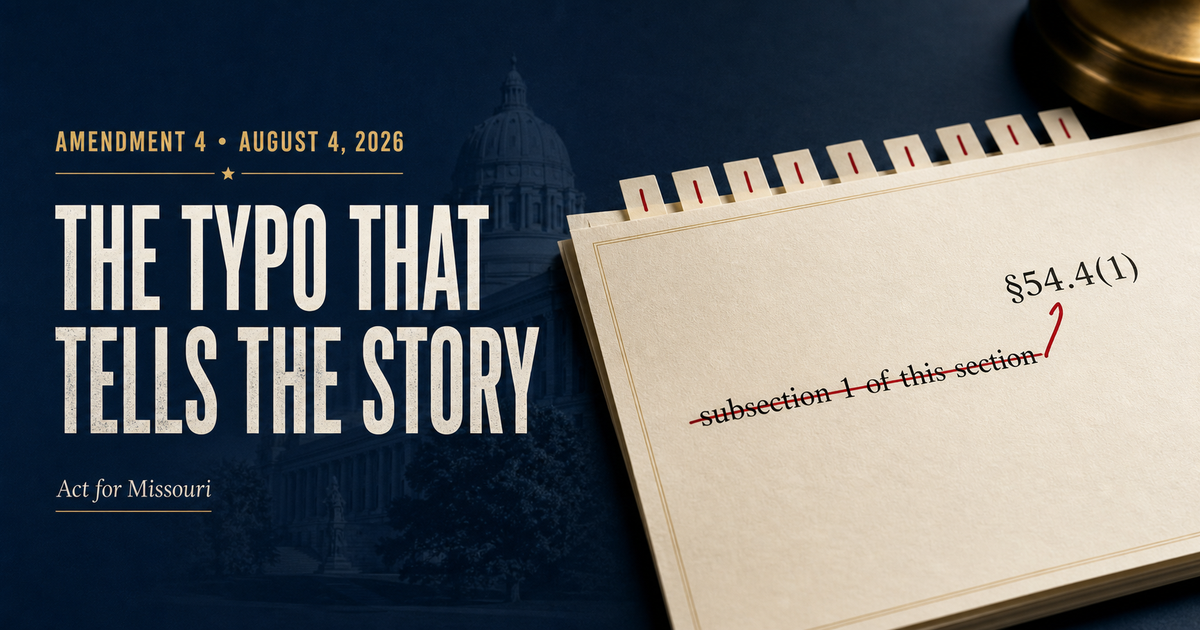
A criminal provision in Amendment 4 cites the wrong part of itself. The error is minor. What it reveals is not.
Listen to the article
Hear an audio reading of “The Typo That Tells the Story.”
Amending the Missouri Constitution is supposed to be a deliberate act. It is the document that defines who holds power in this state, and changing it is not a thing you do casually or quickly. Amendment 4 does something rarer still: it does not just change a rule, it changes who gets to change the rules. It raises the bar for one path to amend the Constitution — the citizen initiative — while leaving the legislature's own path untouched. A change that reaches that deep deserves the most careful drafting the General Assembly can produce.
It did not get it. And the proof is sitting in the amendment's own text — a criminal provision that cites the wrong part of itself, a slip small enough to miss and telling enough to matter. It was not caught before the resolution was signed and sent to the Secretary of State.
A crime that points to the wrong rule
A cross-reference is just a pointer: one part of a law tells you to go read another part. When the pointer aims at the wrong place, the sentence that relies on it stops meaning what it was supposed to mean. Amendment 4 has one sitting in the middle of a criminal provision.
The drafting error
The signature-fraud subsection creates a second offense: it makes it a crime to submit a circulator's signatures for counting while knowing that circulator broke the rules. The catch is which rules. The text says a person is also guilty of petition signature fraud if they know the circulator has…
“…violated subsection 1 of this section…shall also be deemed to have committed the crime of petition signature fraud.”
Read literally, “subsection 1 of this section” is §54.1 — the naming clause, the sentence that does nothing but say “this section shall be known as the ‘Protect Missouri Voters’ amendment.” There is no conduct there to violate. Read charitably, the drafters meant the list of prohibited acts one paragraph up — §54.4(1), the actual definition of the crime — and simply wrote the wrong number.
A court would probably rescue it by choosing the charitable reading. But notice what that reading concedes: in a criminal provision — one that can put a person in jail for up to a year — the exact conduct that triggers the offense is stated incorrectly on the face of the constitutional text. Either it points to nothing, or it points to the wrong number. Nobody fixed it either way.
Note: the section labels (“subsection,” “subdivision,” “paragraph”) follow the enrolled resolution as signed. The defect is that the words on the page send the reader to the wrong place, whichever labeling convention you apply.
This is not a partisan reading. It is not a claim about anyone's intent. It is a mis-citation you can see by following the pointer yourself. On its own, it is minor — the kind of thing a careful edit catches in an afternoon. Which is exactly why it is worth your attention. The question is not how bad the error is. The question is how it survived.
How many hands it passed through
This was not a bill that slipped through on a quiet afternoon. Before Amendment 4 reached your ballot, it cleared four separate committee votes — House Elections, House Rules, House Fiscal Review, and the Senate's Local Government committee. Then it was passed on the floor of both chambers. In the House, 98 members voted yes. In the Senate, 21 members voted yes. That is 119 legislators who put their name to placing this language in the Missouri Constitution.
After the votes, the Speaker Pro Tem signed it. The President Pro Tem signed it. The Secretary of State's office stamped it received. At no point in that entire chain — four committees, two floor votes, three signatures — did anyone correct a criminal provision that cites the wrong subsection of itself.
That is not an argument that 119 legislators are careless people. It is an argument about what happens to any deliberative body when it is made to move this fast. When a constitutional amendment goes from filing to the Secretary of State in nine days, with debate cut off before it begins, the ordinary safeguards — the line-by-line committee read, the floor debate where a colleague raises a hand and says “wait, that citation is wrong” — do not get the time they need. The mis-citation is not the disease. It is the fever that tells you the process was rushed.
Filing to the Secretary of State: nine days
- Sep 3 The Second Extraordinary Session convenes in Jefferson City. HJR 3 is introduced and read the first time the same day.
- Sep 4–9 The House runs it through three committees, perfects it, and on Sep 9 passes it on third reading, 98–58.
- Sep 11 The Senate holds a single public hearing and committee vote on the resolution.
- Sep 12 Senate leadership cuts off debate with a rarely used “previous question” motion, forces a final vote, and the resolution passes 21–11. It is signed by both presiding officers and stamped RECEIVED by the Secretary of State's office the same day.
Sources: Missouri House and Senate Journals (2nd Extra Session); official roll calls (House 98–58, Sep. 9; Senate 21–11, Sep. 12); Governor's proclamation, Aug. 29, 2025; signed HCS HJR 3, SOS received stamp Sep. 12, 2025.
Laid out day by day, the pace is the whole story. In the Missouri Senate — a body whose entire tradition rests on unlimited debate and negotiation over hard questions — the “previous question” motion that ended debate is used so rarely that its appearance is itself news. Members who wanted to raise problems with the text were not voted down. They were cut off. A criminal provision citing the wrong subsection is what a cut-off debate leaves behind.
What an honest debate could have fixed
We do not raise the process only to complain about it. We raise it because a real debate would have produced a better amendment — and there were specific, fixable problems left on the table when the microphone was switched off. Two stand out.
One · Make every path equal
Missouri has more than one way to change its Constitution. Amendment 4 raises the bar for only one of them — the citizen initiative — while the legislature's own referral path stays at a simple statewide majority. That is not a neutral tightening of standards; it is a change that makes the people's path harder and leaves the politicians' path exactly as easy as before. The honest fix is simple to state: whatever the final approval standard is, apply it equally to all paths. No route to amending the Constitution should be easier than another, least of all the route controlled by the legislature.
Two · A standard the whole state actually shares
If the concern is that constitutional changes should command broad support across Missouri — a concern we take seriously — there is a cleaner way to require it than the eight-of-eight congressional-district veto. Require a majority of Missouri House districts to approve before the eight-congressional-district requirement is triggered, and apply that same test to every amendment path alike. It measures genuine statewide agreement using the districts closest to the voters, and it does so symmetrically, instead of handing one region an effective veto over what the rest of the state wants. This is the kind of alternative that belongs in a committee markup and on the Senate floor. It never got there.
A cleaner alternative was in fact available during the same special session. HJR 4, sponsored by Rep. Bryant Wolfin, would have applied a single heightened standard to all constitutional amendments equally, rather than singling out the citizen initiative. It received no serious consideration. When leadership decides in advance which version will pass and then shuts down debate to guarantee it, the better ideas do not lose the argument. They simply never get to have it.
Why this matters on August 4
A yes vote on Amendment 4 does not just add a foreign-funding rule or punish petition fraud — provisions that, on their own, most Missourians would support and some of which are already law. A yes vote ratifies a one-sided, permanent change to the Constitution that shifts power away from the people and toward the General Assembly. And it ratifies it in the exact form the rush produced: a mis-cited criminal provision and all.
We think the standard for changing Missouri's Constitution should be high. We have said so consistently. But “high” has to mean carefully drafted, evenly applied, and honestly debated. Amendment 4 is none of the three. The drafting error did not cause those problems. It just made them impossible to hide.
Act for Missouri recommends
Vote No on Amendment 4
Every factual claim in this article traces to a primary source: the signed text of HCS HJR 3 (Second Extraordinary Session, 103rd General Assembly), the Missouri Senate Journal, and the Governor's Aug. 29, 2025 proclamation calling the session. Secondary reporting is noted where used.