
A Real Problem. The Wrong Fix. Why Amendment 4 Is Missouri’s Patriot Act Mistake
It is being sold as a fix for a real problem. But as written, it goes much further than reform. It appears to leave the legislature with an easier path to amend the constitution than the people themselves.
Audio version of this article.
After 9/11, Congress used a real crisis to pass the Patriot Act, a measure sold as protection but remembered by many Americans as a major transfer of power to government. Amendment 4 follows the same political pattern in Missouri: a real problem, a delayed response, and then a "solution" that gives government more power than a fair fix requires.
Missouri’s initiative petition process has needed reform for years. Conservatives were right about that. The constitution is supposed to be harder to change than ordinary law. The initiative process was meant to be a check on the legislature, not an easy shortcut for well-funded campaigns to write major policy into the state’s highest law.
But for more than a decade, while Republicans held strong numbers in Jefferson City, they repeatedly failed to deliver meaningful reform. During that failure, Missouri voters were asked to constitutionalize major policy questions again and again. Medicaid expansion was added to the constitution. Recreational marijuana was added to the constitution. Then Missouri’s abortion amendment passed, creating another major constitutional shift.
That history explains why many voters are open to reform now. They know the process has been abused. They know the constitution has been treated too casually. The problem is real. The question is whether Amendment 4 is a fair correction, or whether it is an overreach that makes the legislature the practical gatekeeper of the constitution.
The problem Amendment 4 was created to solve is real
There is no need to pretend otherwise. Missouri’s initiative process has been too easy to use for major constitutional change. A constitution is not supposed to function like an ordinary statute book. It is supposed to set the framework of government and protect fundamental structure, not become a running policy wishlist for whichever side can finance a statewide campaign.
The initiative power exists for a reason, though. It is a relief valve. It gives the people a lawful constitutional check when the legislature fails badly enough that citizens need to act directly. That is the proper balance: not no initiative process, and not an overly loose one either.
That is why the current debate matters so much. Reforming the initiative process is one thing. Re-engineering the constitution so the legislature keeps the easier road while the people get the harder one is something very different.
Instead of rare structural changes, the constitution has increasingly become a battlefield for major policy campaigns.
Many Missourians wanted a stronger requirement for broad support before the constitution could be changed.
A fix can still go too far if it weakens the people more than it restrains the political class.
Lawmakers had several reasonable reform options
If legislators had wanted honest reform without gutting the people’s constitutional check, they had better options available.
They could have required a citizen-led constitutional amendment to win a statewide majority plus a majority of congressional districts. They could have used state senate districts. They could have used state house districts, which may have been the best fit because they reflect Missouri at a more local and representative scale.
Any of those approaches would have made constitutional amendments harder to pass, as they should be. Any of them would have required broader geographic buy-in. Any of them still would have preserved the basic point of the initiative process: when the legislature fails the people, the people retain a realistic constitutional way to respond.
- Option 1: Statewide majority plus majority of congressional districts.
- Option 2: Statewide majority plus majority of state senate districts.
- Option 3: Statewide majority plus majority of state house districts.
All three would have tightened the process without functionally turning the legislature into the constitution’s gatekeeper.
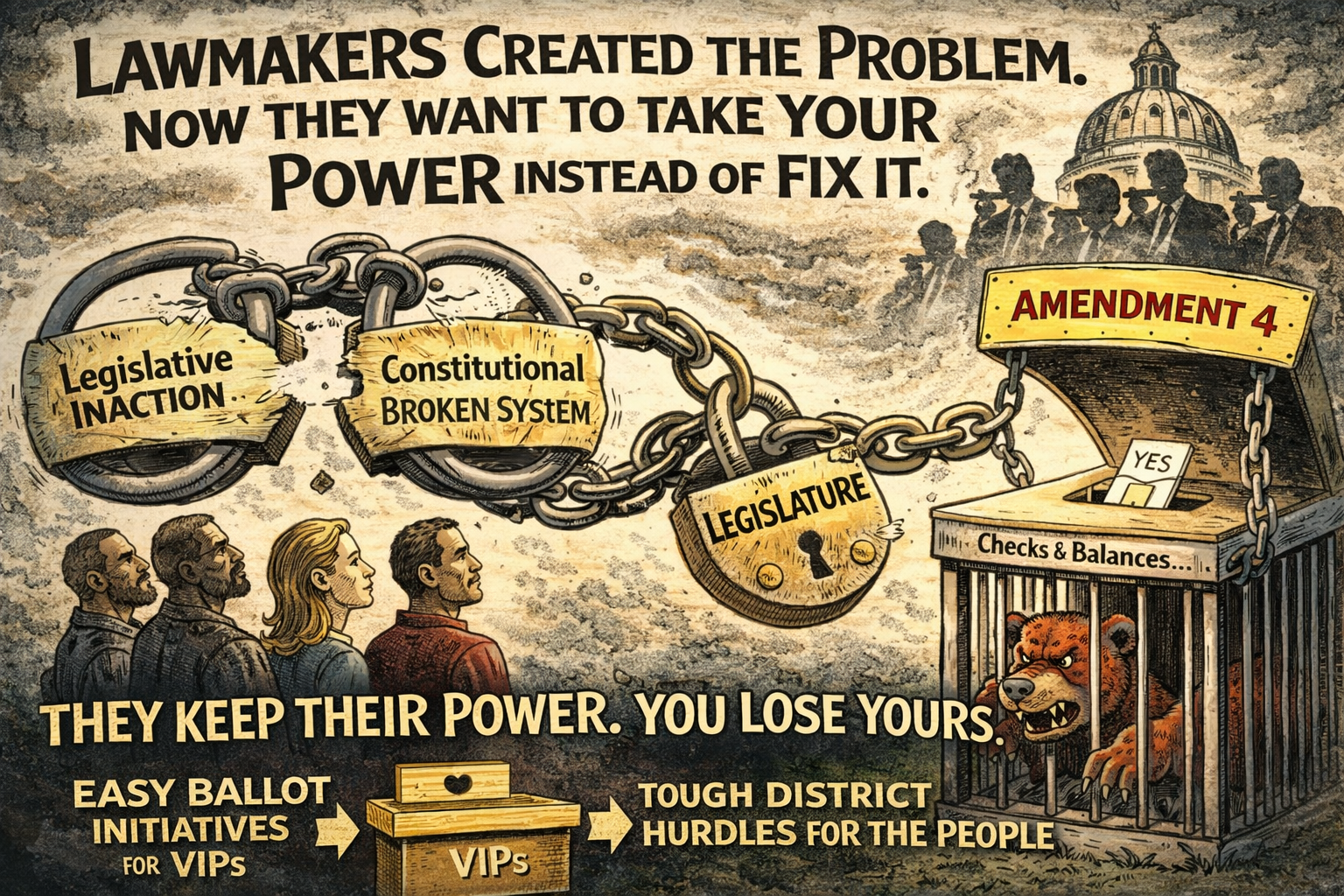
Instead, lawmakers chose a much more aggressive model. As written, a citizen initiative can win the statewide vote and still lose if it fails in even one congressional district. At the same time, measures referred by the legislature still appear to stay under the ordinary statewide-majority rule. That is not symmetrical reform. That is a power tilt.
Video testimony
Reform Was Needed. This Was the Wrong Fix.
This testimony is important because it shows opposition to Amendment 4’s structure did not just come from the left or from people who wanted to keep the current initiative process unchanged. Ron Calzone supported reform in principle, but warned this version goes too far and shifts power away from the people and toward the legislature.
This was not just a debate over election procedure. It was a warning that lawmakers had reasonable reform options available, but chose a version that shifts power away from the people and toward the government.
Key takeaways from his testimony
1. Better options existed
Calzone did not argue that Missouri should keep the initiative process exactly as it is. He pointed to more balanced reform ideas, reinforcing that lawmakers had reasonable alternatives and chose a much more extreme version.
2. The people reserved this power
His testimony fits the constitutional argument that initiative petitions are a check on government when the legislature fails to act. Weakening that power this severely changes the balance between the people and their government.
3. This creates a double standard
This is the key point. He argues that the legislature keeps the easier statewide-majority path for its own ballot measures while citizen-led proposals face the much harsher district-by-district hurdle.
4. The process was rushed
His remarks also support the concern that this proposal was pushed forward too quickly, even though it changes something as serious as the constitutional balance of power.
Why this matters
Ron Calzone testified before the House committee during the push for the initiative-petition resolution in special session. His remarks help explain why many Missourians who favor reform still oppose this particular amendment. His testimony strengthens the case that the problem was real, but the chosen solution was an overreach.
Why this strengthens the case against Amendment 4
Calzone’s testimony helps show that this is not a choice between keeping a broken system and fixing it. The real choice is between a fair reform that preserves the people’s constitutional check on government, and an overreaching amendment that makes the legislature the practical gatekeeper of future constitutional change.
How Amendment 4 would work
To understand why this matters, you have to separate two different things: getting a proposal onto the ballot, and getting it approved once voters see it.
For citizen-led proposals
Under Missouri’s current initiative system, campaigns collect signatures across congressional districts to qualify a measure for the ballot. Once on the ballot, a citizen initiative traditionally rises or falls by the statewide vote total.
Amendment 4 changes the approval stage. As written, statewide ballot measures proposed by the initiative would be approved only if they receive a majority of votes in each congressional district. With Missouri currently having eight congressional districts, that means a citizen-led proposal would need to carry all eight.
That means a citizen initiative could win statewide, receive more yes votes than no votes across Missouri, and still fail because one district voted against it.
For legislature-led proposals
This is the critical distinction many voters will miss unless someone spells it out plainly. The new all-district rule is written for measures proposed by the initiative. It is not written as a blanket rule for every ballot measure. That means legislative referrals appear to remain under the older statewide-majority standard.
In practical terms, that creates two tracks. One track applies to ordinary citizens trying to use the initiative power reserved to them in the constitution. The other applies to measures the legislature sends to the ballot itself.
A side-by-side comparison: citizen path vs legislature path
- Step 1: Gather enough signatures across Missouri’s congressional districts.
- Step 2: Get onto the ballot.
- Step 3: Under Amendment 4, win a majority in all 8 congressional districts.
- Result: Statewide victory alone would not be enough.
- Step 1: Legislature places the measure on the ballot.
- Step 2: Voters consider the proposal statewide.
- Step 3: The measure still appears to pass by simple statewide majority.
- Result: The legislature keeps the easier path.
Amendment 4 does not just make constitutional change harder. It appears to make it much harder for the people, while leaving the legislature with the old easier standard.
Why this is such a major transfer of power
The initiative process was never designed to replace the legislature. But it also was never designed to be weakened so severely that only the legislature effectively controls constitutional change.
That is the real concern here. If Amendment 4 passes, the legislature still appears to have the practical ability to send constitutional changes to the voters and win by a simple statewide majority. Citizens, by contrast, would face an almost insurmountable hurdle. A single congressional district could block what a statewide majority wanted.
That changes the relationship between the people and their government. The initiative process exists because the legislature is not always faithful, not always prompt, and not always trustworthy. Amendment 4 does not abolish that power on paper. But it weakens it so deeply that the people’s check becomes largely theoretical.
That is why the Patriot Act comparison is useful. The political class is pointing to a real abuse and asking Missourians to accept a solution that expands government’s own power well beyond a measured fix.
What else is in Amendment 4
Not every part of the amendment is the same kind of concern. It also includes provisions dealing with foreign funding in ballot measure campaigns, petition signature fraud, public hearings before an initiative is placed on the ballot, and giving voters access to the full text of initiative measures.
Some Missourians may support parts of that package. But voters should not let those side issues distract from the main structural change. The heart of the amendment is the different treatment for citizen initiatives versus legislative referrals. That is where the real power shift occurs.
- Foreign-funding restrictions
- Petition-signature fraud penalties
- Public hearings before ballot placement
- Full-text access for initiative measures
If this was really just honest reform, why did lawmakers not apply the harder rule to their own ballot referrals too?
Quick questions voters may ask
Does Missouri’s initiative process need reform?+
Yes. The constitution should not be easy to change. Many Missourians are right to want a stronger requirement for broad support before major constitutional changes can pass.
Is Amendment 4 just making the process tougher?+
Not just tougher. As written, it appears to create a tougher standard for citizen-led proposals while preserving an easier path for measures referred by the legislature.
Could a citizen proposal win statewide and still lose?+
Yes. Under the text as understood, a citizen-led initiative could receive more yes votes than no votes statewide and still fail if it lost even one congressional district.
Why does this matter beyond one election?+
Because it changes who holds real constitutional leverage in Missouri. The people keep the initiative power on paper, but the legislature gains a much stronger practical advantage.
The bottom line
Missourians are right to be frustrated with how often the constitution has been used as a policy battleground. They are right to want reform. But they should not confuse reform with surrender.
Amendment 4 appears to do far more than simply tighten a broken process. It gives the legislature an easier path to constitutional change than ordinary citizens. That is a major shift in power, and voters should weigh it very carefully before they hand that advantage to the same political class that failed to fix the problem when it had years to do so.
Amendment 4 is not just about reforming initiative petitions. It is about who gets to remain a real check on power in Missouri: the people, or the legislature.