
Amendment 3's Fatal Flaw: Repeal Isn't Where It Stops
The debate is not about demanding a perfect law. It is about whether Missouri voters should repeal the abortion-rights language adopted in 2024 and then take the additional step of placing new language in the Constitution that expressly permits abortion in specified circumstances.
Listen to This Article
You can play the narration here or download the MP3 .
If Amendment 3 simply repealed the reproductive-rights language Missouri voters adopted in 2024, this would be a very different discussion. There is a serious argument for removing as much bad constitutional language as voters presently can and continuing the fight for fuller protection afterward.
But Amendment 3 does not stop with repeal.
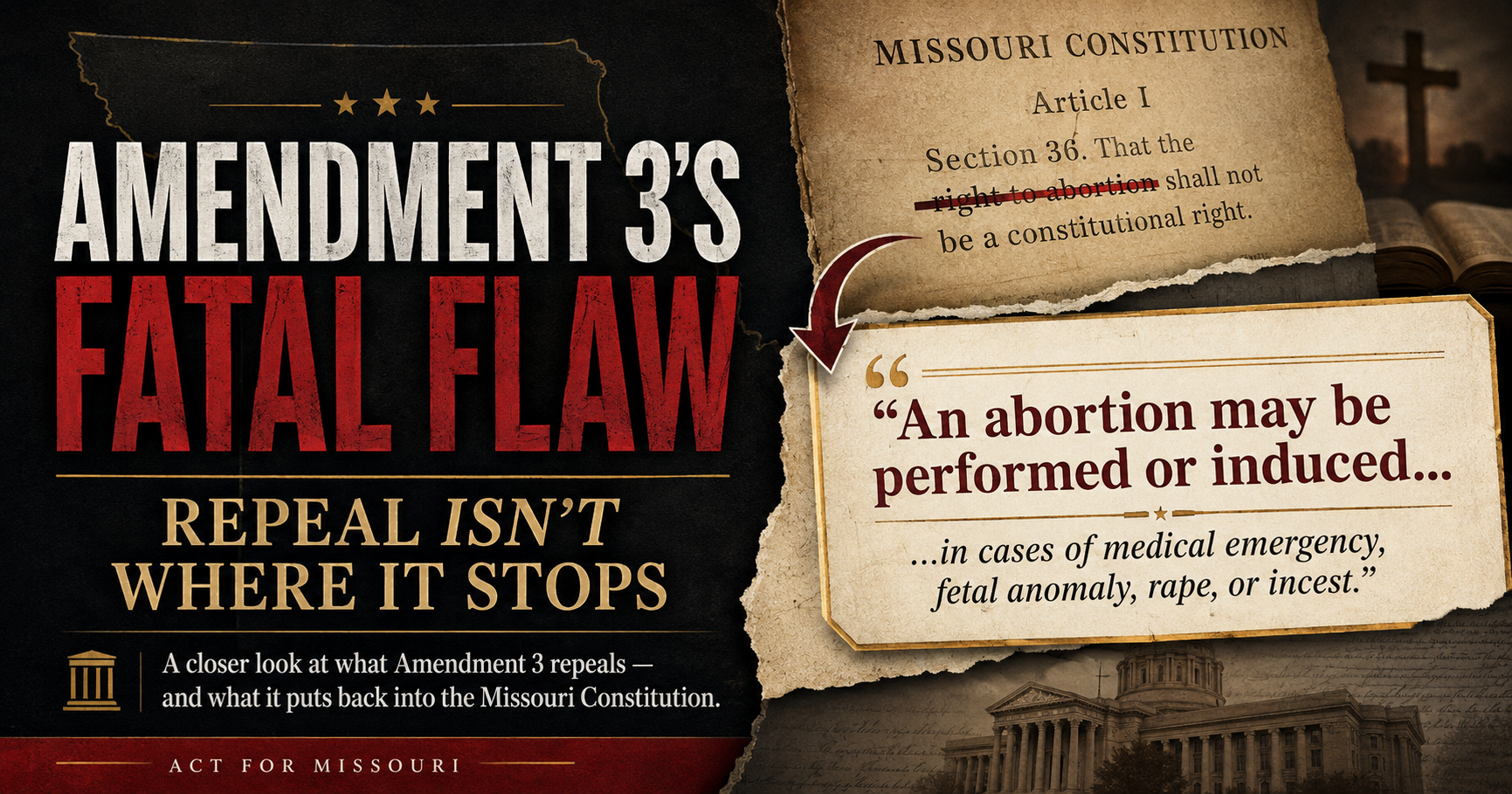
HJR 73 repeals the current Article I, Section 36 and replaces it with a new Section 36(a). The replacement language includes this sentence:
“An abortion may be performed or induced upon a woman in cases of medical emergency, fetal anomaly, rape, or incest.”
For rape or incest, the amendment allows the abortion through twelve weeks' gestational age. The official ballot title likewise tells voters that Amendment 3 would “Allow abortions for rape and incest (under twelve-weeks' gestation), emergencies, and fetal anomalies.”
That sentence—not whether Amendment 3 is “perfect”—is the issue Christians should examine carefully.
Start Before the Ballot: What Do We Believe?
Before talking about polling, political feasibility, or how many abortions a new law might reduce, it helps to establish the moral principles first. Christians who believe Scripture speaks to the value of unborn life can walk through a simple sequence of questions:
- Does human life begin at conception?
If the answer is yes, then from conception we are dealing with a living human being—not merely a potential future human life. - When does that human being deserve protection?
If every human being bears God's image and possesses value because of what he or she is, why would equal protection begin at twelve weeks, viability, or birth rather than when that human life begins? - Is intentionally ending that innocent human life through abortion morally wrong?
If yes, then the moral rule must be established before we calculate which political outcome appears most advantageous. - Does rape or incest change the child's humanity, innocence, or value before God?
The crime is horrific. The child did not commit it. Deuteronomy 24:16 and Ezekiel 18:20 both reflect the principle that guilt is not transferred from parent to child. - Does a terminal prenatal diagnosis erase personhood?
Amendment 3 narrowly defines “fetal anomaly” as a condition that would make life outside the womb impossible. But a shortened prognosis does not answer the prior moral question: is this still an innocent human life bearing God's image?
A genuine medical emergency involving the mother's life deserves separate treatment. There are circumstances in which physicians are trying to preserve life in a tragic situation where both lives may not be saved. That is morally different from allowing the intentional killing of a child because of the crime of the father or because the child's life is expected to be short.
The Question That Follows
If we answer the first questions by saying that life begins at conception, that the unborn child is innocent, and that the circumstances of conception do not change the child's value, then a harder question follows:
If that child deserves the protection of the state, what biblical principle gives government—or voters—the moral authority to enact a constitutional exception saying that child's abortion may be performed?
That is not a demand for perfection. It is a question about the line between tolerating an evil we cannot presently eliminate and affirmatively enacting legal permission for that evil.
This Is Not “Perfect or Nothing”
Christians can support incremental laws. A bill can reduce an evil without eliminating every instance of it. Government operates in a fallen world, and prudence matters.
If Amendment 3 merely said, “The 2024 reproductive-freedom provision is repealed, and abortion policy is returned to the General Assembly,” the incrementalist argument would have much greater force. A voter could reasonably say: I am removing an existing constitutional barrier; I am not being asked to enact new constitutional language affirmatively permitting abortion in specified cases.
But that is not where HJR 73 stops. After striking the current language, it writes a new rule into the Constitution:
“An abortion may be performed or induced…”
The distinction matters. There is a moral difference between failing to prohibit every evil and affirmatively creating a constitutional category in which an acknowledged evil is legally permitted.
The Romans 3:8 Question
Supporters of Amendment 3 make a compelling appeal: repeal the broad abortion right, accept limited exceptions, save more children now, and continue fighting for the rest later.
Every Christian should want fewer children to die. But Scripture requires us to examine not only the desired end, but also the means by which we pursue it. Romans 3:8 rejects the principle summarized as, “Let us do evil that good may come.”
Romans 3:8 does not answer the Amendment 3 question until we first identify whether the act being asked of us is itself wrong. That is why the earlier questions matter.
If we conclude that intentionally killing an innocent child conceived in rape is contrary to God's moral law, then the next question cannot simply be, “How many more children might be saved?”
That question measures the morality of the decision primarily by its expected outcome. Philosophically, that resembles utilitarian reasoning: choosing the course expected to produce the greatest overall good or the least overall harm.
Christian ethics is not indifferent to consequences. Saving lives matters enormously. Prudence matters. We should seek outcomes that protect the innocent and restrain evil.
But Christianity does not teach that a desirable result can make an otherwise wrongful act morally permissible. Scripture requires us to examine both the end we seek and the means by which we seek it. Romans 3:8 directly rejects the reasoning, “Let us do evil that good may come.”
So if we have already concluded that these children are innocent human beings, that they bear God's image, and that intentionally killing them is wrong, the first question must be:
May we affirmatively authorize what we believe God's law forbids because we expect that doing so will save a greater number of other lives?
Only after answering that moral question should we begin calculating the projected consequences.
What is certain
Amendment 3's text expressly says that “an abortion may be performed or induced” in the listed circumstances. That language would become part of Missouri's Constitution if voters approve the measure.
What is uncertain
How many abortions the amendment would actually prevent. The text does not contain a number, and modern abortion access includes interstate travel, telehealth, mailed medication, and exceptions whose future enforcement details are not contained in the amendment.
The Reporting Requirement Was There—Then It Was Removed
This is one place where the legislative history is especially revealing.
The introduced version of HJR 73 permitted abortion following rape or incest through twelve weeks only when documentation was presented showing that the rape or incest had been reported to law enforcement at least forty-eight hours before the abortion.
The final version sent to voters removed that requirement. The final text simply permits abortion for rape or incest through twelve weeks and contains no reporting prerequisite.
Any reporting or verification safeguard would require future legislation. It is not part of the constitutional amendment voters are being asked to approve.
During the legislative debate, Act for Missouri was told that the reporting requirement could not remain because the votes were not there to move the proposal with it. Public reporting also quoted the House handler giving a different rationale: that victims should not be pressured to report. We cannot independently prove how every legislator would have voted.
But the documented fact is enough to raise the question: the safeguard was included at introduction and did not survive the legislative process. Voters are now being told that safeguards can be added later. Perhaps they can. But adding them would require a future General Assembly to pass legislation that is not before voters now.
“The legislature can address it later” is therefore not the same as having the protection in Amendment 3 itself.
Personhood Changes the Question
There is another way to frame the constitutional issue without pretending that one amendment can answer every difficult statutory question.
Human life begins at conception, and every innocent human being is entitled to equal protection of the law from conception.
A personhood amendment would change the debate at its foundation. Instead of beginning with which abortions should be legal, under what circumstances, and at what gestational age, the first constitutional question would become:
When does human life begin, and when does that human life become entitled to equal protection of the law?
That is a very different conversation from the one Missouri is having today. It is different within the pro-life movement, where much of the debate now centers on exceptions, incremental restrictions, and political feasibility. And it is different in the broader debate with abortion-rights advocates, because the discussion would have to address the status and value of the unborn child before moving to the circumstances under which that life may be intentionally ended.
If Missouri establishes that human life begins at conception and that equal protection attaches at that point, the Constitution supplies the governing principle. The legislature would still have substantial work to do: medical emergencies, criminal intent, coercion, trafficking, jurisdiction, due process, enforcement, abortion drugs, physician standards, and many other difficult questions would still require ordinary legislation.
That is not instant perfection. It is a constitutional starting point. It establishes who is entitled to protection before lawmakers debate how that protection should be implemented.
Amendment 3 takes a different approach. It repeals the current reproductive-rights provision, but then writes into the replacement language specific circumstances in which “an abortion may be performed or induced.” The disagreement is therefore not simply perfect law versus imperfect law. It is a disagreement over what foundational principle Missouri should place in its Constitution.
Conclusion: The Question Amendment 3 Leaves Us With
The facts established by the amendment's text are straightforward.
- Amendment 3 would repeal Missouri's current constitutional reproductive-rights provision.
- It would then replace that language with a new constitutional section.
- That replacement section expressly states that “an abortion may be performed or induced” in cases of medical emergency, fetal anomaly, rape, or incest.
- The final text contains no police-report requirement or specified verification procedure for the rape or incest exception; adding such safeguards would require future legislation.
- The amendment would sharply restrict what Missouri abortion providers may legally do, but it cannot tell voters with certainty how many abortions would actually be prevented rather than obtained through another route.
Those facts bring the discussion back to the first principles.
If human life begins at conception, if that child bears God's image, if the circumstances of conception do not change the child's innocence or value, and if intentionally ending that innocent life is wrong, then Christians must decide what follows from those beliefs when the ballot asks them to enact constitutional language permitting abortion in specified circumstances.
This is not a demand that one amendment instantly solve every legal and medical question surrounding abortion. Nor is it an argument that incremental progress is always wrong.
It is a narrower question:
Does repealing one constitutional wrong justify placing new constitutional permission for abortion in its place?
Before relying on polling, projected lives saved, or political feasibility, Christians should examine the amendment's actual language, measure the proposed means against Scripture, pray for wisdom, and decide with a clear conscience before God.
Sources & Documents
- Missouri Secretary of State — 2026 Ballot Measures (official Amendment 3 ballot title and fair ballot language).
- Final HCS HJR 73 signed copy (language submitted to voters).
- Introduced HJR 73, 2454H.01I (includes the original 48-hour law-enforcement reporting requirement for rape/incest abortions).
- U.S. Food and Drug Administration — Mifepristone Questions and Answers (current dispensing and shipping rules).
- Society of Family Planning — #WeCount, data through December 2025 (telehealth and shield-law abortion provision).
- The Beacon — May 13, 2025 report on HJR 73 (reporting-requirement removal and public comments from lawmakers).
Editor's note: This article distinguishes the amendment's text from predictions about its practical effects. Nothing here claims that Amendment 3 would prevent no abortions. Rather, we show that even if Amendment 3 passes, legal avenues could remain available to a Missouri woman determined to obtain an abortion—including travel to another state, medication abortion obtained through lawful out-of-state channels, or an abortion qualifying under one of Amendment 3's own exceptions. The question is therefore not simply whether Amendment 3 would restrict abortion in Missouri, but how many abortions it would actually prevent—and whether that number can be known with the certainty sometimes asserted. More importantly, projected consequences do not resolve the prior moral question raised by the amendment's express authorization of abortion in specified circumstances.