
Path to the Robes: The Missouri Plan
How Missouri Chooses Its Supreme Court Justices
Published: January 30, 2026 | Updated as events unfold
⚖️ Breaking: History Repeats Itself
In January 2026, Missouri witnessed an unprecedented constitutional clash between the legislature and judiciary—a confrontation eerily similar to the 1930s battle that created the Missouri Plan in the first place. Once again, politicians are calling to change how we select our judges after the courts ruled against them.
The Current Constitutional Crisis
What Just Happened?
- 📅 January 23, 2026: Missouri Supreme Court unanimously strikes down SB 22, sponsored by Senator Rick Brattin
- ⚖️ The court ruled the bill violated the Missouri Constitution's "original purpose" requirement—it was amended beyond its initial scope
- 🏛️ January 28, 2026: Senate GOP, led by Brattin, filibusters and boycotts the State of the Judiciary address
- 🎤 Chief Justice W. Brent Powell cancels his speech—the first time in decades this annual address has been scrapped
- 🔥 Brattin calls justices "little kings and queens in their black robes" hiding in "their little brick building"
"They get to hide behind their little brick building, like little kings and queens in their black robes... They're just going to do whatever the heck they want to do. They want to act like they're the legislature."
— Senator Rick Brattin, R-Harrisonville, January 28, 2026
Chief Justice W. Brent Powell
Address to Missouri Lawyers
Pay close attention to, and frequently remind yourself of, the words of your oath of admission as a Missouri lawyer. It requires us to support our federal and state constitutions; to respect courts, judges, and one another; and to serve those who need our help."
"As John Adams expressed, ours is a 'government of laws, not of men.' This concept is the bedrock of our federal and state constitutions, ensuring that the Rule of Law, not individual men and women, governs our way of life. But the freedoms and justice enshrined in our constitutions are not guaranteed unless we guard, protect, and preserve them. It is our responsibility as lawyers to defend and promote the Rule of Law."
"The oath we have taken as lawyers requires us to step up and serve. Diligent and honorable service to your clients, your profession, and your community is what being a lawyer is really all about.
Why This Matters
This isn't just political theater. Senator Brattin and other Republican legislators have now renewed calls to fundamentally change Missouri's judicial selection system—the very system created in 1940 to prevent exactly this kind of political retaliation against judges who rule against powerful politicians.
Senate President Pro Tem Cindy O'Laughlin has reintroduced legislation to replace the Missouri Plan with a plan modeled after the federal system. The justification? The recent court decision striking down SB 22 (2026).
History Repeats: Brattin vs. Pendergast
The parallels between 2026 and 1938 are striking. In both cases, a powerful political figure targeted judges who ruled against their interests, ultimately leading to calls for judicial reform—though for very different reasons.
1938: Boss Pendergast
The Political Machine
- The Politician: Tom Pendergast, Kansas City political boss
- The Judge: James M. Douglas, Missouri Supreme Court
- The Ruling: Douglas cast deciding vote against insurance companies with Pendergast's secret financial backing
- The Retaliation: Pendergast recruited opponent James V. Billings to run against Douglas in 1938 election
- The Campaign: Violence, intimidation, and corruption—the "Bloody Election"
- The Outcome: Douglas won; public demanded reform; Missouri Plan passed in 1940
- The Goal: Remove corrupt political influence from judiciary
2026: Senator Brattin
The Supermajority
- The Politician: Rick Brattin, Missouri State Senator (R-Harrisonville)
- The Judge: Chief Justice W. Brent Powell (appointed by Republican Governor)
- The Ruling: Court unanimously struck down SB 22 for violating constitutional process
- The Retaliation: Filibuster and boycott of State of Judiciary address
- The Campaign: Calls justices "kings and queens"; says court is "flipping the middle bird" to legislature
- The Outcome: Renewed push to eliminate Missouri Plan; replace with partisan elections or Senate confirmation
- The Goal: Give legislature more control over judiciary
The Irony
The Missouri Plan was created to prevent politicians from retaliating against judges for unfavorable rulings. Now, politicians are using judicial decisions they disagree with as justification to dismantle the very system designed to protect judicial independence.
Key difference: In 1938, the public demanded reform to stop corruption. In 2026, politicians are demanding reform to gain control.
The Birth of the Missouri Plan: A Cure for Corruption
📺 Watch: How the Missouri Plan Came to Be
An explainer video on the origins of the Missouri Plan
The Crisis of the 1930s
Before 1940, Missouri selected all its judges through partisan elections. During the 1930s, this system fell into crisis as powerful and corrupt urban political machines heavily influenced judicial elections.
Early 1930s: Political Machines Dominate
Tom Pendergast's Kansas City machine and ward bosses in St. Louis controlled judicial elections through fraud and intimidation. Candidates were chosen for loyalty to the machine rather than legal skill, eroding public trust.
1934: The "Bloody Election"
The violent 1934 primary became known as the "Bloody Election" due to widespread violence committed by thugs connected to the Pendergast machine. This marked the system's breaking point.
1937: Judge Douglas vs. Pendergast
Governor Lloyd Stark appointed James M. Douglas to the Missouri Supreme Court. Douglas cast the deciding vote against insurance companies that Pendergast secretly supported, making him an enemy of the machine.
1938: The Political Battle
Pendergast recruited Judge James V. Billings to challenge Douglas in the election. Governor Stark stood by Douglas. The campaign became a proxy war between the governor and the boss. Douglas won, demonstrating public rejection of machine politics.
1939: Pendergast Falls
Six months after Douglas's victory, Pendergast was convicted of tax evasion and sent to federal prison. His political machine began to crumble, creating momentum for reform.
November 1940: The Missouri Plan Passes
Reformers, bypassing a legislature influenced by political machines, used an initiative petition to take their proposal directly to the people. Missouri voters adopted the "Non-partisan Selection of Judges Court Plan" with nearly 55% of the vote.
1942: Reaffirmed by Voters
The legislature immediately attempted to repeal the Missouri Plan, but voters reaffirmed their support in a statewide vote, cementing the reform.
The Core Goal
The Missouri Plan was created with a clear purpose: select judges based on merit rather than political affiliation and reduce the corrosive influence of politics and money in the judiciary.
How the Missouri Plan Works Today
Where Does It Apply?
The Missouri Plan applies to:
- Missouri Supreme Court (statewide)
- Missouri Court of Appeals (statewide)
- Circuit courts in Clay, Jackson, and Platte counties (Kansas City area)
- Circuit courts in St. Louis City and St. Louis County
- Circuit courts in Greene County (Springfield area)
Other judicial circuits in Missouri continue to use partisan elections.
The Path to the Missouri Supreme Court
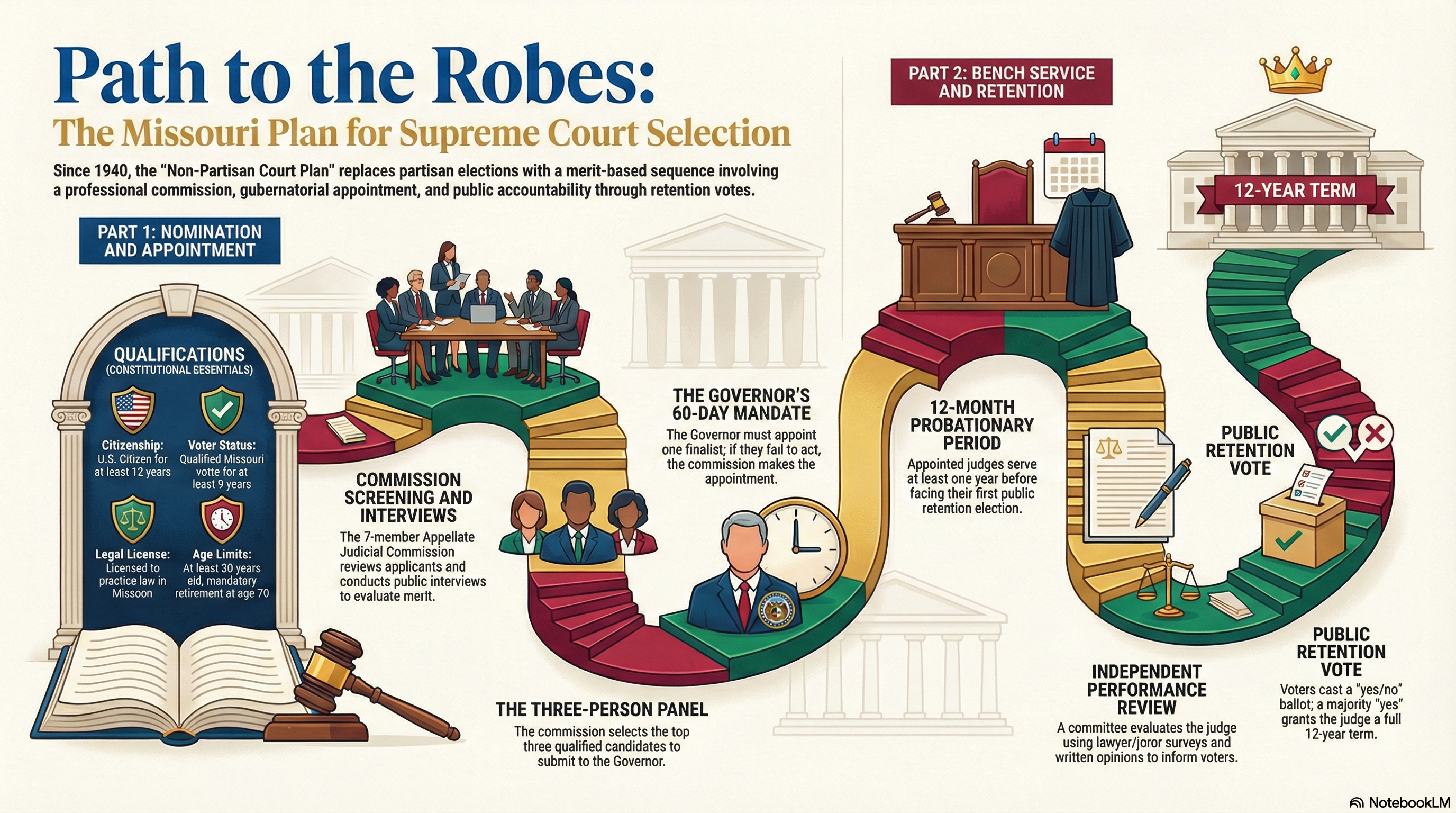
Visual guide to Missouri's judicial selection process
The Selection Process: Three Steps
Nominating Commission Selects Three Finalists
When a vacancy occurs, a non-partisan judicial nominating commission reviews applications, interviews candidates, and selects the three most qualified individuals.
Commission Composition:
- 3 lawyers elected by The Missouri Bar
- 3 citizens selected by the Governor
- Chief Justice (serves as chair)
Governor Appoints One of the Three
The Governor has 60 days to review the three nominees and appoint one of them to fill the judicial vacancy.
⏱️ Constitutional Check:
If the Governor fails to make an appointment within 60 days, the commission itself selects one of the three nominees. This prevents any governor from blocking appointments indefinitely.
Public Retention Vote
After serving at least one year, judges face a retention election. Voters answer: "Shall Judge [Name] be retained in office?"
📊 Important Context:
Approximately 99% of judges are retained in these elections. If retained, judges serve full terms:
- Supreme Court & Court of Appeals: 12 years
- Circuit Judges: 6 years
- Associate Circuit Judges: 4 years
How Can Voters Make Informed Choices?
Because judges don't campaign like politicians, The Missouri Bar established the Judicial Performance Review process. A committee of lawyers, retired judges, and citizens evaluates each judge based on:
- Fairness and impartiality
- Legal knowledge and skill
- Diligence and work ethic
- Judicial temperament
Results are available at YourMissouriJudges.org before each election.
The Ongoing Debate: Is the Missouri Plan Working?
The debate over the Missouri Plan is not a settled historical matter but a live, high-stakes political conflict. The January 2026 clash transformed this from an academic debate into a tangible constitutional crisis.
✓ Arguments FOR the Plan
Why supporters defend merit selection
Selects Judges on Merit
The commission vets candidates based on legal qualifications, experience, and judicial temperament—not their ability to raise campaign funds or political connections.
Reduces Partisan Politics
By eliminating contested elections, the plan helps shield judges from political pressure. They can make rulings based on the law without fear of politically motivated campaigns to unseat them.
Ensures Voter Accountability
Retention elections give citizens the final say on whether a judge's performance warrants another term, balancing independence with accountability.
Proven Track Record
The Missouri Plan has been a national model for over 80 years and has been adopted in some form by more than 30 states.
Prevents Money in Judicial Elections
Merit selection eliminates the need for judges to raise campaign funds, preventing the appearance that "justice is for sale."
✗ Criticisms of the Plan
Why critics want change
Excessive Influence of Trial Lawyers
Critics argue Missouri Bar members, especially trial attorney groups like MATA, have disproportionate power in selecting commission members, making the process accountable to special interests.
Lack of Transparency and Voter Choice
Commission deliberations happen "behind closed doors." Voters aren't involved in selecting the initial three candidates, and the 99% retention rate suggests elections aren't effective accountability.
Still Political, Just Hidden
Critics claim the plan doesn't remove politics but moves it to the "opaque, behind-closed-doors politics of the legal profession." Data shows 87-93% of campaign donations from nominees went to Democrats (1995-2008).
"Rigged Slates"
Critics allege commissions can submit biased panels to force a governor's hand, citing the 2008 example where Governor Blunt was allegedly given an unacceptable slate.
May Disadvantage Women
Research suggests merit selection systems may disadvantage female judicial candidates, particularly from private practice, compared to electoral systems.
Undermines Checks and Balances
Critics like Senator Brattin argue the courts have become an unaccountable branch that overrules the legislature and ignores the will of voters.
"It's been quite clear that this is a problem with the judiciary thinking that they have carte blanche capability to do the job of the legislature."
— Senator Rick Brattin, January 2026
Chief Justice W. Brent Powell
On the Missouri Plan
Missouri's Non-Partisan Court Plan has worked well for 85 years to ensure the appointment of fair and impartial judges across our state while keeping the influence of money and partisan politics out of our courts and giving citizens the final say. Dubbed 'The Missouri Plan,' this plan has become a model for the nation, with several other states adopting aspects of the plan to improve their court systems. I look forward to working with The Missouri Bar to ensure the success of this plan continues.
What's the Alternative? The Federal System vs. The Missouri Plan
The primary alternative being proposed in the Missouri General Assembly would replace the Missouri Plan with a system modeled after how federal judges are chosen: the Governor nominates a candidate, and the Senate confirms by vote.
How the Federal System Works
- President nominates a judicial candidate
- Senate Judiciary Committee holds hearings
- Full Senate votes to confirm or reject
- If confirmed, judge serves for life (with "good behavior")
Comparing the Systems
| Feature | Missouri Plan | Federal/Senate Confirmation |
|---|---|---|
| Initial Selection | Nominating commission selects 3 finalists | Governor nominates one candidate |
| Appointment | Governor appoints one of three | Senate confirms (or rejects) |
| Public Role | Retention vote after 1 year (yes/no) | None (or full term elections) |
| Term Length | 12 years (appellate), then retention vote | Life tenure (federal) or set terms (state variant) |
| Legislative Check | Limited (3 citizens on commission appointed by Governor) | Direct (Senate confirmation vote) |
| Political Nature | Designed to minimize | Explicitly political |
Potential Benefits of Federal System
✓ Clear Democratic Accountability
Elected senators directly vote on judicial nominees, making the process transparent and accountable to voters.
✓ Legislative Check on Executive
Restores traditional separation of powers with legislative confirmation of executive appointments.
✓ Reduces Special Interest Influence
Eliminates the Missouri Bar's role in selecting commission members, addressing concerns about trial lawyer influence.
Potential Risks of Federal System
✗ Increased Politicization
Confirmation hearings could become partisan battles, as seen with federal Supreme Court nominations. Judges might feel beholden to political parties.
✗ Less Focus on Qualifications
Political ideology could override merit, resulting in less qualified but more politically aligned judges.
✗ Gridlock and Vacancies
Political divisions could lead to prolonged vacancies if Senate refuses to confirm nominees (as seen at federal level).
✗ Undermines Judicial Independence
Judges might be reluctant to rule against the party that confirmed them, threatening impartial justice.
The Central Question
Do we want judges selected primarily for their legal qualifications or their political alignment? Do we trust a non-partisan commission of lawyers and citizens, or do we trust elected politicians to make the best choice?
The following sources were used in researching and compiling this article:
"Appellate Judicial Commission." Boards and Commissions - MO.gov, https://boards.mo.gov/userpages/Board.aspx?169.
"Bill Summary." Missouri Senate, https://www.senate.mo.gov/25info/BTS_Web/Summary.aspx.
"Canceled: Legislators Delay State of Judiciary over Supreme Court Ruling." The Missouri Times, https://themissouritimes.com/canceled-legislature-axes-state-of-judiciary-over-supreme-court-ruling/.
"Choosing Judges: Judicial Nominating Commissions and the Selection of Supreme Court Justices." IAALS - University of Denver, https://iaals.du.edu/sites/default/files/documents/publications/choosing_judges_jnc_report.pdf.
"A Defense of the Elected Judiciary." The Heritage Foundation, https://www.heritage.org/courts/report/defense-the-elected-judiciary.
"Does Merit Selection Work for Choosing Judges?" Judicature, https://judicature.duke.edu/articles/does-merit-selection-work/.
"HJR5 - Proposes a Constitutional Amendment Changing How Judges Are Selected to Certain Courts." Missouri Senate, https://www.senate.mo.gov/25info/BTS_Web/Bill.aspx.
"How the Missouri Plan Works." Missouri Judicial Evaluations, https://yourmissourijudges.org/the-missouri-plan/how-it-works/.
"How the Missouri Supreme Court Ruling on Caps on Pain and Suffering Violates the People's Right to Self-Governance." PMC - NIH, https://pmc.ncbi.nlm.nih.gov/articles/PMC6179755/.
"Implicit Bias in Judicial Performance Evaluations: We Must Do Better Than This." University of Nevada, Las Vegas, https://oasis.library.unlv.edu/cgi/viewcontent.cgi.
"Indiana Merit Selection and the 'Missouri Plan'." Indiana Court Times, https://times.courts.in.gov/2012/05/02/indiana-merit-selection-and-the-missouri-plan/.
"Iowa's Crazy Judges, Part II." National Review, https://www.nationalreview.com/bench-memos/iowas-crazy-judges-part-ii-gary-marx/.
"Judicial Branch." Missouri Secretary of State, https://www.sos.mo.gov/cmsimages/bluebook/2015-2016/5_Jud.pdf.
"The Judges We Choose." Americans for Prosperity, https://americansforprosperity.org/wp-content/uploads/2025/12/Judges-We-Choose-Report.pdf.
"Judicial Selection." Missouri Judicial Evaluations, https://yourmissourijudges.org/the-missouri-plan/judicial-selection/.
"Judicial Selection in the States." Ballotpedia, https://ballotpedia.org/Judicial_selection_in_the_states.
"Judicial Selection Process." 16th Circuit Court of Jackson County, Missouri, https://www.16thcircuit.org/judicial-selection-process.
"Merit Selection." U.S. Chamber Institute for Legal Reform, https://instituteforlegalreform.com/wp-content/uploads/media/meritselectionbooklet.pdf.
"Missouri Non-Partisan Court Plan." Your Missouri Lawyers, https://missourilawyershelp.org/lessons-plans/missouri-non-partisan-court-plan/.
"Missouri Plan." Wikipedia, https://en.wikipedia.org/wiki/Missouri_Plan.
"The Missouri Plan." Missouri Judicial Evaluations, https://yourmissourijudges.org/wp-content/uploads/2021/04/Missouri-Plan-How-it-WorksSpeakerNotes-2020.pdf.
"The Missouri Plan Archives." Missouri Judicial Evaluations, https://yourmissourijudges.org/tag/the-missouri-plan/.
"Missouri Supreme Court Throws Out 2025 Ballot Wording, Attorney General Appeals Bill." Missourinet, https://www.missourinet.com/2026/01/23/missouri-supreme-court-throws-out-2025-ballot-wording-attorney-general-appeals-bill/.
"Missouri: Trial-Lawyer Heaven." National Review, https://www.nationalreview.com/bench-memos/missouri-trial-lawyer-heaven-carrie-severino/.
"MO SB22." BillTrack50, https://www.billtrack50.com/billdetail/1754863.
"Non-Partisan Court Plan." Bryan Feemster | Greene County Circuit Clerk, http://www.greenecountycourts.org/non-partisan-court-plan.
"Pennsylvania Needs to Stay Away from the Missouri Plan." National Review, https://www.nationalreview.com/bench-memos/pennsylvania-needs-to-stay-away-from-the-missouri-plan/.
"Picking Judges: How Judicial-Selection Methods Affect Diversity in State Appellate Courts." Judicature, https://judicature.duke.edu/articles/picking-judges-how-judicial-selection-methods-affect-diversity-in-state-appellate-courts/.
"Rethinking Judicial Selection." American Bar Association, https://www.americanbar.org/groups/professional_responsibility/publications/professional_lawyer/2016/volume-24-number-1/rethinking_judicial_selection/.
"SJR105 - Provides for the Appointment of All Appellate Judges by the Governor with the Advice and Consent of the Senate and for the Election of All Circuit and Associate Circuit Judges." Missouri Senate, https://www.senate.mo.gov/26info/BTS_Web/Bill.aspx.
"Special Committee on Judiciary F. James Robinson, Jr. Kansas Bar Association October 1, 2019 Judicial Select." Kansas Legislature, https://www.kslegislature.gov/li/b2019_20/committees/ctte_spc_2019_judiciary_1/documents/testimony/20191001_18.pdf.
"State Supreme Court Diversity - November 2025 Update." Brennan Center for Justice, https://www.brennancenter.org/our-work/research-reports/state-supreme-court-diversity-november-2025-update.
"Statement in Support of Equal Branches of Government." The Missouri Bar, https://news.mobar.org/statement-in-support-of-equal-branches-of-government/.
"Trial Lawyers, Inc. Missouri." Manhattan Institute, https://media4.manhattan-institute.org/sites/default/files/TLI-JC-0118.pdf.
Additional news sources and web searches from January 2026 were also consulted for current events.
Conclusion: A Continuing Conversation
The Missouri Plan is a landmark innovation in American government—a system born from a crisis of corruption and designed to carefully balance the competing values of judicial independence and public accountability. It replaced a broken system of partisan elections with a merit-based process that has since been adopted in some form by over 30 other states.
While the plan was created to solve the problems of the 1930s, the conversation around it is now more intense than ever. The January 2026 constitutional clash between the legislature and the judiciary demonstrates that the debate over the best way to select qualified, impartial judges is a vital and ongoing conversation in our democracy.
Your Voice Matters
How we choose our judges is fundamental to justice. It affects every Missourian's access to fair and impartial courts. This is a conversation in which every citizen has a stake.
Stay informed. Stay engaged. Make your voice heard.